

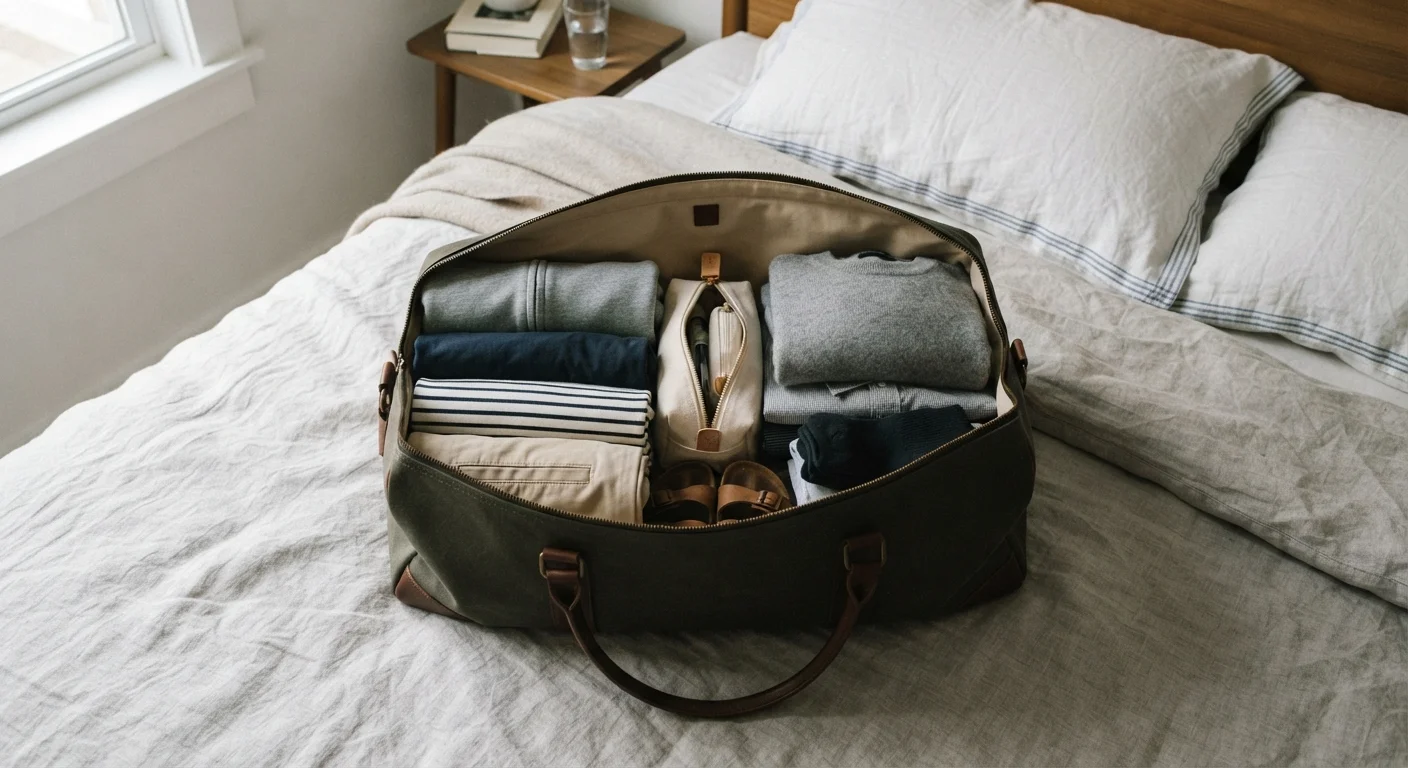
Why This Is Harder Than It Sounds
Most travelers know they overpack. They do it anyway. That's because packing light isn't just a spatial puzzle - it involves making decisions under uncertainty before a trip even begins. If you've struggled with this before, the reasons behind chronic overpacking are worth understanding first.
The good news: fitting a week into a weekend bag is a learnable skill, not a talent. It comes down to three things - what you choose, how you pack it, and what you're willing to let go of.
What you will need
Build a Capsule Wardrobe, Not a Full Closet
The foundation of week-in-a-small-bag packing is a capsule wardrobe: a compact set of clothing pieces that mix and match across multiple outfits. The target is roughly 5-7 clothing items (excluding underwear and socks) that can generate 10 or more outfit combinations.
Stick to one neutral palette - navy, grey, black, or earth tones - with one accent piece if you want variety. Every item should work with at least two others. A single pair of dark pants, for example, should go from a day of sightseeing to a casual dinner without a change.
For complementary guidance on handling temperature variation within that same small bag, see dressing for multiple climates in one suitcase.
One Neutral Palette, Fewer Decisions
Anchoring your wardrobe to a single color family means everything pairs with everything - no mental load figuring out what goes together each morning. It also makes the visual edit easier: if a new item doesn't match the palette, it probably doesn't belong in the bag.
Fabric Is the Real Variable
Volume and weight in a bag are largely determined by fabric. Cotton is bulky and slow to dry. Synthetic blends - particularly lightweight nylon or polyester - compress well and dry overnight in a hotel bathroom. Merino wool sits in a category of its own: it resists odor effectively, regulates temperature across a wide range, and one shirt can realistically be worn two or three days in a row without issue.
Choosing even two or three merino or synthetic pieces over their cotton equivalents can free up meaningful space. This is not a fringe packing approach - it's a practical response to the physics of a small bag. For broader packing principles that hold regardless of trip length, see smart packing principles that hold across every type of trip.
Step-by-Step: How to Pack the Bag
Follow these steps in order. Skipping the planning phase - steps 1 and 2 - is the most common reason packing fails before the zipper even closes.
Write your outfit list before touching the bag
List every day of the trip and the activities involved. Assign an outfit to each day. Only after you have a written list should you begin selecting clothes - this prevents the common habit of packing items "just in case" without a specific plan for them.
Lay everything out and cut by 20%
Assemble your intended packing on a flat surface before putting anything in the bag. Look at the pile objectively. Most people find at least two or three items that duplicate a function another item already covers. Remove those first.
Pack shoes first, against the back panel
Place shoes at the bottom of the bag (the panel that rests against your back when carried). Stuff socks inside the shoes to use that space. This positions the heaviest items close to your body for balance and leaves the main compartment clear for clothing.
Roll clothes tightly and pack vertically
Roll each garment into a tight cylinder and stand rolls upright in the main compartment rather than stacking them flat. This lets you see every item at a glance without unpacking, and generally fits more volume than flat folding.
Fill gaps with soft items and use every pocket
Stuff socks, a packable jacket, or an undergarment into any visible gaps between rolled items. Use interior pockets for charging cables, a travel adapter, and small accessories. Use the front pocket for items you'll need during transit - boarding pass, earbuds, snacks.
The Two Categories Most People Get Wrong
Shoes: Shoes are dense, inflexible, and eat space faster than any clothing item. Aim for two pairs maximum: one for walking all day, one that handles an evening or a slightly more formal setting. Wear the bulkier pair on travel days so they don't occupy bag space.
Some travelers manage a week on one pair of well-chosen shoes. That's not always realistic, but three pairs almost never is. This is one area where common packing myths tend to steer people wrong - the idea that you need a different shoe for every activity rarely holds up in practice.
Toiletries: Most hotel properties provide soap, shampoo, and conditioner. Check before you pack. Decant what you actually need into containers under 3.4 oz (100ml) for carry-on compliance, and skip anything you can buy at a drugstore at your destination if you run out. A small, structured toiletry pouch keeps liquids contained and stops them from colonizing the rest of the bag.
For travelers considering going even further, the one-bag carry-on philosophy applies a similar logic at a more committed level.
The Mid-Trip Laundry Factor
Access to laundry changes the math entirely. If you can wash clothes once during a seven-day trip - whether at a laundromat, an Airbnb with a washer, or a hotel with self-service machines - you can cut your clothing count nearly in half. A four-day clothing supply becomes a full week.
Factor this into your planning before you pack, not after. If laundry access is realistic, build your packing list around it. If it's genuinely not available, add one or two extra items rather than packing for every contingency.
Packing cubes can help keep a smaller load organized across a week - a practical look at how packing cubes actually work is worth reading before you invest in them.
The content on this site is for informational purposes only and is not a substitute for professional advice. Always consult a qualified professional for guidance specific to your situation.