

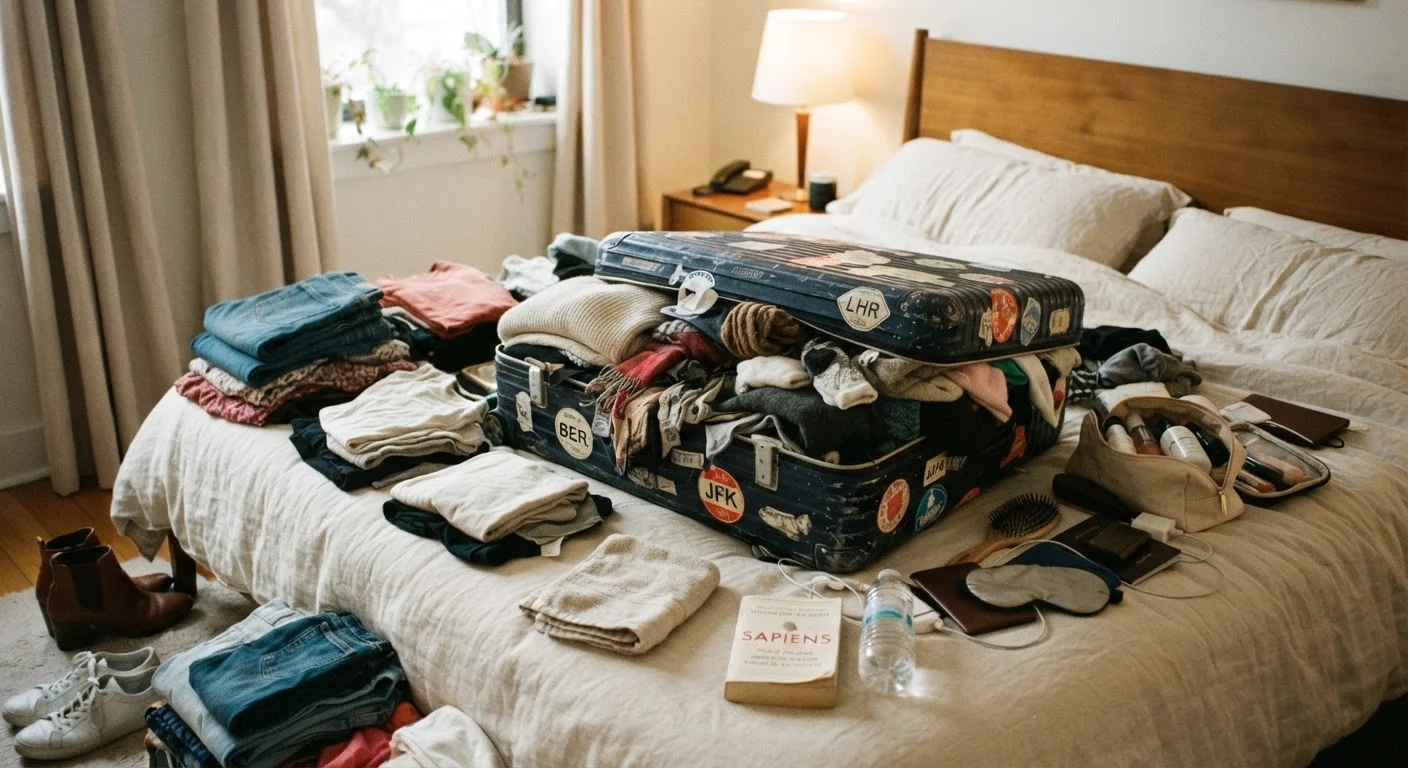
It's Not Really About the Clothes
Most people who overpack don't do it because they love hauling heavy bags through airports. They do it because packing a full suitcase feels like preparation - like control. Before a trip, uncertainty is high and the bag is the one thing you can manage. So you fill it.
This is worth naming plainly: overpacking is largely an emotional response to travel anxiety, not a practical one. And if you try to solve it purely with packing tips - rolling instead of folding, using compression bags - you're treating the symptom rather than the cause. Our core packing principles are more useful once you understand why the bag got heavy in the first place.
Below are the most common overpacking mistakes, what actually causes them, and what to do differently.
Packing for every possible 'what if' scenario instead of your actual itinerary.
Why it happens: Uncertainty about the trip - weather, occasions, mood - prompts travelers to hedge by bringing options for situations that rarely materialize.
Treating the suitcase as the maximum rather than the target.
Why it happens: A large bag creates a psychological permission slip - if there's room, it feels wasteful not to use it. Travelers fill available space rather than packing to need.
Duplicating items 'just in case' one gets damaged, lost, or dirty.
Why it happens: Loss aversion is strong before a trip. The fear of being without something essential feels more real than the near-certainty of never needing the backup.
Adding items at the last minute without removing anything.
Why it happens: Packing anxiety peaks in the 24 hours before departure. Late additions feel urgent, but they're rarely evaluated against what's already in the bag.
Packing clothes that don't combine with anything else in the bag.
Why it happens: Travelers pack items they like individually without thinking through whether they work together as a wardrobe, leading to more items needed to create complete outfits.
What the Data Suggests About Packing Behavior
~50%
Packed clothes left unworn per trip
Travel behavior surveys consistently find that roughly half of packed clothing never gets worn, particularly on trips of seven days or fewer.
4-6 lbs
Average weight added by 'just in case' items
Packing researchers and frequent travelers estimate that contingency items - things packed for scenarios that don't occur - account for several pounds in the average checked bag.
These patterns aren't just anecdotal. Travelers consistently report using far less than they pack, particularly on trips of a week or less. The gap between what goes in the bag and what gets worn is a reliable signal that packing decisions are being made emotionally, not logistically.
If you're preparing for a longer journey and want a more structured approach from the start, the long-haul packing primer covers how to think about volume relative to trip length in practical terms.
Breaking the Cycle Before You Zip Up
The most effective packing habit is also the least exciting: plan outfits by day before you pack a single item. Lay them out physically. Count them. Then put back anything that doesn't belong to a specific day and purpose. This turns an emotional process (grabbing things that feel reassuring) into a logistical one (matching items to actual plans).
It also helps to acknowledge that most destinations have stores. Running out of shampoo or needing an extra layer is a minor inconvenience, not a crisis. Packing for every possible scenario inflates your bag without proportional benefit.
For a useful reality check on advice that sounds helpful but often isn't, see packing myths worth ignoring - some common strategies actively make the problem worse. And if you want a broader framework that holds across trip types, the complete packing and prep guide walks through the full process end to end.
Overpacking a bag and overpacking an itinerary come from the same instinct: trying to hedge against uncertainty by cramming in more. Both have the same fix - make deliberate choices rather than accumulative ones.
The content on this site is for informational purposes only and is not a substitute for professional advice. Always consult a qualified professional for guidance specific to your situation.