

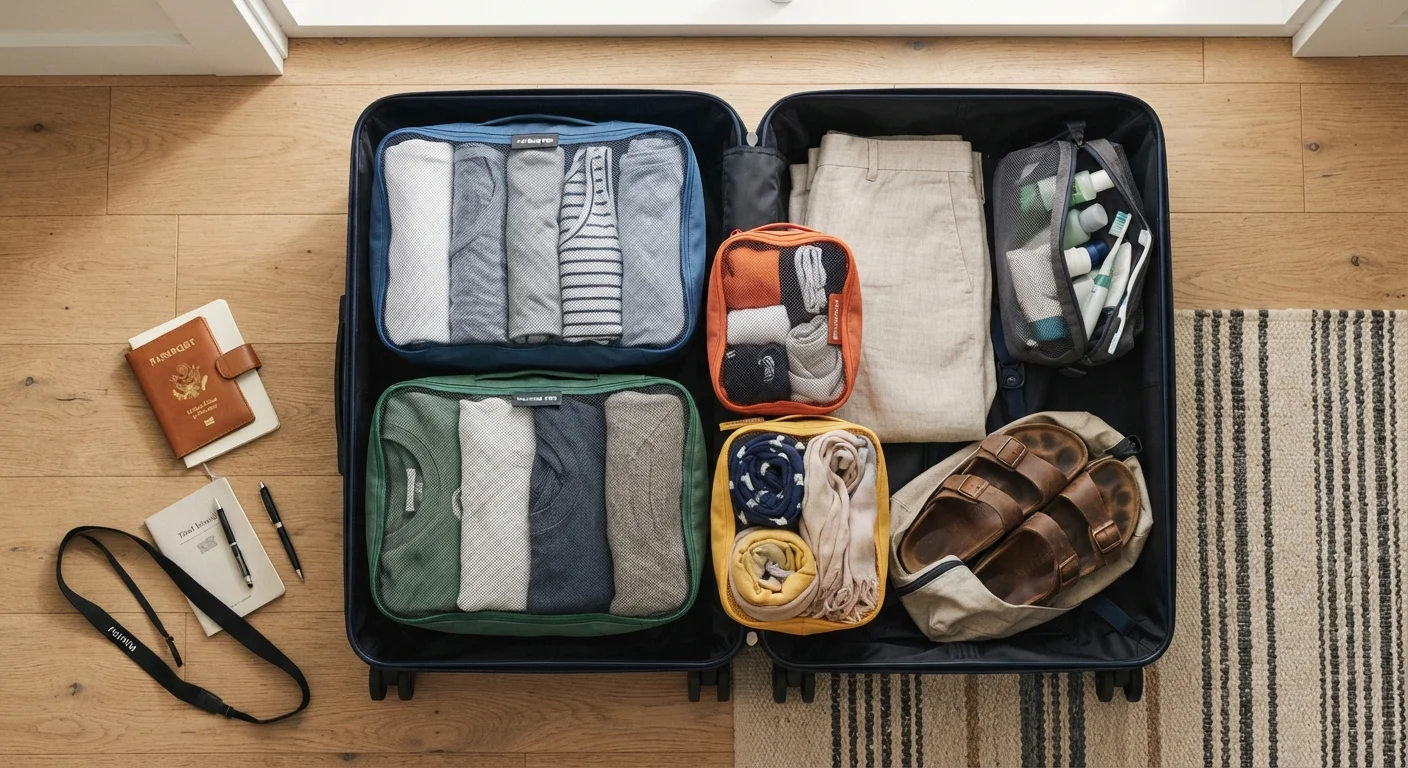
What Packing Cubes Actually Do
Packing cubes are organizational tools, not space-saving magic. The core function is simple: they let you group clothing by type so that opening your bag doesn't mean digging through a jumbled pile. You pull out the cube you need, not everything you packed.
What they do well:
- Separate categories — tops, bottoms, workout gear, and delicates each get their own container.
- Speed up repacking — at checkout, you reload cubes rather than refolding individual items one by one.
- Reduce chaos in shared bags — if two people are sharing a checked bag, labeled cubes eliminate the "whose stuff is this" problem.
- Make hotel stays tidier — pull a cube out and set it on a shelf instead of living out of a sprawling suitcase.
What they don't do: cubes don't let you pack more than your bag's actual volume allows. If you're already overpacking, cubes will reorganize the problem, not fix it. For more on that pattern, see why overpacking happens and how to stop it.
When Packing Cubes Are Worth Using
Packing cubes earn their place under specific travel conditions. The more of these apply to your trip, the more useful cubes become.
Match Cube Size to Your Bag
Before buying cubes, measure the interior dimensions of your luggage. Cubes sold as 'large' vary widely by brand. A cube that fits perfectly in one suitcase may leave awkward gaps or refuse to lay flat in another. When possible, check dimensions against your specific bag before purchasing.
Multi-stop itineraries
If you're moving between three cities in ten days, repacking at every stop is exhausting. Cubes let you pull everything out, use your room, and reload cleanly — without re-sorting from scratch each time.
Backpack travel
Backpacks are a single open cavity. Without structure, finding a specific item means unpacking half the bag. Cubes create internal compartments that don't otherwise exist.
Longer trips
On a two-week trip, you'll interact with your bag daily. Having a consistent system reduces low-grade friction — you always know which cube holds your socks. This matters less on a three-night trip where you barely unpack.
Shared luggage
Two travelers, one checked bag. Cubes in different colors or with labels keep belongings separate without any guesswork.
If none of those apply — say, you're taking a two-night trip with a single personal item — cubes probably aren't worth adding to your system. Check whether your overall approach holds up against core packing principles that work across trip types.
The Compression Cube Distinction
Compression cubes have a second zipper that flattens the cube's contents once filled. They can reduce stack height, which matters if your bag is a few inches too full. However, the savings are modest — typically a centimeter or two per cube — and they don't remove air the way vacuum compression bags do.
6–12 oz.
Typical weight added by a 4-cube set
Based on commonly available packing cube sets; weight varies by material and cube size.
2–4
Cubes most travelers actually need
Travel organizers and experienced packers generally recommend keeping the number of cubes low to avoid over-managing your system.
If you're trying to fit a week's worth of clothing into a small carry-on, compression cubes may help, but the bigger lever is packing fewer or thinner items. The realistic approach to packing a week into a weekend bag covers that strategy in more depth.
Standard cubes are lighter and easier to use. Unless you're routinely fighting bag volume, compression cubes add complexity without proportional benefit.
Common Mistakes With Packing Cubes
Even a useful tool can slow you down when used poorly. The most common missteps:
- Using too many cubes — six cubes in a medium bag means you're managing six containers. Two to four is usually enough.
- Buying cubes before fixing packing habits — if your base problem is packing too much, cubes won't help. Address the list first. Some popular packing advice doesn't hold up — and overreliance on organizers is one of them.
- Ignoring cube weight — a set of four cubes can add 6–12 oz. to your bag. On a strict carry-on weight limit, that matters.
- Packing cubes inside cubes — nesting organizers within organizers creates a system that takes longer to use than the problem it solves.
The goal is a system you'll actually use consistently, not one that requires perfect execution every time. If cubes feel like a chore, simplify. Your broader packing system — from list-building to gate arrival — is covered in the complete packing and prep guide.
Frequently Asked Questions
Standard packing cubes don't save space — they reorganize it. Compression cubes can reduce stack height slightly by squeezing out air, but the difference is modest. If you're hoping to pack more by using cubes, you'll likely be disappointed.
For a one or two-night trip with a single small bag, cubes often add more complexity than they solve. They shine more on longer trips or when you're moving between multiple destinations and repacking frequently.
Most travelers manage well with two to four cubes. A common setup is one for tops, one for bottoms, and one for underwear and socks. Adding more cubes doesn't necessarily improve organization — it can make your system harder to maintain.
Yes, and many backpack travelers find cubes especially helpful because backpacks lack the compartments of hard-shell suitcases. Cubes create structure in an otherwise open bag and make it easier to find items without unpacking everything.
No — how you fold or roll your clothes still matters. Cubes contain your items but don't compress wrinkles or reduce volume on their own. Good folding technique paired with cubes gets better results than cubes alone.
Compression bags (like vacuum-seal bags) remove air mechanically and can dramatically reduce bulk — useful for bulky items like down jackets. Packing cubes are fabric containers with no meaningful compression. They serve different purposes and aren't interchangeable.
The content on this site is for informational purposes only and is not a substitute for professional advice. Always consult a qualified professional for guidance specific to your situation.