

Why Multi-Climate Packing Goes Wrong
Most travelers approaching a trip that spans cold mountains and humid coasts make the same error: they pack for each climate separately. The result is a bag stuffed with overlapping items - three jackets, redundant shoes, and fabrics that don't pull double duty. Understanding why this happens is half the fix. See our breakdown of common overpacking habits for more context on the psychology involved.
The better approach starts with a question: What's the range? Identify the coldest expected low and the warmest expected high across your entire itinerary. That range - not each individual destination - is what you're packing for. A trip that runs from 40°F nights to 80°F afternoons doesn't require two separate wardrobes. It requires a layering system.
Test Your Layers Before You Travel
A week before departure, wear your planned base, mid, and outer layers together on a cool morning. Check that movement feels unrestricted and the layers don't bunch uncomfortably under the shell. Small fit issues that seem minor at home become real frustrations on the road.
Build a Layering System That Actually Works
The three-layer framework - base, mid, outer - is the most reliable approach for wide temperature ranges. Each piece works independently in mild conditions and stacks with the others when temperatures drop.
- Base layer: Worn closest to skin, this regulates moisture. Merino wool is the most versatile option - it insulates in cold air, stays breathable in warmth, and resists odor well enough that one shirt can wear for several days. Lightweight synthetic base layers are lighter and dry faster, though they retain odor more readily.
- Mid layer: A packable fleece or lightweight down sweater adds warmth without bulk. Look for versions that compress to roughly the size of a water bottle.
- Outer layer: A packable rain shell - not a heavy winter coat - handles wind, rain, and sharp temperature drops. In most travel scenarios, a shell over a mid layer outperforms a single heavy jacket while packing far smaller.
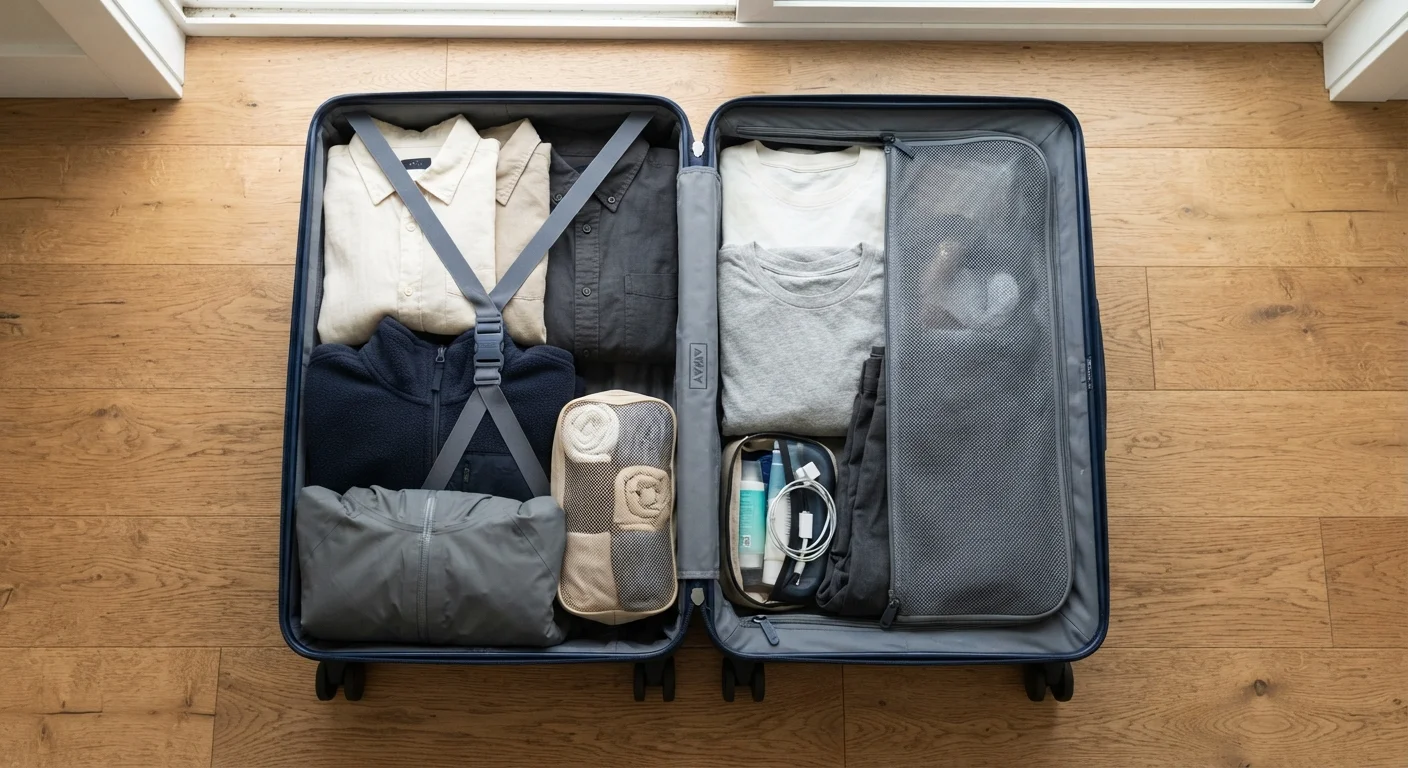
Avoid cotton as a base layer. It absorbs moisture and holds it, leaving you cold and damp in transitional weather. This isn't a niche concern - it's the most common fabric mistake travelers make. For a broader look at how fabric and fold choices interact, see how to organize these layers in your bag.
Steps to Plan Your Climate-Spanning Wardrobe
Follow this sequence before you start pulling items from your closet. Packing for multiple climates is a planning problem first, a logistics problem second.
Map your temperature range, not your destinations
Look up average highs and lows for each stop on your itinerary - not just the general climate description. Write down the single coldest low and the single warmest high. Pack for that full range, treating it as one unified challenge rather than separate destination wardrobes.
Choose a neutral color palette
Select two or three base colors - navy, grey, and olive work well - and build every item around them. When everything coordinates, five tops and two bottoms can create ten or more distinct outfits, eliminating the need to pack a matching piece for every planned occasion.
Select fabrics before selecting items
For each category - tops, bottoms, layers - decide on fabric first. Merino wool or moisture-wicking synthetics for base layers; packable insulating fill for mid layers; a waterproof-breathable shell for outer. Once your fabric rules are set, choosing specific items becomes much faster and less prone to impulse additions.
Pack for activities, not just weather
Group your itinerary by activity type: urban sightseeing, outdoor hiking, casual dining, formal events. Identify which pieces serve multiple activity types. A water-resistant chino, for example, covers both city walking and light hiking. Where one item covers two activities, you've eliminated a duplicate.
Do a dry run layout before packing
Lay every item flat on your bed before it goes in the bag. Physically look at duplicates - two black t-shirts, two pairs of similar pants - and remove the one that adds less versatility. This visual check catches redundancy that's easy to miss when pulling items one at a time from a closet.
For further guidance on structuring a lightweight kit, the capsule packing approach for week-long trips applies directly here. And if you're questioning the popular advice you've heard before, separating packing fact from folklore is worth a read before you zip up.
What to Leave Behind
A working multi-climate wardrobe depends as much on restraint as on selection. The items that blow up a bag most reliably are bulky shoes, single-use specialty gear, and 'just in case' extras that duplicate existing coverage.
Limit footwear to two or three pairs - one versatile walking shoe that handles both city streets and light trails, one pair of sandals or flats for warm evenings or indoor venues, and one compact packable option if your itinerary includes formal settings. Shoes are non-negotiable space consumers, so every additional pair requires a real justification.
Apply the same logic to outerwear: if your shell plus mid layer covers the coldest conditions on your itinerary, a separate heavy coat is redundant weight. If the itinerary includes genuinely extreme cold - think sub-zero destinations - wear the bulkiest layer on travel days rather than packing it.
These principles sit at the core of smart packing fundamentals that hold regardless of destination type.
The content on this site is for informational purposes only and is not a substitute for professional advice. Always consult a qualified professional for guidance specific to your situation.