

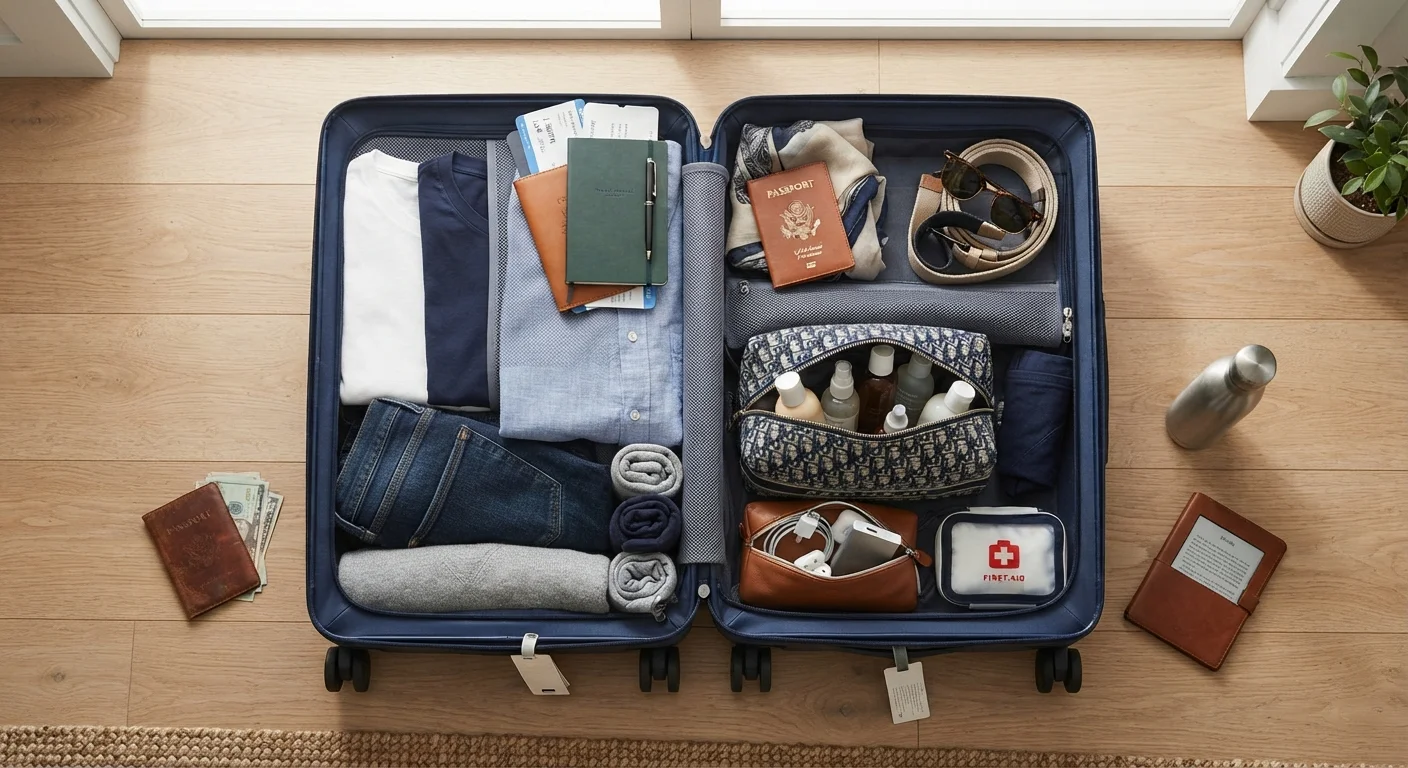
Start with a Trip Profile, Not a Packing List
Most packing mistakes happen before a single item is chosen. Travelers reach for their bag and start throwing things in without a clear picture of what the trip actually demands. The fix is simple: build a trip profile first.
Answer four questions before anything else: How long is the trip? What's the climate? What activities are planned (beach, business meetings, hiking)? And what are the laundry options at the destination? A five-day city trip with hotel laundry has almost nothing in common with a five-day camping trip - the packing list shouldn't look the same either.
For long-haul travel specifically, the calculus shifts further. Weight limits, jet lag, and layovers all influence what belongs in your bag. See our long-haul packing primer for how those trips require their own logic.
Choosing the Right Luggage for the Job
Luggage choice shapes everything that follows. A carry-on-only approach saves time and baggage fees but demands discipline. A checked bag gives you room but adds airport friction. Neither is universally right.
General rules that hold up in practice: carry-on only works well for trips under 10 days if you're willing to do laundry or re-wear items. Checked luggage makes sense for beach trips with bulky gear, family travel, or destinations with strict dress codes across multiple contexts. Backpacks outperform wheeled bags on uneven terrain, cobblestones, and public transit - they're harder to drag, easier to carry.
Whatever you choose, verify your airline's size and weight limits before packing, not after. These vary meaningfully between carriers and fare classes, and the gap between a domestic and international allowance can be significant.
Weigh your packed bag at home before heading to the airport - a simple luggage scale costs very little and can save you a surprisingly large checked-bag overweight fee at the counter.
Overweight baggage fees are among the most avoidable travel costs, and they're consistently cited by travelers as an unpleasant surprise on departure day.
When packing for a multi-climate trip, layer rather than bulk up - a lightweight base layer, a mid-layer, and a packable wind or rain shell covers a wider temperature range than a single heavy jacket at roughly half the weight.
Layering is standard advice among long-distance travelers and outdoor enthusiasts because it adapts to changing conditions without requiring multiple large items.
Building a Packing List That Actually Works
A good packing list is reusable, not rebuilt from scratch every trip. Start with a master list of every category - clothing, toiletries, documents, tech, medications, comfort items - then subtract what doesn't apply to this specific trip profile.
Structure it by category, not by bag. Grouping by category makes it easier to spot gaps (did I add a power adapter? a backup charger?) without hunting through a chronological list. Many travelers keep this list in a notes app or spreadsheet so it's available on every device.
Be deliberate about the overlap between clothing items. A useful heuristic: if an item only works with one outfit, reconsider it. Neutral colors and versatile cuts travel better than statement pieces. For a deeper look at what actually transfers across trip types, smart packing principles covers the reasoning behind building a flexible wardrobe.
Also worth checking: common packing myths - some popular advice doesn't hold up under scrutiny and can cost you space or weight you don't have.
Packing Strategies Worth Using
Technique matters more than most travelers expect. Two approaches consistently reduce bulk and improve organization:
- Rolling clothes rather than flat folding reduces wrinkles in casual fabrics and typically opens up 15-20% more space in a bag.
- Packing cubes compress soft items and group categories so you can find things without unpacking the entire bag at customs or in a dim hotel room.
Place heavier items (shoes, toiletries bag) closest to the wheels on a rolling bag, or against the frame on a backpack. This keeps the bag balanced and easier to move. Shoes go in a reusable bag or shower cap - not loose in the bag where they soil clothing.
Pack your personal item (under-seat bag or daypack) with everything you'd need if your checked luggage were delayed: one day's clothing, chargers, medications, and documents. This isn't pessimism - it's a practical hedge against a fairly common scenario.
Pre-Departure Prep Beyond the Bag
Packing the bag is only part of being ready to leave. The administrative prep that happens in the days before departure is where most travelers lose ground under pressure.
Key items to handle before departure day:
- Documents: Passport validity (many countries require 6 months beyond your travel date), visa requirements, printed or downloaded confirmations, and travel insurance details.
- Devices: Fully charged electronics, downloaded offline maps and entertainment, and any region-specific adapters or SIM cards.
- Finances: Notify your bank, confirm you have local currency or a card with low foreign transaction fees, and keep small cash accessible - not buried in a checked bag.
- Home: Pause mail or deliveries, arrange pet or plant care, lock windows, and set thermostat to an efficient setting.
For a structured walkthrough of these tasks, the pre-departure checklist and pre-trip prep checklist cover each category in detail.
Note: Entry requirements - including visas, vaccinations, and border rules - change. Always verify with official government sources and your airline before traveling. This article provides general guidance only.
Day-of Moves That Keep You Calm
Everything upstream feeds into this: a calm, friction-free departure. A few habits make a consistent difference.
Set two alarms, not one. Lay out your travel outfit the night before. Do a final sweep using your checklist - don't rely on memory after a 5 a.m. wake-up. Lock your bag before leaving home, not at the curb.
At the airport, build in more time than you think you need. Security wait times are unpredictable, and running to a gate is an avoidable stressor. If you're checking a bag, factor in queue time at the counter. If you're flying internationally, factor in customs forms or biometric screening.
Travel prep is a system, not a single act. Getting it right is less about any individual item and more about the habit of planning early and working through a consistent process. For a full view of how packing fits into the wider arc of trip planning, see the complete trip planning framework.
The content on this site is for informational purposes only and is not a substitute for professional advice. Always consult a qualified professional for guidance specific to your situation.