

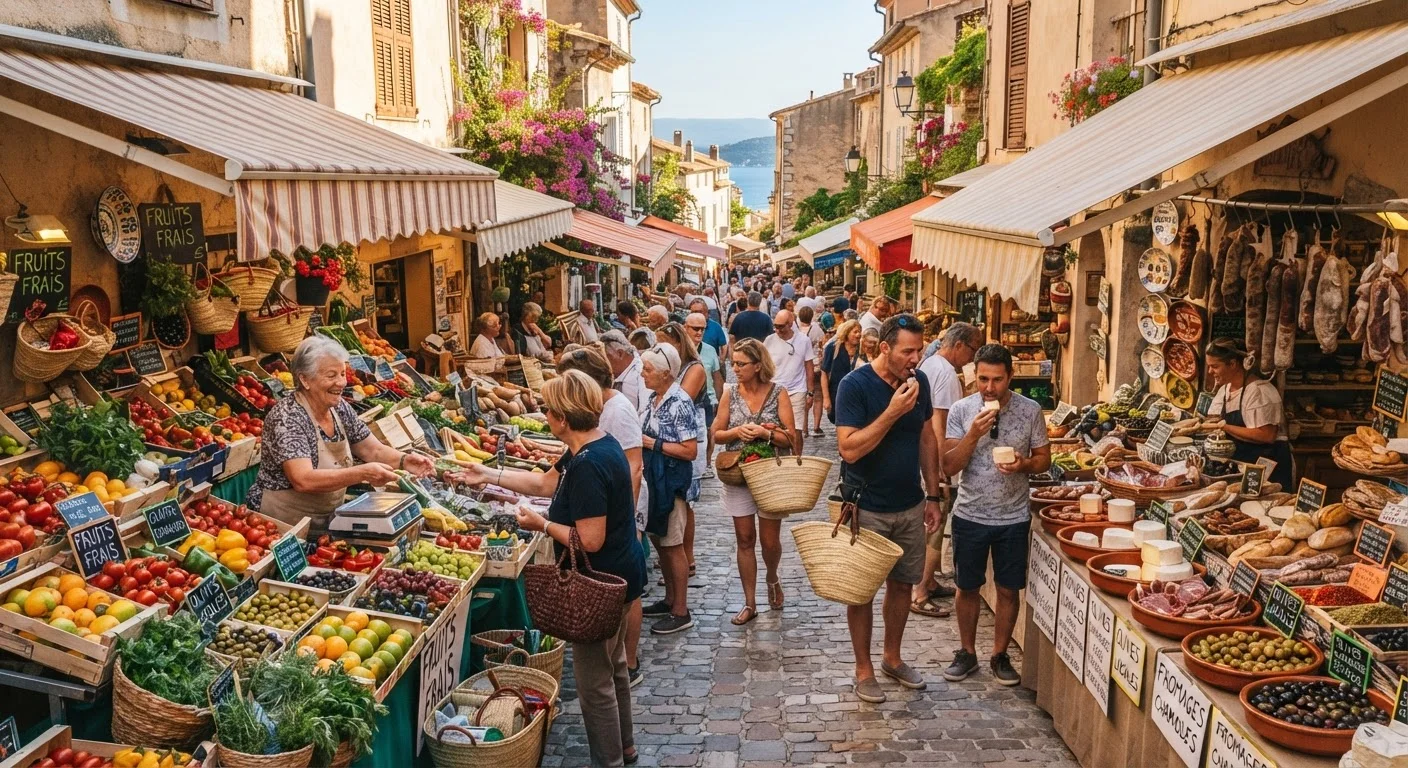
Why Food Costs Can Spiral Fast When Traveling
Food is one of the most variable lines in any travel budget - and one of the easiest to overspend without noticing. A few breakfasts at a hotel café, lunch from a restaurant with an English menu out front, and dinner somewhere that looked good on a walk-by: that pattern costs two to three times more than it needs to in most destinations.
The restaurants closest to major sights are almost always priced for visitors, not residents. That's not a cynical observation - it's just economics. Understanding that distinction is the starting point for eating well without the tourist markup. For a broader look at how food fits into daily spending, see our guide on building a realistic daily travel budget.
Proven Practices for Eating Affordably and Well
These approaches work across a wide range of destinations - from Western Europe to Southeast Asia to Latin America. The specifics vary, but the underlying logic is consistent.
Eat at markets, food halls, and neighborhood bakeries instead of tourist-district restaurants.
Covered markets and local food halls sell prepared dishes, fresh produce, and street snacks at prices that reflect local income levels - not visitor expectations. Bakeries in many countries also offer complete savory items, sandwiches, or pastries that make a filling low-cost meal.
Orient yourself in a new city by visiting a neighborhood market within the first 24 hours.
Markets reveal local staples, price norms, and the rhythm of how people actually eat. Spending an hour at a produce or food market early in your trip calibrates your expectations and helps you spot inflated tourist pricing elsewhere.
Take advantage of fixed-price lunch menus when they're available.
Many restaurants in Europe, Latin America, and parts of Asia offer structured midday meals - multiple courses at a set price - as their primary draw for local workers. These menus often include food that doesn't appear on the dinner menu at all, and the value is substantially better.
Learn two or three words about food in the local language before you arrive.
Knowing how to say 'what do you recommend' or 'the local specialty' - even imperfectly - signals genuine interest rather than tourist autopilot. Staff at non-tourist restaurants are more likely to steer you toward good-value dishes when they sense you're open to it.
Buy breakfast and snack items from supermarkets or convenience stores.
Breakfast is the meal most consistently overpriced relative to its simplicity. Picking up local bread, fruit, yogurt, or cheese from a neighborhood shop saves money without sacrificing quality - and it's often a more interesting experience than a hotel buffet.
Using Meal Timing to Your Advantage
In many countries - Spain, France, Portugal, Mexico, and much of Southeast Asia among them - the midday meal carries cultural and commercial weight that the evening meal does not. Restaurants offer fixed-price lunch menus (menu del día, prix fixe, set lunch) that include multiple courses and a drink for a fraction of the dinner equivalent.
Eating your larger meal at lunch and keeping dinner light - street food, market finds, bakery items - is one of the most effective ways to stretch a food budget without sacrificing quality or variety. This approach also aligns better with how locals actually eat in many parts of the world. If you're curious about the cultural dimension of that difference, street food vs. restaurant culture is worth a read.
Reading the Room - and the Menu
A restaurant with a menu posted only in the local language, a handwritten daily special board, and no laminated tourist photo-menu out front is almost always a good sign. That's not a hard rule, but it's a useful heuristic. Similarly, a packed dining room at local lunch hour suggests the place is priced for regulars.
Walking into an unfamiliar cuisine doesn't have to feel intimidating. Reading an unfamiliar menu with some basic orientation can help you order confidently and avoid accidentally choosing the most expensive option. Being a respectful, curious diner also goes a long way - dining etiquette across cultures covers practical customs worth knowing before you sit down.
These habits connect to a broader set of money-saving behaviors that locals take for granted - and that visitors rarely discover on their own.
The content on this site is for informational purposes only and is not a substitute for professional advice. Always consult a qualified professional for guidance specific to your situation.