

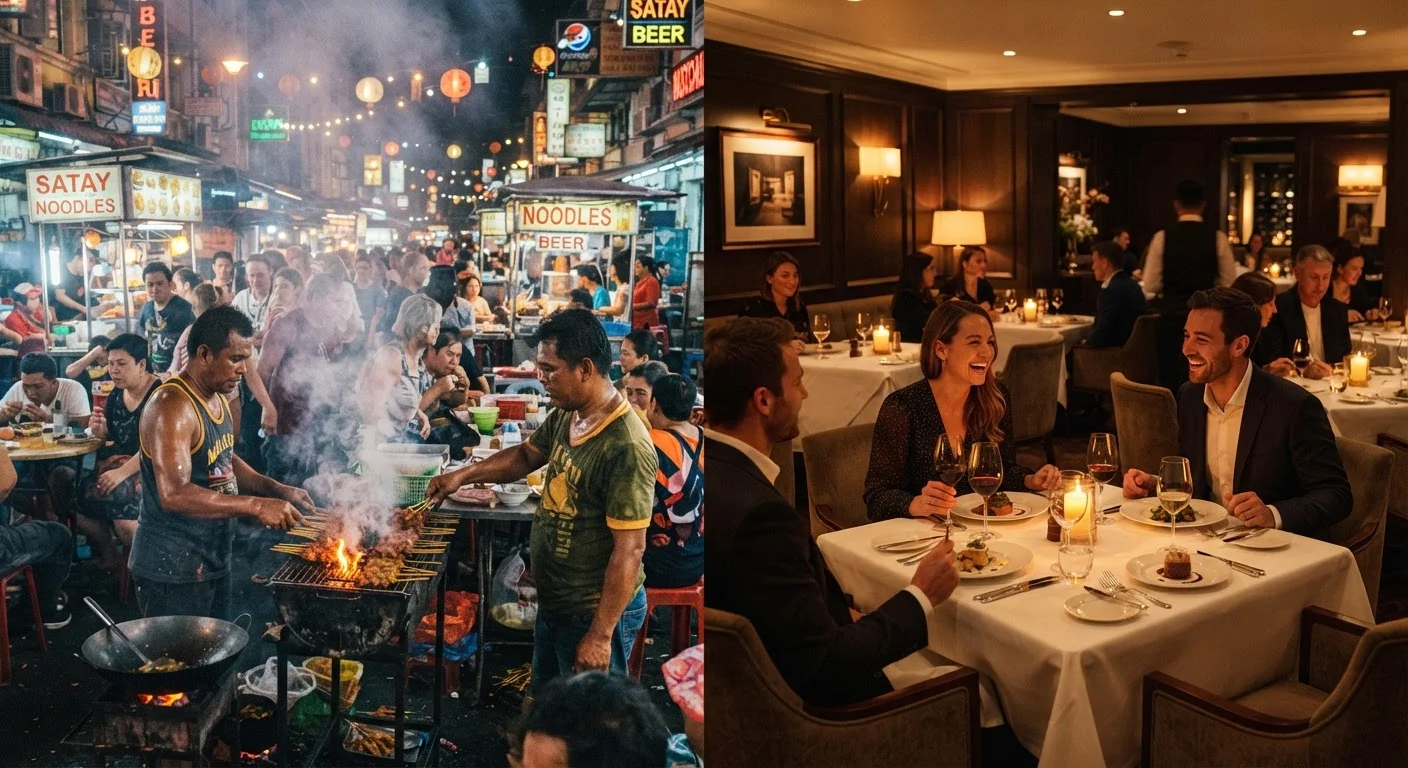
Option A
Street Food Culture
The democratic, open-air expression of everyday eating.
Best for: Understanding what a population actually eats day to day - unfiltered, affordable, and deeply regional.
Option B
Restaurant Culture
The curated, codified space where food becomes social ritual.
Best for: Experiencing how a society frames celebration, hospitality, and culinary ambition in a structured setting.
Why Where You Eat Tells You as Much as What You Eat
Walk through Bangkok at 7 a.m. and you'll find office workers eating noodle soup perched on plastic stools. Walk through Paris at the same hour and breakfast is a croissant eaten standing at a zinc bar. Both are fast, both are local - but they reflect completely different relationships between food, time, and public space.
The divide between street food and restaurant culture isn't simply about price or formality. It's about what a society considers normal, appropriate, and even dignified when it comes to eating. And that, in turn, tells you quite a lot about how communities use food to organize social life.
In Mexico, tacos al pastor served from a rotating spit on a busy corner are not considered lesser food than anything served at a formal restaurant - they are simply what people eat. In France, the bistro and the brasserie carry specific cultural weight that a paper-wrapped sandwich never quite matches. Neither country is wrong. They've just developed different systems for expressing what food means to them.
What Street Food Actually Tells Us
Street food is, at its core, a response to how people actually live. It's fast because work doesn't stop. It's inexpensive because most people aren't wealthy. It's portable because public space is where daily life happens. This makes it an unusually honest cultural artifact.
In countries where street food culture is deeply embedded - Thailand, India, Vietnam, Mexico, Nigeria, Turkey - the dishes served roadside are often the same ones that appear in home kitchens and at family gatherings. They aren't simplified versions of «real» food; they are the real food. The flavors tend to be bold and regionally specific because the cook has no incentive to dilute them for outside palates.
Street food also preserves historical records that formal cuisine sometimes loses. Many dishes sold at market stalls have roots in migration, agricultural cycles, or older cooking methods that restaurants later modernized or repackaged. Just as a nation's soups reveal its values, the snacks and handheld meals sold curbside often carry deep local memory.
| Criterion | Street Food Culture | Restaurant Culture |
|---|---|---|
| Primary audience | Local everyday population | Mixed: locals, visitors, special occasions |
| Formality | Informal, spontaneous | Structured, staged |
| Price point | Generally low to very low | Ranges widely by type |
| Cultural signal | Daily life, working rhythms | Hospitality norms, prestige, occasion |
| Authenticity perception | Often seen as more «real» | Seen as curated or representative |
| Historical depth | Often preserves older traditions | Can codify or modernize traditions |
| Tourist exposure | Varies; some stalls cater to visitors | Higher tourist influence in many cities |
It's also worth noting that colonial history has shaped which kinds of food ended up on the street versus in formal spaces. In some post-colonial contexts, local cuisine was systematically excluded from «respectable» dining settings, which pushed it onto streets and markets - a history explored in depth when considering how colonialism reshaped food culture worldwide.
What Restaurant Culture Reveals Instead
Restaurants, even casual ones, introduce a layer of staging that street food rarely has. There's a menu, a host, an implied sequence to the meal. That structure isn't arbitrary - it reflects how a culture thinks about hospitality, hierarchy, and the relationship between guest and provider.
In Japan, even a small ramen shop operates with precise, almost ritualistic standards - the broth, the toppings, the way the bowl is presented. In Ethiopia, a formal restaurant meal might center on a shared injera spread, mirroring the communal logic of home eating but elevated with more variety and ceremony. In the United States, the diner occupies a cultural role that's neither high-end nor purely casual - it's egalitarian nostalgia made edible.
Restaurants also tend to be where a cuisine gets codified and sometimes frozen. The dishes that end up on menus become the dishes tourists recognize, which shapes how outsiders understand the food culture entirely. If you walk into an unfamiliar cuisine for the first time, knowing how to read a menu in an unfamiliar cuisine can help you get past the surface-level tourist options.
A Note on the Word 'Authentic'
Food writers and travelers often describe street food as more «authentic» than restaurant food - but authenticity is a complicated idea. Restaurant cuisine can be just as rooted in tradition, technique, and community as anything sold from a cart. The more useful question isn't which is real, but what each format is designed to do and for whom. Both can be deeply meaningful; both can also be performative. Context is everything.
When the Line Blurs - and What That Means
In Singapore, hawker centres occupy a fascinating middle ground: open-air, communal, and inexpensive, yet formally organized and even celebrated with Michelin recognition. This blurring of the street-versus-restaurant divide is itself culturally significant. It says something about how Singapore values both access and excellence without viewing them as opposites.
Similar hybrids appear in other contexts - the taco trucks of Los Angeles that operate like restaurants-without-walls, the night markets of Taiwan where vendor stalls have been family institutions for generations, the dhabas of northern India where truckers and travelers eat alongside urban professionals. These spaces resist easy categorization, and that resistance is part of their cultural meaning.
When you visit any of these, the etiquette of participation matters too. Knowing how to eat respectfully in another culture's setting - whether you're at a family table or a street stall - changes the quality of the experience for everyone.
The key insight across all of this: neither format is more authentic than the other. Both are socially constructed, historically shaped, and capable of carrying genuine cultural meaning. What matters is paying attention to what each one reveals in its specific context - and resisting the urge to rank one above the other.
The content on this site is for informational purposes only and is not a substitute for professional advice. Always consult a qualified professional for guidance specific to your situation.