

Option A
Whole Grains
The complete kernel - nothing removed.
Best for: People looking to increase fiber, vitamins, and minerals through everyday food choices.
Option B
Refined Grains
The milled, stripped-down version of grain.
Best for: Situations where lighter texture or longer shelf life is the priority, though typically lower in fiber and key nutrients.
What Milling Actually Does to a Grain
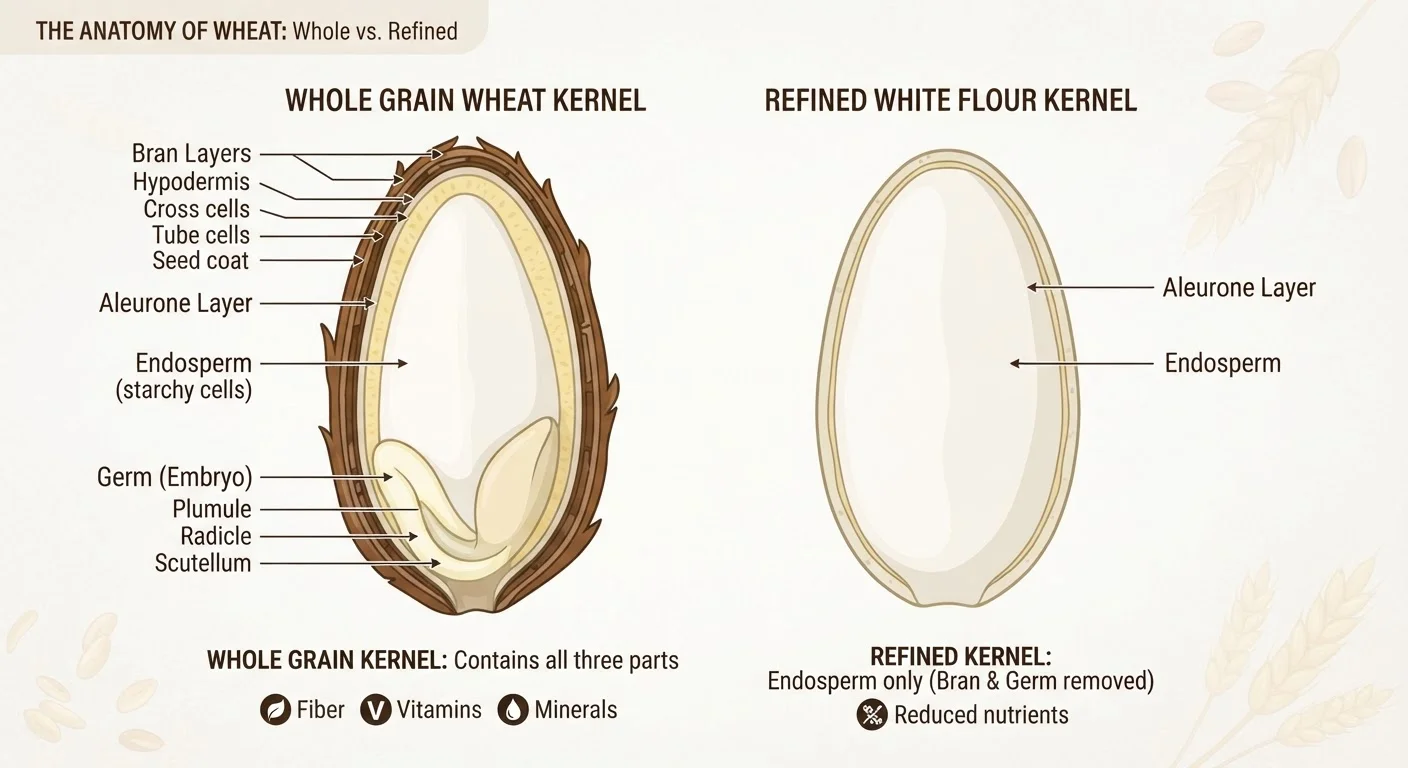
A grain of wheat has three main parts: the bran (the fibrous outer layers), the germ (the nutrient-dense inner embryo), and the endosperm (the starchy middle that makes up most of the kernel's bulk). When wheat is milled into white flour, the bran and germ are removed. What remains is almost entirely endosperm.
That process trades nutritional density for a softer texture and longer shelf life. The bran carries most of the grain's dietary fiber along with B vitamins, iron, copper, zinc, and magnesium. The germ adds vitamin E, additional B vitamins, and healthy fats. When those two parts leave, so does the majority of those nutrients.
This is not a minor rounding difference. Whole wheat flour contains roughly three times the fiber of its refined counterpart, plus meaningful amounts of nutrients that are almost entirely lost during milling. As a comparison, see what's removed step by step during grain processing for a more granular breakdown.
| Criterion | Whole Grains | Refined Grains |
|---|---|---|
| Parts of kernel retained | Bran, germ, endosperm | Endosperm only |
| Dietary fiber | High (e.g. ~3g per slice whole wheat bread) | Low (e.g. ~1g per slice white bread) |
| B vitamins (natural) | Present in meaningful amounts | Largely removed; some added back via enrichment |
| Vitamin E | Present in germ | Mostly removed, not replaced by enrichment |
| Mineral content (iron, zinc, magnesium) | Naturally higher | Reduced; iron partially restored by enrichment |
| Digestion speed | Slower (fiber slows starch breakdown) | Faster (less fiber to slow digestion) |
| Shelf life / texture | Shorter shelf life; denser texture | Longer shelf life; lighter texture |
| Common examples | Oatmeal, brown rice, whole wheat bread | White bread, white rice, regular pasta |
Enrichment: What Gets Put Back - and What Doesn't
After milling, many refined grain products are enriched, meaning manufacturers add back certain nutrients that were lost - typically thiamin, riboflavin, niacin, folic acid, and iron. This practice became standard in the US in the 1940s and has been credited with reducing deficiencies in the population.
Enrichment is meaningful, but it is not restoration. It replaces a handful of specific nutrients; it does not replace fiber, vitamin E, magnesium, zinc, or the various plant compounds naturally present in the bran and germ. A label that says "enriched wheat flour" tells you the product starts with refined grain - not whole grain.
What 'Enriched' Means on a Label
When you see 'enriched' on a grain product, it signals that specific nutrients - typically thiamin, riboflavin, niacin, folic acid, and iron - were added back after milling removed them. This is a regulatory standard in the US, not a marker of nutritional completeness. Fiber, vitamin E, magnesium, and other compounds lost during refining are not restored through enrichment. Enriched does not mean whole grain.
If you're navigating label language more broadly, nutrition claims on packaging can be misleading in ways that go beyond grain - understanding enrichment is one piece of a larger puzzle.
Why Fiber Is the Headline Difference
Among the nutrients lost during refining, fiber is probably the most consequential for everyday health. Dietary fiber slows digestion, helps you feel fuller for longer, supports gut bacteria, and is associated in research with lower risks of cardiovascular disease and type 2 diabetes. Most Americans consume well below the recommended daily intake of fiber, and shifting grain choices is one of the most practical levers available.
~5%
Americans meeting daily fiber recommendations
Research published in the American Journal of Lifestyle Medicine has noted that only a small fraction of US adults consume adequate dietary fiber on a daily basis.
3x
More fiber in whole wheat vs white flour
USDA nutrient data shows whole wheat flour contains roughly three times the dietary fiber per 100g compared to refined all-purpose wheat flour.
50%+
Recommended share of grains that should be whole grains
The US Dietary Guidelines for Americans recommend that whole grains make up at least half of total daily grain consumption.
Refined grains digest more quickly, causing a faster rise in blood sugar compared to whole grains - though the size of this effect varies significantly depending on the overall meal, portion size, and how the food is prepared. No single food operates in isolation, and dietary context matters as much as individual choices.
For a related look at how processing affects other nutrient categories, the distinction between natural and added sugar follows a similar logic - what's present in the original food versus what's changed by processing.
How to Actually Read Grain Labels
Food packaging regularly uses language that sounds whole-grain without being so. "Wheat bread," "multigrain," "made with whole grains," and brown coloring are not reliable signals. The practical test is the ingredient list: if the first ingredient says "whole wheat" or "whole grain ", the product qualifies. If it says "enriched wheat flour" or "unbleached wheat flour" first, it is refined - regardless of what the front of the package suggests.
This connects to a broader pattern worth knowing: many nutrition claims that sound authoritative on packaging don't hold up to scrutiny. Grain labeling is a clear example.
The US Dietary Guidelines recommend that at least half of all grains consumed be whole grains. That does not require eliminating refined grains - it suggests balance. Practical swaps that most people find manageable include choosing whole wheat bread, oatmeal, brown rice, or whole grain pasta in place of their refined counterparts in the meals where the swap is easy.
This article is for general informational purposes only and is not a substitute for personalized nutrition or medical advice. Consult a registered dietitian or healthcare provider for guidance specific to your needs.
The content on this site is for informational purposes only and is not a substitute for professional advice. Always consult a qualified professional for guidance specific to your situation.