

Option A
Whole Grains
The complete, minimally processed kernel.
Best for: People who want the full nutritional package a grain naturally provides, including fiber, vitamins, and minerals.
Option B
Refined Grains
The stripped-down, shelf-stable version.
Best for: Situations where texture, shelf life, and mild flavor take priority over nutrient density.
What's Actually Inside a Grain
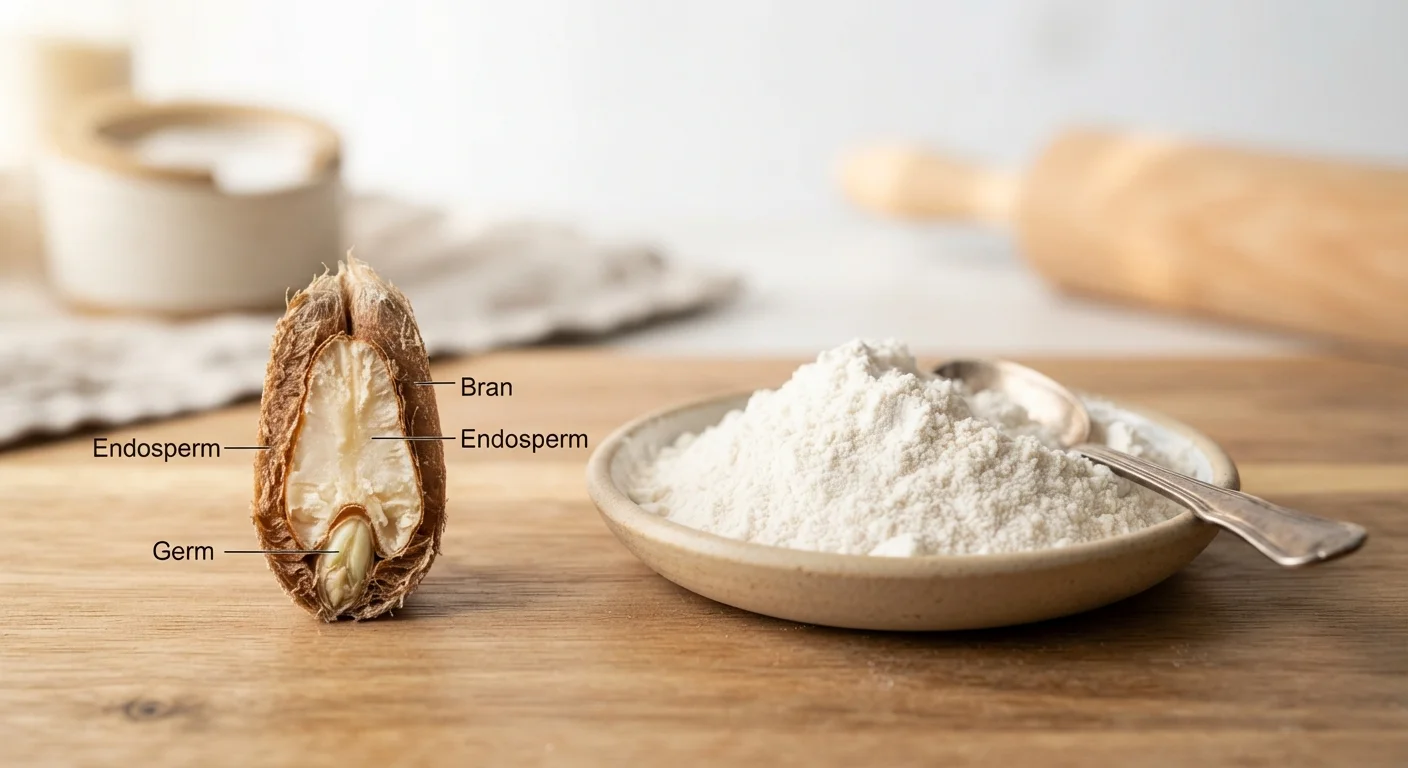
A grain kernel has three distinct layers, and each one does something different nutritionally. Understanding these layers makes the whole-vs-refined question a lot easier to grasp.
The bran is the outer shell. It's dense with dietary fiber, B vitamins like thiamine and niacin, and trace minerals including iron and zinc. The germ is the grain's embryo - small but packed with vitamin E, healthy fats, and additional B vitamins. The endosperm is the starchy middle section that makes up the bulk of the kernel. It provides carbohydrates and some protein, but comparatively few micronutrients on its own.
When a grain is described as "whole," all three layers are present. Oats, brown rice, quinoa, whole wheat, and barley all qualify. The grain is milled or cooked, but structurally it still contains what it started with.
What Refining Actually Does
Refining - typically through industrial milling - removes the bran and germ, leaving primarily the endosperm. The result is a finer, lighter flour or grain that stores longer, cooks faster, and has a milder taste. White flour, white rice, and most cornmeal are classic examples.
The nutritional trade-off is real. Refining strips away most of the fiber and a significant share of B vitamins, vitamin E, iron, zinc, and naturally occurring phytonutrients (plant compounds associated with various biological functions). Exactly how much depends on the grain and the milling process, but the structural loss is consistent.
| Criterion | Whole Grains | Refined Grains |
|---|---|---|
| Grain layers present | Bran, germ, endosperm | Endosperm only |
| Dietary fiber | High | Low |
| B vitamins (natural) | Full range retained | Mostly removed; some re-added via enrichment |
| Vitamin E | Present (from germ) | Largely removed |
| Phytonutrients | Present | Largely removed; not restored by enrichment |
| Digestion speed | Slower (fiber-mediated) | Faster |
| Shelf life | Shorter (germ fats can go rancid) | Longer |
| Texture in baking | Denser, heartier | Lighter, more uniform |
To partially offset these losses, many refined grain products in the U.S. are enriched - meaning thiamine, riboflavin, niacin, folic acid, and iron are added back in. Enrichment is required by federal standards for certain refined grain products. It does restore some micronutrients, but it doesn't replace fiber, vitamin E, or the range of phytonutrients lost in the bran and germ. For a broader look at how processing claims can be misleading, see our guide to nutrition claims that sound scientific but aren't.
How Each Type Behaves in the Body
One of the most discussed differences between whole and refined grains is how they affect blood sugar. Because the fiber in whole grains slows digestion, glucose is released into the bloodstream more gradually. Refined grains, stripped of most fiber, tend to digest faster and can produce a quicker rise in blood sugar followed by a faster drop.
This doesn't mean refined grains are harmful in isolation - the overall composition of a meal matters a great deal. A refined grain eaten alongside protein, fat, and vegetables behaves differently than the same grain eaten alone. Dietary patterns across a whole day or week are more meaningful than any single food choice.
~5%
Adults meeting fiber intake recommendations
According to data published in the American Journal of Lifestyle Medicine, only about 5% of Americans meet the adequate intake for dietary fiber.
25-28g
Daily fiber intake recommended for most adults
The U.S. Dietary Guidelines for Americans suggest 25g per day for women and 38g for men, with averages falling well below these figures.
~75%
Fiber lost in wheat refining
Research on grain milling indicates that refining whole wheat to white flour removes roughly 75% of its original dietary fiber content.
Fiber also plays roles beyond blood sugar - it supports digestive regularity, contributes to satiety, and feeds beneficial gut bacteria. Since most Americans fall short of recommended fiber intake, the fiber difference between whole and refined grains is worth keeping in mind when making everyday food choices. If you're also curious about how different types of sugar behave in food, our piece on natural vs. added sugar covers that ground clearly.
This article is for general informational purposes only and is not medical or dietary advice. Speak with a registered dietitian or healthcare provider about grain intake decisions that relate to your individual health.
The content on this site is for informational purposes only and is not a substitute for professional advice. Always consult a qualified professional for guidance specific to your situation.