

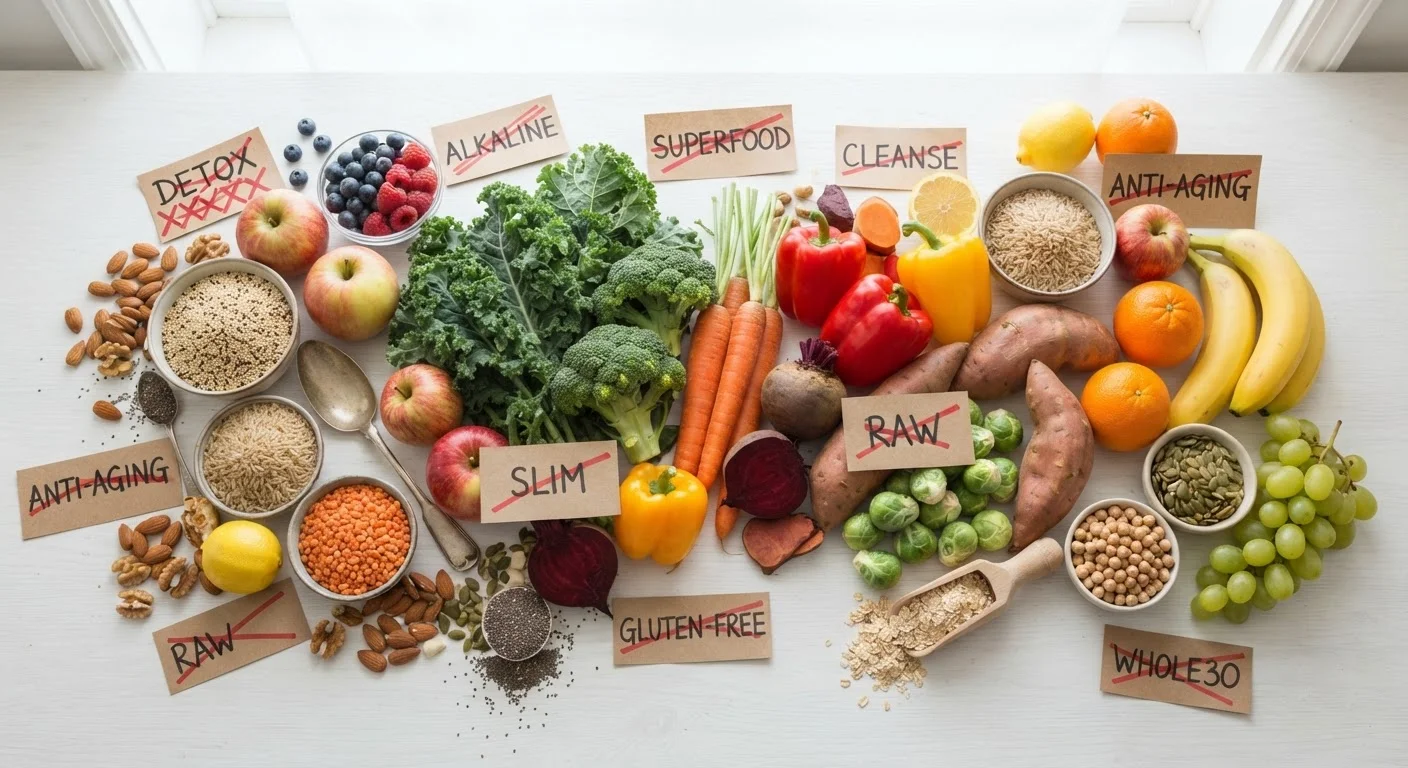
Why Nutrition Language Is So Easy to Misuse
Food and nutrition sit at an interesting intersection: they're subjects everyone engages with daily, yet the underlying science is genuinely complex, still evolving, and often misrepresented. That gap creates fertile ground for confident-sounding claims that don't hold up under scrutiny.
Terms like 'detox', 'alkaline', and 'superfood' travel easily because they sound scientific. They carry the vocabulary of biology without the rigor. And because most of us don't have time to cross-reference every health claim we encounter, they tend to stick.
This article walks through five of the most persistent nutrition myths that wear a scientific costume - what they claim, what the evidence actually shows, and how to think more clearly about nutrition language going forward. For a broader look at how these patterns show up across nutrition media, our guide on spotting shaky claims is a useful companion read.
Myth
Certain foods or juice cleanses 'detox' your body by flushing out harmful toxins.
Fact
The liver and kidneys are your body's actual detoxification system - no food or drink has been shown to meaningfully enhance or accelerate that process.
The word 'detox' does a lot of heavy lifting in wellness marketing, but it rarely comes with a definition of which toxins are being removed or how. In reality, the liver filters blood and processes substances for removal, while the kidneys excrete waste products through urine. These are continuous, highly regulated biological processes.
There's no credible clinical evidence that juice cleanses, detox teas, or specific foods speed up or improve this system in healthy people. If your liver or kidneys aren't functioning well, that's a medical issue requiring professional care - not a dietary intervention.
Myth
Eating alkaline foods makes your blood more alkaline, which is healthier.
Fact
Blood pH is kept within an extremely narrow range by your lungs and kidneys - food cannot meaningfully shift it in healthy people.
Blood pH sits between roughly 7.35 and 7.45. Your body works hard to keep it there through a system of chemical buffers and organ-level regulation. If blood pH strayed significantly outside that range, it would be a medical emergency, not a dietary outcome.
When you eat or drink something acidic or alkaline, it affects the pH of your urine - not your blood. Urine pH changes are measurable but don't reflect any change in your body's internal environment. The 'alkaline diet' premise rests on a misunderstanding of basic physiology.
Myth
Superfoods are a scientifically recognized category of especially powerful, health-boosting foods.
Fact
'Superfood' is a marketing term with no formal scientific or regulatory definition - it has no standardized nutritional criteria.
Blueberries, acai, kale, and goji berries have all worn the superfood label at various points. Each of these foods does contain valuable nutrients - antioxidants, vitamins, fibre - but none of them is nutritionally unique enough to justify the elevated status the label implies.
Nutrition scientists and dietitians generally avoid the term because it implies that eating specific 'super' foods compensates for an otherwise poor diet, which the evidence doesn't support. A varied diet across food groups is consistently what the research points toward - not a handful of celebrated individual foods.
Myth
Natural ingredients are always safer and healthier than synthetic ones.
Fact
Whether something is natural or synthetic doesn't determine its safety, nutritional value, or health impact - that depends on the substance itself.
'Natural' is one of the least regulated terms on food packaging. In the U.S., the FDA has noted significant difficulty defining it in a meaningful regulatory sense. Many naturally occurring compounds - certain plant toxins, for example - are harmful, while many synthetic vitamins are functionally identical to their natural counterparts.
The appeal to nature is a recognizable cognitive shortcut, but it's not a reliable nutritional filter. Packaging claims like 'natural' and 'clean' often tell you more about marketing intent than actual nutritional content.
Myth
Eating sugar causes diabetes.
Fact
Type 2 diabetes involves complex interactions between genetics, body weight, physical activity, and overall diet - sugar consumption alone doesn't cause it.
This myth collapses an intricate metabolic condition into a single dietary villain. While diets high in added sugars can contribute to weight gain, and excess body weight is a risk factor for type 2 diabetes, the causal chain is indirect and varies considerably between individuals.
It's also worth distinguishing between types of sugar. Naturally occurring sugar in whole fruit behaves differently in the body than large amounts of added sugar in processed foods - largely because of the fibre and other nutrients that come alongside it in whole foods.
What to Look for When a Nutrition Claim Sounds Convincing
80%
Adults who have tried a 'detox' diet
Survey data from various consumer research sources consistently find that a significant majority of adults in the U.S. have tried some form of cleanse or detox product, despite the lack of clinical evidence supporting their efficacy.
0
Regulatory definitions of 'superfood' in the U.S.
Neither the FDA nor the USDA has established a formal regulatory definition for the term 'superfood', meaning it can be applied to any food without meeting a nutritional standard.
7.35-7.45
Normal human blood pH range
According to standard physiology references, this narrow range is tightly maintained by the body's buffer systems regardless of dietary intake in healthy individuals.
A few practical habits can help filter credible nutrition information from noise. First, ask what specific mechanism is being described. A claim like 'boosts immunity' or 'detoxifies the body' is vague enough to mean almost anything - or nothing. Credible nutrition science describes specific nutrients, pathways, and effects with some precision.
Second, check whether the claim is backed by multiple independent studies in humans, or just a single small study or animal research. Nutrition headlines often outrun the actual evidence. Understanding how cherry-picked studies create misleading impressions is one of the most useful skills you can develop as a reader.
Third, notice who's making the claim. A product manufacturer has a financial incentive to frame research favorably. Independent researchers, registered dietitians, and public health bodies don't have a product to sell.
None of this means becoming cynical about every food you eat. Most everyday foods - whole grains, vegetables, legumes, fruit - are straightforwardly useful without needing inflated marketing language attached. Eating a varied plate across different food groups remains one of the most durable and well-supported ideas in nutrition, no buzzwords required.
This article is for general informational purposes only and is not a substitute for professional medical or nutritional advice. Consult a qualified healthcare provider with any questions about your diet or health.
The content on this site is for informational purposes only and is not a substitute for professional advice. Always consult a qualified professional for guidance specific to your situation.