

What the Silk Road Actually Was
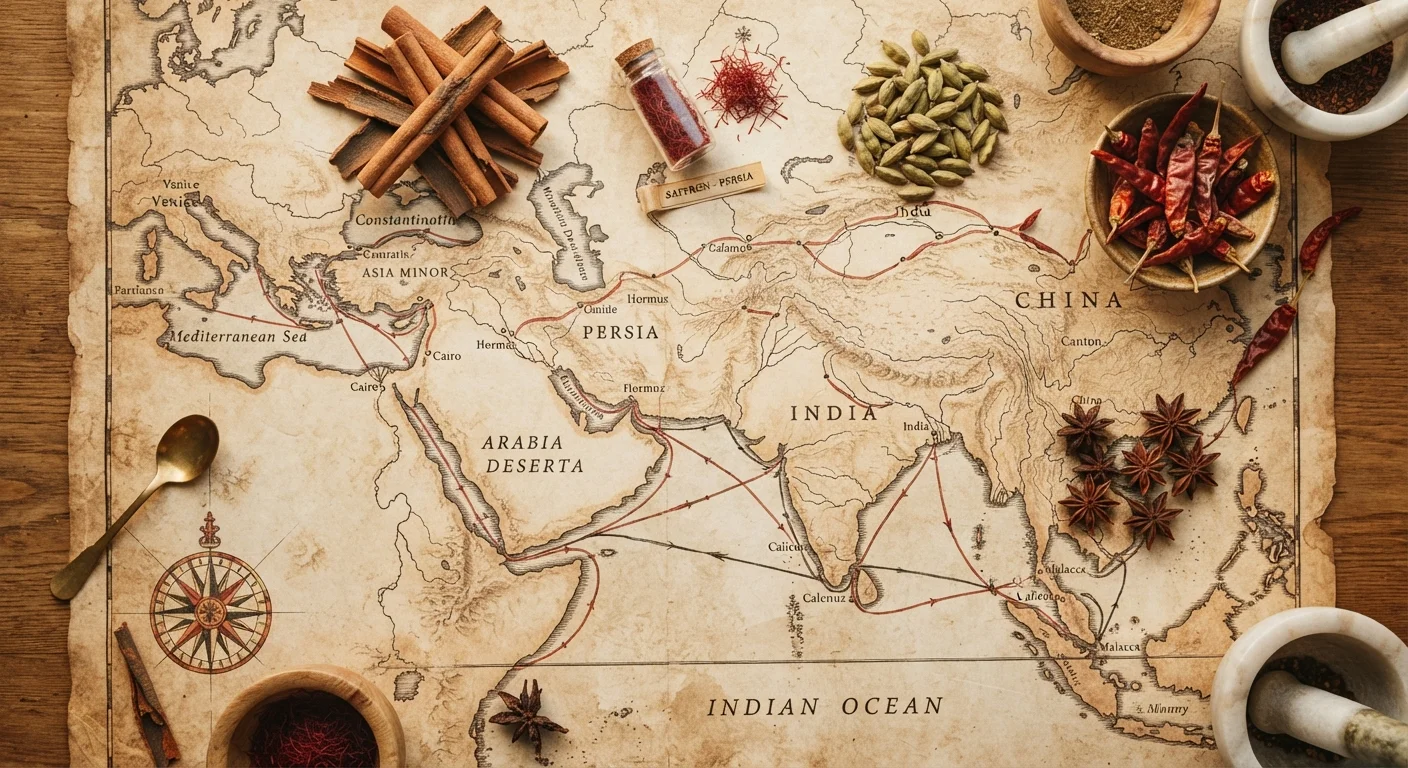
The term "Silk Road" was coined by German geographer Ferdinand von Richthofen in 1877, but the trade networks it describes are far older - and far messier - than the name implies. Rather than a single paved highway, the Silk Road was a sprawling web of overland and maritime corridors connecting China, Central Asia, the Indian subcontinent, Persia, the Arabian Peninsula, East Africa, and ultimately the Mediterranean world. Active in various forms from around the 2nd century BCE through the 15th century CE, these routes carried silk, yes, but also cotton, glass, precious metals, ideas, religions - and food.
Most merchants never travelled the full length. Goods changed hands many times across relay stations, city-state markets, and caravan hubs like Samarkand, Kashgar, and Palmyra. This relay system is actually crucial for understanding how food culture spread: a spice didn't arrive in Rome with a label saying "from India." It arrived transformed by the tastes, blending traditions, and culinary imaginations of every culture that handled it along the way.
Spices: The Original Currency of Flavour
If one category of ingredient defines Silk Road food exchange, it's spices. Black pepper, originally cultivated in the Western Ghats of India, was so valuable in medieval Europe that it was used as currency and stored in treasuries. Cinnamon from Sri Lanka, cardamom from Guatemala's ancestor region via Arab traders, saffron cultivated in Persia - each of these ingredients permanently altered the flavour logic of the cuisines that received them.
Persian cuisine offers one of the clearest windows into this layering. The combination of dried fruits, nuts, and warm spices in dishes like fesenjan (a walnut-pomegranate stew) reflects centuries of ingredient exchange along the northern Silk Road corridors. Arab traders carried these flavour profiles westward, which is why medieval European cuisine - before it gradually stripped back complexity - shared surprising similarities with what we'd now call Middle Eastern cooking.
When cooking with whole spices, toast them briefly in a dry pan before grinding - even 60 seconds of heat unlocks volatile oils that pre-ground spices have already lost.
This technique, foundational in Indian and Persian cooking traditions, was likely standardised through the very trade networks that spread the spices themselves across continents.
If you're exploring Silk Road-influenced cuisines, start with the sweet-sour-savoury axis: a dish that balances pomegranate, walnut, and meat is a reliable entry point into Persian and Caucasian cooking.
That flavour combination is one of the oldest documented taste profiles along the northern trade routes and appears in remarkably consistent forms from Iran to Georgia to medieval Arab cookbooks.
For a deeper look at how individual ingredients carry entire cultural stories, see The Global Pantry - it traces 14 defining ingredients back to their roots.
Noodles, Bread, and the Movement of Staples
Few food debates are as lively - or as misunderstood - as the origins of noodles. Archaeological evidence from Lajia in China suggests noodle-like food was being made from millet as early as 4,000 years ago. But the idea that noodles "came from China" and became Italian pasta via Marco Polo is a popular oversimplification that food historians largely reject. More likely, similar techniques for working grain dough developed in multiple places, and trade routes accelerated cross-pollination rather than delivering finished foods wholesale.
What the Silk Road unquestionably did was move wheat. Hard durum wheat, ideal for dried pasta and flatbreads, spread westward from its origins in the Fertile Crescent and was cultivated progressively further along the Mediterranean. Leavened bread technology, which depends on understanding fermentation, also travelled - and with it came distinct regional bread cultures that persist today in Georgian shoti, Central Asian non, and Indian naan, all of which share a common ancestor in clay-oven baking traditions. For more on the fascinating tangle of noodle history specifically, Noodles, Pasta, and Everything In Between unpacks what food historians actually know.
Cooking Techniques That Crossed Borders
Food exchange wasn't only about ingredients - it was also about method. The practice of dry-roasting whole spices before grinding them, common in Indian and Persian cooking, appears in adapted forms across the Levant and North Africa. Clay-pot slow cooking - which retains moisture, deepens flavour, and requires no fat - shows remarkable consistency from Moroccan tagine to Uzbek dimlama, suggesting shared technique ancestry rather than coincidence.
Preservation methods also migrated. Pickling in vinegar or brine, fermenting vegetables, and drying meat all served the practical needs of long-distance travel, and the foods developed for the road eventually became part of settled cuisine. Salt's role in fermentation and preservation is one of the oldest and most universal culinary technologies - and the Silk Road helped standardise how it was used across regions.
Where You Can Still Taste the Route Today
One of the most rewarding ways to understand Silk Road food history is through geography. The further you move along the old trade corridors, the more you can trace flavour lineages. Georgian cuisine, sitting at the crossroads of routes from both Persia and the Byzantine world, layers walnut sauces, pomegranate molasses, and fenugreek in ways that echo both east and west simultaneously. Sicilian cooking carries unmistakable traces of Arab influence - agrodolce (sweet-sour) sauces, pine nuts and raisins in savoury dishes, and the widespread use of saffron - reflecting the island's position as a medieval trade hub.
Central Asian cuisine, particularly Uzbek and Tajik cooking, may be the most directly "on-route" food tradition still widely practiced. Plov (a rice and meat pilaf), samsa (stuffed pastries), and lagman (pulled noodles in broth) are all dishes whose core elements can be traced to multiple incoming influences absorbed over centuries. If you're encountering any of these cuisines for the first time, Reading a Menu in an Unfamiliar Cuisine offers a practical orientation before you order.
Why This History Still Matters at the Table
Understanding the Silk Road as a food story reframes how we think about "authenticity" in cuisine. No food tradition developed in isolation. The tomato in Italian cooking, the chilli in Thai food, the potato in Irish stew - all are imports that became inseparable from their adopted cuisines. The Silk Road was simply an earlier, longer chapter of the same ongoing process.
This history also pushes back gently on the idea that cuisines are fixed, bounded, or "owned" by a single culture. Food has always moved with people, and people have always adapted what they received to suit local tastes, available ingredients, and cultural meaning. Diaspora cooking is the living continuation of that same dynamic - communities carrying flavours across borders and reshaping them in the process.
The Silk Road didn't just connect markets. It connected kitchens. And in doing so, it gave the world a flavour vocabulary that no single civilisation could have invented alone.
The content on this site is for informational purposes only and is not a substitute for professional advice. Always consult a qualified professional for guidance specific to your situation.