

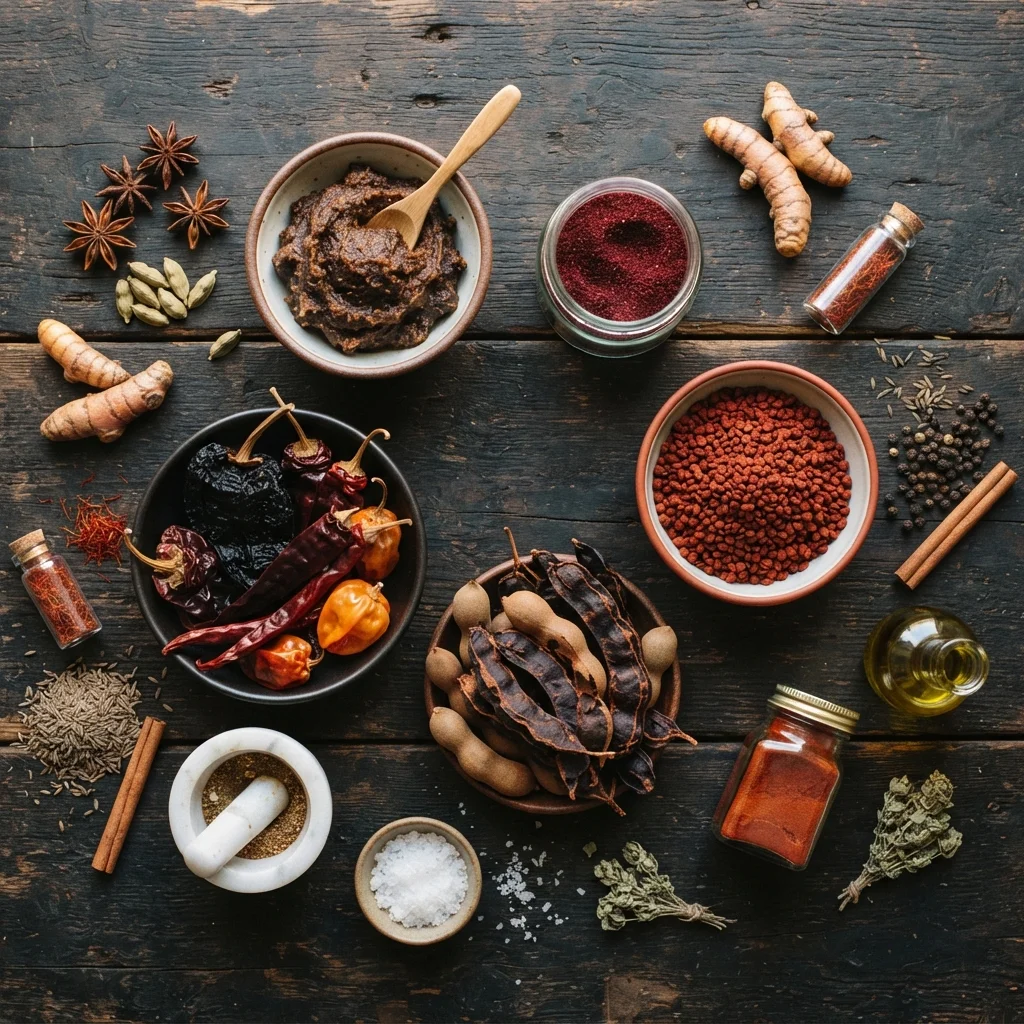
Why a Single Ingredient Can Define a Whole Cuisine
Every cuisine has its anchor - the ingredient that shows up across breakfasts, celebrations, and everyday dinners alike. Remove it, and the food becomes something else entirely. These aren't just flavors; they're cultural shorthand, agricultural heritage, and daily ritual packed into a paste, a powder, or a seed.
The fourteen ingredients below each carry that kind of weight. Some are fermented (and if you're curious why fermentation appears so universally, fermentation's global history is a fascinating rabbit hole). Others are spices whose trade routes reshaped the entire world. Together they form a snapshot of how geography, climate, and ingenuity translate into taste. They're also a reminder that what feels "exotic" to one palate is someone else's most ordinary comfort.
Different cultures also prioritize flavor differently - if you've ever wondered why some cuisines lean sour or bitter where others go sweet, how cultures prioritize taste explores exactly that divergence.
Miso (Japan)
Made from fermented soybeans - often with rice or barley - miso is Japan's deeply savory backbone. Its flavor ranges from mild and sweet (white miso) to earthy and intense (red miso), and it turns up in soups, glazes, marinades, and dressings. Miso production is a slow craft; some varieties ferment for years, developing extraordinary complexity.
Miso's flavor ranges from gently sweet to deeply earthy depending on how long it ferments.
Sumac (Levant and Eastern Mediterranean)
Ground from dried, tart berries, sumac delivers a bright, lemony acidity without any citrus at all. It's sprinkled over hummus, stirred into spice blends like za'atar, and used to season grilled meats and salads across Lebanon, Syria, Jordan, Turkey, and beyond. Sumac does the work of a souring agent in cuisines where lemon is less available or where a drier finish is preferred.
Sumac adds lemony acidity to dishes without a drop of citrus - a clever pantry solution from a dry region.
Annatto (Caribbean and Latin America)
The seeds of the achiote tree give Caribbean and Latin American cooking its warm, earthy color and mild, slightly peppery flavor. Ground into a paste or infused into oil, annatto tints rice dishes, stews, and marinades with a golden-orange hue. It's a vivid reminder that color itself is a dimension of flavor - and cultural identity.
Annatto's golden-orange hue is as culturally distinctive as its subtle, earthy flavor.
Tamarind (South and Southeast Asia, West Africa)
Tamarind's fruity, sweet-sour sourness is irreplaceable in Tamil, Thai, and West African cooking. Used as a concentrate, paste, or whole pod, it brings depth to chutneys, curries, pad thai, and cooling drinks. Unlike vinegar, tamarind's acidity comes layered with fruit sugars and tannins, giving dishes a rounded complexity that's hard to replicate.
Tamarind delivers sweet-sour complexity that no other souring agent can quite replicate.
Doenjang (Korea)
Korea's fermented soybean paste is pungent, funky, and deeply savory - similar in concept to miso but with a rougher, more assertive character. It anchors classic stews like doenjang-jjigae and forms the base of many traditional dipping sauces. Like miso, it represents centuries of fermentation knowledge shaped by the need to preserve food through harsh winters.
Doenjang's bold fermented funk is the backbone of Korean everyday cooking in ways few outsiders realize.
Preserved Lemon (North Africa)
Lemons salt-cured in their own juice for weeks become something fundamentally different: mellow, intensely aromatic, and almost floral. Used sparingly in Moroccan tagines, Tunisian stews, and salads, preserved lemon is a case study in how preservation doesn't just extend shelf life - it creates entirely new flavor dimensions. Only the rind is typically used; the pulp is often discarded.
Salt-curing transforms lemons into something mellow, floral, and deeply aromatic - a preservation miracle.
Fenugreek (South Asia and Ethiopia)
Both the seeds and the leaves of fenugreek are used across Indian and Ethiopian cooking, contributing a slightly bitter, maple-like undertone to spice blends, dal, and injera batters. Fenugreek is one of those quietly pivotal spices - rarely the loudest note, but noticeably absent when it's missing. Ethiopian berbere and Indian panch phoron both rely on it heavily.
Fenugreek's bitter, maple-like note is rarely the loudest flavor - but its absence is immediately obvious.
Fish Sauce (Southeast Asia)
Liquid fermented from salted fish, fish sauce is the umami engine of Thai, Vietnamese, Cambodian, and Filipino kitchens. A few drops deepen curries, noodle broths, and dipping sauces in ways that no other condiment can match. Its salt isn't just salty - it carries a layered savory richness that makes food taste more of itself. Salt's many roles in cooking explores why that distinction matters.
Fish sauce's salt isn't just salty - it carries deep umami that makes everything taste more fully itself.
Dried Ancho Chile (Mexico)
Mexico's chile pantry is vast, but the dried ancho - a ripened, dried poblano - deserves a spotlight. Mild-to-medium in heat, rich in fruity, chocolate-edged flavor, it forms the base of mole sauces, enchilada sauces, and spice rubs. Drying concentrates the chile's sugars and creates a depth fresh peppers simply can't offer.
Drying transforms a poblano into an ancho - concentrating sugars into a rich, chocolate-edged depth.
Ras el Hanout (North and West Africa)
Translated loosely as "top of the shop," ras el hanout is a spice blend - not a single ingredient - but it functions as one flavor identity across Moroccan, Algerian, and Tunisian cooking. Each merchant or family has their own formula; some contain over 30 spices. The result is warm, complex, and faintly floral, central to slow-braised meats and couscous dishes.
Each family's ras el hanout formula is unique - meaning no two kitchens share exactly the same blend.
Ghee (South Asia)
Clarified butter cooked until its milk solids brown and are strained away, ghee has a higher smoke point than regular butter and a rich, nutty flavor. In Indian and Pakistani cooking, it's used for tempering spices, finishing dal, and enriching rice dishes. It also carries deep ritual significance in Hindu culture, used in religious ceremonies alongside its everyday culinary role.
Ghee's nutty richness and high smoke point make it one of South Asia's most versatile cooking fats.
Epazote (Mexico and Central America)
This wild herb - pungent, resinous, and difficult to describe in familiar terms - is added to black beans, tamales, and quesadillas across Mexico and Central America. It's believed to reduce the gas-producing properties of beans, making it practical as well as aromatic. Epazote doesn't translate well to substitution; it's one of those ingredients where the cuisine simply doesn't taste right without it.
Epazote is so distinctive that Mexican black beans rarely taste quite right without it.
Pomegranate Molasses (Levant and Iran)
Reduced pomegranate juice becomes a thick, intensely tart, faintly sweet syrup that defines dishes from fesenjan (Persian walnut and pomegranate stew) to muhammara (Syrian roasted pepper and walnut dip). It's a souring and sweetening agent simultaneously - capable of adding both brightness and depth in a single spoonful.
Pomegranate molasses both sours and sweetens at once - a culinary two-for-one unique to its region.
Dried Shrimp (West Africa, China, Southeast Asia, Brazil)
Tiny, intensely flavored dried shrimp appear across multiple unrelated culinary traditions - a reminder that some flavor instincts are nearly universal. In West African cooking they season stews and soups; in Chinese cuisine they enrich dumplings and congee; in Brazil they define the flavor of acarajé. Their concentrated umami and brininess act as a seasoning layer that salt alone can't provide.
Dried shrimp appearing independently across four continents suggests some flavor instincts are near-universal.
What These Ingredients Have in Common
At first glance, miso paste and annatto seeds don't seem to share much. But look closer and a pattern emerges: each of these ingredients is a concentrated expression of its environment. Fermented staples like miso, doenjang, and preserved lemons reflect climates or traditions that prized longevity. Spices like sumac and fenugreek grew wild or were cultivated along specific trade corridors that still define their culinary reach today. Ancient trade routes moved many of these ingredients far beyond their origins - and permanently rewired regional flavor profiles in the process.
These staples also tend to be versatile within their home cuisine, appearing in savory dishes, sweets, beverages, and ritual foods. That flexibility is partly why they stuck. And when people migrate, these are often the ingredients they carry with them - the culinary seeds of identity. For a closer look at how that plays out, diaspora cooking shows how communities keep these traditions alive and evolving far from home.
Start with one unfamiliar ingredient
Rather than overhauling your pantry at once, try adding a single new ingredient from this list each month. Cook it in a traditional dish first to understand its baseline role, then experiment. Miso stirred into a salad dressing or sumac sprinkled over roasted vegetables are low-effort ways to build genuine familiarity with a new flavor.
Curious about the breads that pair with so many of these ingredients? Flatbreads of the world traces another thread of global culinary identity - one that touches nearly every cuisine on this list.
The content on this site is for informational purposes only and is not a substitute for professional advice. Always consult a qualified professional for guidance specific to your situation.