

Why Food Travels With People
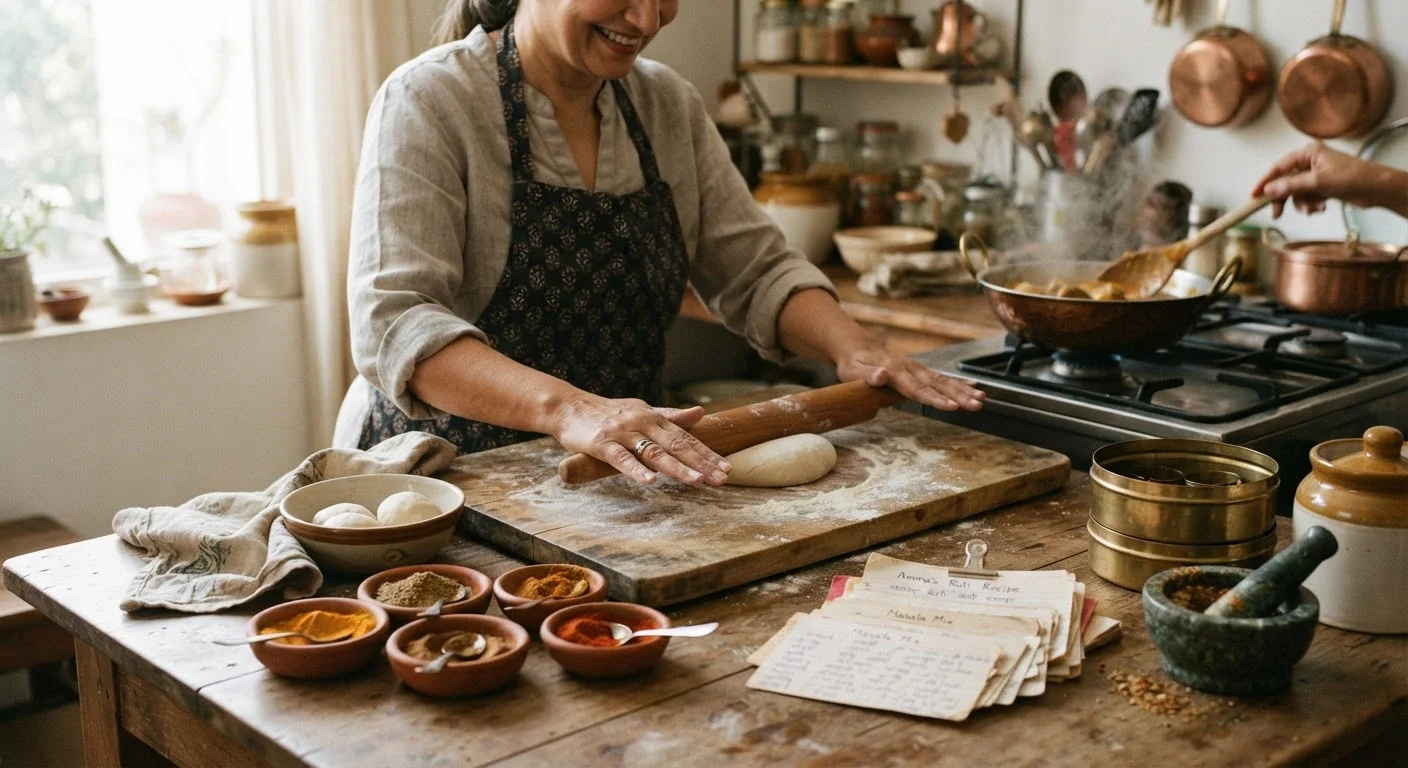
When people migrate - whether by choice, necessity, or force - they rarely leave their food culture behind. Recipes travel in memory, in handwritten notebooks, in the hands of grandmothers teaching grandchildren before departure. A pot of adobo, a batch of injera, a pan of börek: these dishes carry the weight of home in a way that almost nothing else can.
Food functions as one of the most immediate and sensory expressions of cultural identity. It connects people to place, family, and belonging - which is exactly why diaspora communities put so much effort into maintaining it, even across continents and generations. As the communal dimensions of food suggest, eating together is never just about nutrition. It's about who you are and where you come from.
Diaspora cooking is the living evidence of that relationship - and it's far more dynamic than simple preservation.
The Substitution Problem - and Its Creative Solutions
One of the first challenges any migrant cook faces is the ingredient gap. The specific chile variety, the particular fermented paste, the regional grain - these things aren't always available in a new country. What happens next is where diaspora cooking gets genuinely interesting.
Cooks adapt. They find what's close. They experiment. Sometimes a local ingredient performs a similar function; sometimes it introduces an entirely new flavour note that gradually becomes part of the dish's identity in its new home. Over generations, these substitutions can solidify into tradition in their own right.
This is why single ingredients can carry so much cultural meaning - and why their absence in a new place demands such creative problem-solving. The substitution is never just practical; it's a negotiation between memory and reality.
Preservation, Drift, and the Question of Authenticity
Here's something that surprises many people: diaspora communities sometimes preserve older, more traditional forms of a cuisine than the homeland itself does. Cuisines at their source keep evolving - shaped by politics, economics, globalisation, and changing tastes. A diaspora community, insulated somewhat from those forces and motivated by nostalgia, can end up as custodians of a culinary moment that has passed in the original country.
Italian-American cooking is a well-cited example. The hearty tomato-based dishes associated with Italian-American communities reflect the peasant cooking of southern Italy in the early 20th century - food that contemporary Italy has largely moved away from. Neither version is more "correct"; they're both authentic expressions of different moments and circumstances.
“Food is never just food. It is history, memory, identity, and belonging compressed into something edible. When you taste diaspora cooking, you are tasting the negotiation between two worlds.”
— Krishnendu Ray, Food studies scholar and author of 'The Ethnic Restaurateur'
This raises a useful question: what does "authentic" even mean in food? Most food historians argue that all cuisines are in constant motion, shaped by trade, migration, and exchange. The history of pasta and noodles alone shows how tangled culinary origins really are. Diaspora cooking is just one particularly visible chapter in that ongoing story.
How Diaspora Food Shapes the Mainstream
The influence of immigrant food cultures on mainstream cuisine is enormous - and often underacknowledged. Many dishes that feel thoroughly "local" in a given country arrived via diaspora communities that built demand, opened restaurants, and gradually introduced flavours to a wider audience.
Indian and South Asian cuisines fundamentally reshaped British food culture over the latter half of the 20th century. Turkish, Lebanese, and Vietnamese communities transformed the street food scenes of European and Australian cities. In the United States, the layered story of Tex-Mex, soul food, and Chinese-American cooking reflects how immigrant culinary traditions become absorbed, adapted, and beloved on a massive scale.
For curious eaters, understanding this history adds depth to any meal. If you're exploring an unfamiliar cuisine for the first time, knowing how to orient yourself can make the experience richer and more respectful. Diaspora-run restaurants are often the best place to start - they frequently offer the most layered, context-rich version of a cuisine you'll find outside the homeland.
The way a culture's soups and broths evolve across borders is a perfect example of how diaspora cooking quietly rewrites culinary history from the ground up, one bowl at a time.
Frequently Asked Questions
Diaspora cooking grows from lived necessity and cultural continuity - it happens organically as people recreate home in a new place. Fusion cuisine, by contrast, is typically a deliberate culinary strategy by chefs combining elements from different traditions. Diaspora cooking often becomes fusion over time, but the motivation is preservation, not experimentation.
Yes, and this is well-documented. Diasporic communities sometimes preserve older recipes and traditions that have since modernised or disappeared in the homeland. Italian-American red-sauce cooking, for instance, reflects mid-20th-century southern Italian peasant food that contemporary Italy has largely moved on from.
Communities typically develop informal and formal supply networks - specialty grocery stores, community markets, and imports from trusted suppliers. When an ingredient is truly unavailable, cooks adapt by finding local substitutes that approximate the flavour, texture, or function of the original.
Profoundly. Many dishes now considered mainstream in a given country arrived via diaspora communities. Indian curries in the UK, Tex-Mex in the American Southwest, and Turkish döner in Germany all began as immigrant community foods before entering the broader culinary mainstream.
Authenticity in food is complex and often contested. Diaspora cooks sometimes face criticism from both sides - accused of diluting traditions by host-country observers, or of "getting it wrong" by people from the homeland. Most food scholars argue that all living cuisines evolve, and adaptation is a mark of vitality, not inauthenticity.
It varies widely. Some second- and third-generation descendants actively reclaim culinary heritage as a form of identity. Others feel disconnected from foods they didn't grow up eating regularly. Many land somewhere in between - cooking a handful of cherished family dishes while otherwise eating the food of the country they grew up in.
The content on this site is for informational purposes only and is not a substitute for professional advice. Always consult a qualified professional for guidance specific to your situation.