

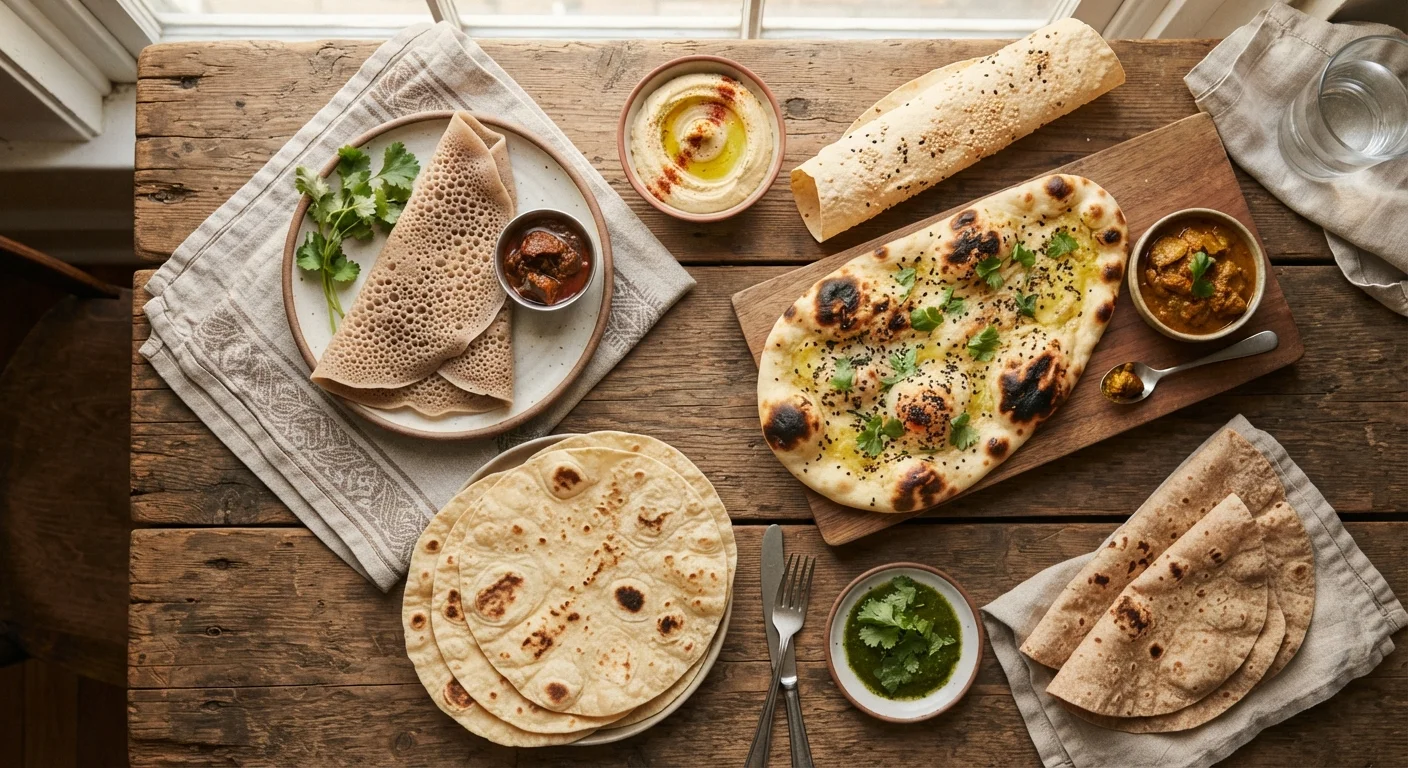
The Simplest Bread Is Also the Most Universal
Before ovens, before leavening, before virtually any other baking technique, humans were pressing dough flat and cooking it over heat. Flatbreads are arguably the oldest prepared food category still eaten in their original form today. Grain, water, heat - that's the core formula. What varies, endlessly, is everything else: the grain, the hydration, the cooking surface, the fermentation, the thickness, the fold.
Every major civilization independently arrived at some version of a flatbread. That convergence isn't coincidence - it reflects practical ingenuity. Flatbreads cook quickly, need minimal equipment, travel well, and function as edible vessels for other foods. They're simultaneously utensil, plate, and sustenance.
If you're curious about how these traditions look on a restaurant menu, our guide to reading an unfamiliar menu is a useful companion to this one.
| Oldest known flatbread evidence | Roughly 14,000 years ago (Natufian culture, Jordan) (Archaeological findings published in scientific literature on prehistoric food) |
| Injera fermentation time | 2-5 days (Traditional Ethiopian and Eritrean preparation practice) |
| UNESCO-recognized flatbread | Armenian lavash (inscribed 2014) (UNESCO Intangible Cultural Heritage list) |
| Primary grain - tortilla | Nixtamalized corn (maize) (Mesoamerican culinary tradition, pre-dating European contact) |
| Primary grain - injera | Teff (Eragrostis tef) (Native to the Horn of Africa) |
| Common cooking surfaces | Tawa, comal, tandoor, open flame, hot stone |
A Region-by-Region Look at Key Flatbreads
The diversity within flatbreads is staggering. Here's a tour of some of the most culturally significant varieties and what makes each one distinct.
South Asia: Roti, Chapati, and Paratha
Across India, Pakistan, Bangladesh, and neighboring countries, whole-wheat flatbreads cooked on a dry tawa (griddle) are daily staples. Roti and chapati are often used interchangeably - both are unleavened, thin, and cooked quickly over high heat. Paratha adds fat folded into layers, producing a richer, flakier result. The technique of folding separates these from their plainer cousins and links to the same logic as pastry-making.
East Africa: Injera
Injera, the spongy sourdough flatbread of Ethiopia and Eritrea, is in a category of its own. Made from teff flour - a tiny, nutrient-dense grain native to the Horn of Africa - injera is fermented for several days before cooking. The result is a tangy, porous bread that functions as both plate and utensil. Dishes are served directly on it, and diners tear pieces to scoop up stews and salads. Its fermentation process connects it to a long human tradition - one explored in depth in our piece on fermentation across cultures.
The Levant and Caucasus: Lavash and Pita
Lavash is a paper-thin flatbread with roots across Armenia, Iran, Turkey, and Georgia. Traditionally baked on the inner walls of a clay oven (tonir or tandoor), it emerges crisp and slightly blistered, then softens as it cools. UNESCO has recognized Armenian lavash as an Intangible Cultural Heritage. Pita, common across the Eastern Mediterranean and Middle East, uses a touch of yeast and high heat to puff dramatically, creating a hollow interior - a pocket that has made it globally recognizable.
Mesoamerica: The Tortilla
The corn tortilla is the product of nixtamalization - an ancient Mesoamerican process of soaking maize in an alkaline solution that unlocks nutrients and transforms texture. The resulting masa (dough) is pressed thin and cooked on a dry comal. Wheat flour tortillas, common in northern Mexico, arrived later with Spanish colonization. Both remain central to Mexican and broader Latin American food culture.
Scandinavia and Central Asia: Lefse and Flatbrød
Flatbreads aren't confined to warm climates. Norwegian lefse, made with potato and flour, and flatbrød, a crisp rye cracker-like bread, reflect how flatbread logic adapts to cold-climate staples. Central Asian lavash variants and Uzbek non (a thicker, leavened sesame-topped round) show that the tradition runs as far as the steppe.
What Flatbreads Reveal About Food Culture
Looking at flatbreads together reveals patterns that transcend geography. Wherever people had access to a starchy grain - wheat, corn, teff, rye, potato - they found ways to flatten and cook it efficiently. The cooking surface (clay oven, iron griddle, open flame, hot stone) shaped the final texture as much as the dough itself.
Flatbreads also carry social meaning. In many cultures, making bread - particularly the labor-intensive kind - is a communal act tied to hospitality, celebration, or daily family ritual. When people carry those practices into new countries, the bread travels with them. Diaspora communities often preserve flatbread traditions long after other culinary practices have shifted, because these breads sit at the heart of cultural identity.
For travelers, flatbreads are often the most affordable, most authentic entry point into a cuisine. A market stall selling fresh chapati or a street vendor pressing tortillas offers more cultural context - and usually better flavor - than a tourist-oriented restaurant. Our article on eating well abroad without overspending explores exactly this kind of approach.
Understanding the grain behind a flatbread, how it's cooked, and what role it plays at the table is also a window into the ingredients that define entire cuisines. Teff in injera, nixtamalized corn in tortillas, and whole-wheat atta in roti aren't interchangeable - each carries distinct flavor, nutrition, and history.
Nixtamalization
An ancient Mesoamerican technique of soaking and cooking maize in an alkaline solution (typically limewater). The process improves nutritional availability, changes the flavor, and creates the distinctive masa dough used in tortillas and tamales.
Teff
A tiny, ancient grain native to the Horn of Africa, particularly Ethiopia and Eritrea. It is the primary grain in injera and is naturally gluten-free, with a mildly earthy, slightly sour flavor.
Tawa
A flat or slightly concave griddle used widely in South Asian cooking, typically made of cast iron or carbon steel. It's the standard surface for cooking roti, chapati, and paratha.
Tandoor / Tonir
A cylindrical clay oven used across South Asia and the Caucasus for high-heat baking. Flatbreads like lavash and naan are often pressed against the inner walls and cooked by radiant heat.
Masa
Dough made from nixtamalized corn, used as the base for corn tortillas, tamales, and other Mesoamerican foods. Its texture and flavor are quite different from non-nixtamalized cornmeal.
Leavening
Any process or ingredient that causes dough to rise by introducing gas bubbles - whether yeast, baking powder, baking soda, or fermentation. Many flatbreads are 'unleavened,' meaning they use none of these.
The content on this site is for informational purposes only and is not a substitute for professional advice. Always consult a qualified professional for guidance specific to your situation.