

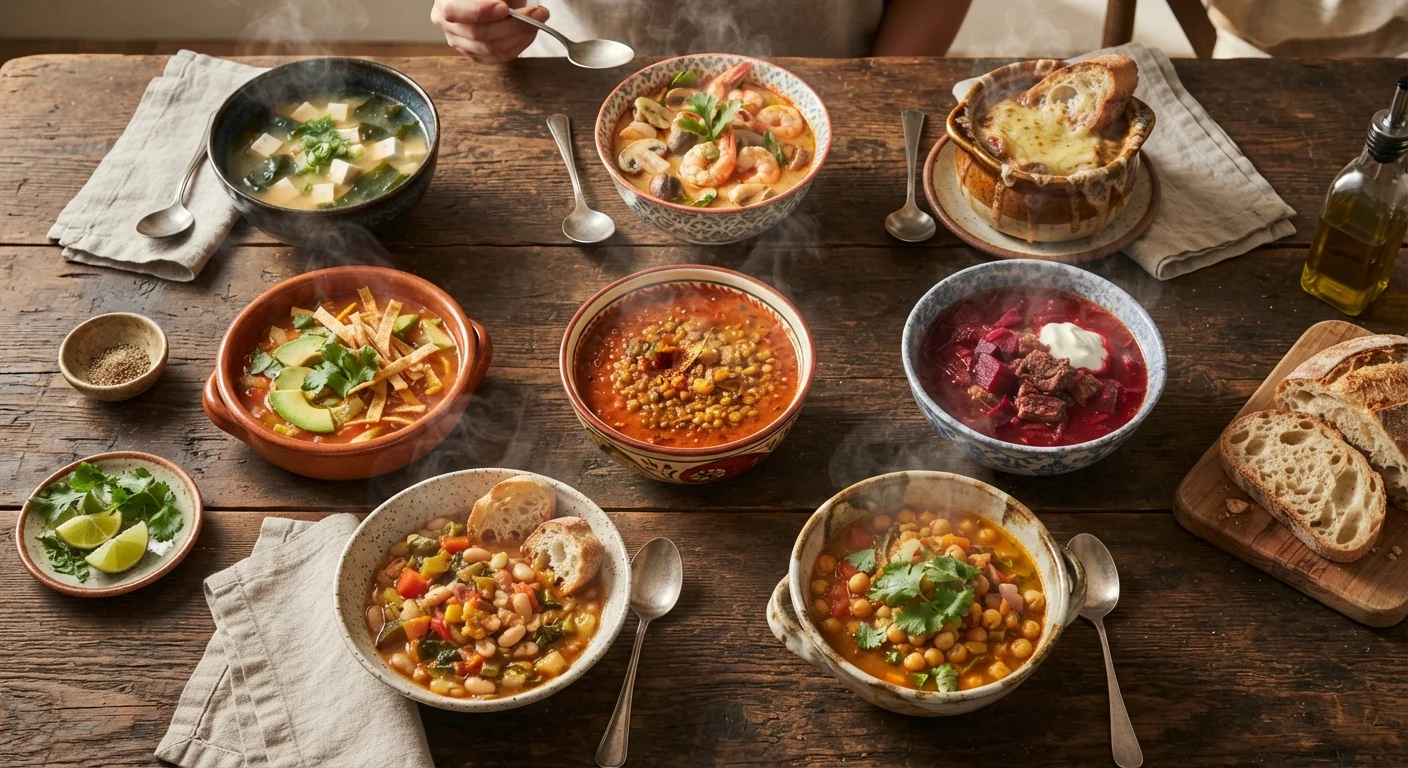
Why Soup Might Be the Most Honest Food
Every cuisine has its showstoppers - the festive roasts, the elaborate pastries, the plated restaurant dishes designed to impress. But soup is different. Soup is what a culture makes when no one is performing. It's the food of early mornings, slow Sundays, illness, celebration, and grief. It simmers at the edge of every food tradition, quiet but revealing.
Across history, soup has been shaped by necessity as much as preference. What grows nearby, what animals were raised, what spices traveled along ancient trade routes - all of it ends up in the pot. In that sense, a nation's broth is almost like an edible autobiography. It tells you about the land, the climate, the economy, and the relationships people form around a shared table.
This is what makes exploring global soups so rewarding. You're not just learning recipes - you're reading culture. For a deeper look at how single ingredients carry entire cultural stories, see The Global Pantry. Below are seven soups from around the world, and what they quietly say about the societies that made them.
Vietnamese Pho - Patience as a Cultural Value
Pho broth is built over many hours - sometimes an entire day - from bones charred with ginger and onion, layered with star anise, cinnamon, and cloves. The result is delicate but deeply complex. In Vietnam, that slow investment of time is not incidental; it reflects a broader cultural reverence for technique and patience over shortcuts.
Pho is also a study in individual expression within communal tradition. The broth arrives standardized; the table fills with herbs, bean sprouts, lime, and chili, and each diner customizes their bowl. It's a neat metaphor for how Vietnamese food culture balances collective identity with personal preference.
Pho's long-simmered broth turns patience itself into an ingredient.
Georgian Kharcho - Hospitality as a Duty
In Georgia, a country at the crossroads of Europe and Asia, soup is inseparable from the tradition of supra - the elaborate feast presided over by a toastmaster. Kharcho, a rich walnut-and-tomato soup spiced with fenugreek and dried plums, exemplifies Georgian hospitality: generous, layered with complexity, and always offered without reservation.
The use of walnuts in kharcho also signals Georgia's geography - the country is one of the world's oldest walnut-cultivating regions. The soup is essentially the land speaking through the pot, as much a product of terroir as any wine.
Kharcho doesn't just feed guests - it enacts the Georgian duty of generosity.
Japanese Miso Soup - Minimalism and Mindfulness
Miso soup appears deceptively simple: a few ingredients dissolved in dashi, served in a lacquered bowl. But simplicity here is not laziness - it's philosophy. Japanese culinary tradition values restraint, seasonality, and the quality of individual ingredients over complexity. Miso soup is its daily embodiment.
It's also a deeply ritualized food. In many Japanese households, miso soup anchors every morning meal, providing both nutrition and routine. That consistency - the same warmth, the same quiet comfort - reflects a cultural understanding of food as grounding rather than entertainment. For a closer look at miso as a defining ingredient, The Global Pantry covers it alongside other culturally essential staples.
Miso soup is restraint made edible - a daily ritual of calm and intention.
Nigerian Egusi Soup - Resourcefulness and Richness
Egusi soup - made from ground melon seeds, leafy greens, palm oil, and meat or fish - challenges Western assumptions about what soup looks like. It's thick, boldly flavored, and often built from a combination of proteins that reflect both resourcefulness and a deep commitment to richness of flavor.
In Nigerian food culture, egusi is celebratory and everyday at once. It's served at funerals and weddings, weekday dinners and holiday tables. That flexibility speaks to the centrality of communal eating in Yoruba, Igbo, and many other Nigerian cultural traditions - food as a thread running through every significant moment of life.
Egusi's bold depth of flavor reflects a culture that sees no occasion too small to cook seriously.
Peruvian Caldo de Gallina - Healing as Community
Peru's caldo de gallina - literally "hen broth" - is the country's answer to what many cultures call "sick soup." Made from a whole stewing hen rather than a young chicken, it produces a richer, more gelatinous broth, served with egg noodles, hard-boiled eggs, and ají amarillo chili. The use of an older bird is telling: it's a soup that values depth over speed, built for restoration.
Caldo de gallina is also deeply tied to the idea of care as an act performed by community, not just individuals. In Peru, it's the soup a neighbor brings, a grandmother prepares. The broth itself is almost secondary to what the act of making and sharing it communicates.
Caldo de gallina says that healing is something you do together, not alone.
French Pot-au-Feu - Frugality Elevated to Art
Pot-au-feu - "pot on the fire" - is one of France's oldest dishes, a long-simmered beef and vegetable broth that speaks to a distinctly French capacity for turning humble ingredients into something refined. Tough cuts of beef, marrow bones, turnips, leeks, and carrots become, over hours of cooking, something elegant enough to anchor a formal dinner.
The dish also reveals a practical cleverness: the broth becomes a first course, the meat and vegetables a second. Nothing is wasted. This thriftiness dressed in sophistication is a recurring motif in French food culture - and a reminder that haute cuisine often has very peasant roots.
Pot-au-feu transforms economy into elegance - French pragmatism at its most delicious.
Turkish Mercimek Çorbası - Democracy in a Bowl
Red lentil soup is arguably Turkey's most democratic dish. It appears in roadside lokantalar (canteens), high-end Istanbul restaurants, school cafeterias, and home kitchens in equal measure. Spiced simply with cumin and paprika, finished with a swirl of butter and dried mint, it costs almost nothing to make and requires few specialized ingredients.
That universality matters. In Turkey, mercimek çorbası crosses class, geography, and generation in a way few other foods manage. It's the soup everyone knows, the soup that tastes like someone's kitchen regardless of which kitchen you're in. Street Food vs. Restaurant Culture explores how that kind of culinary democracy plays out across food settings globally.
Mercimek çorbası is Turkey's great social equalizer - eaten everywhere, by everyone.
What the Bowl Leaves Behind
Soup crosses virtually every cultural boundary - but it never crosses them the same way twice. The broths above share a basic form: liquid, heat, nourishment. What differs is everything else: the ingredients chosen, the time invested, the rituals surrounding the act of eating. That variation is the whole point.
Food scholars often note that communal meals carry meaning far beyond nutrition - something explored thoughtfully in Why Sharing Food Is Never Just About Hunger. Soup, perhaps more than any other dish, embodies that principle. It's rarely eaten in a hurry or in isolation. It invites people to slow down, sit together, and - whether they realize it or not - participate in something much older than the recipe itself.
And as cultures move and mix, soups travel too, picking up new ingredients and adapting to new kitchens. Diaspora Cooking explores exactly how that process of preservation and reinvention works. The next time you order a bowl somewhere unfamiliar, it's worth pausing before the first spoonful - you might be holding an entire culture's history in your hands.
Try Making Broth from Scratch
If you're curious about any of the soups above, starting with a homemade broth is the most direct way to understand what makes each tradition distinct. The difference between a slow-simmered stock and a quick base is significant - not just in flavor, but in what the process teaches you about the dish. Stock, Broth, and Bone Broth: A Practical Comparison breaks down the key differences in a practical, no-jargon way.
The content on this site is for informational purposes only and is not a substitute for professional advice. Always consult a qualified professional for guidance specific to your situation.