

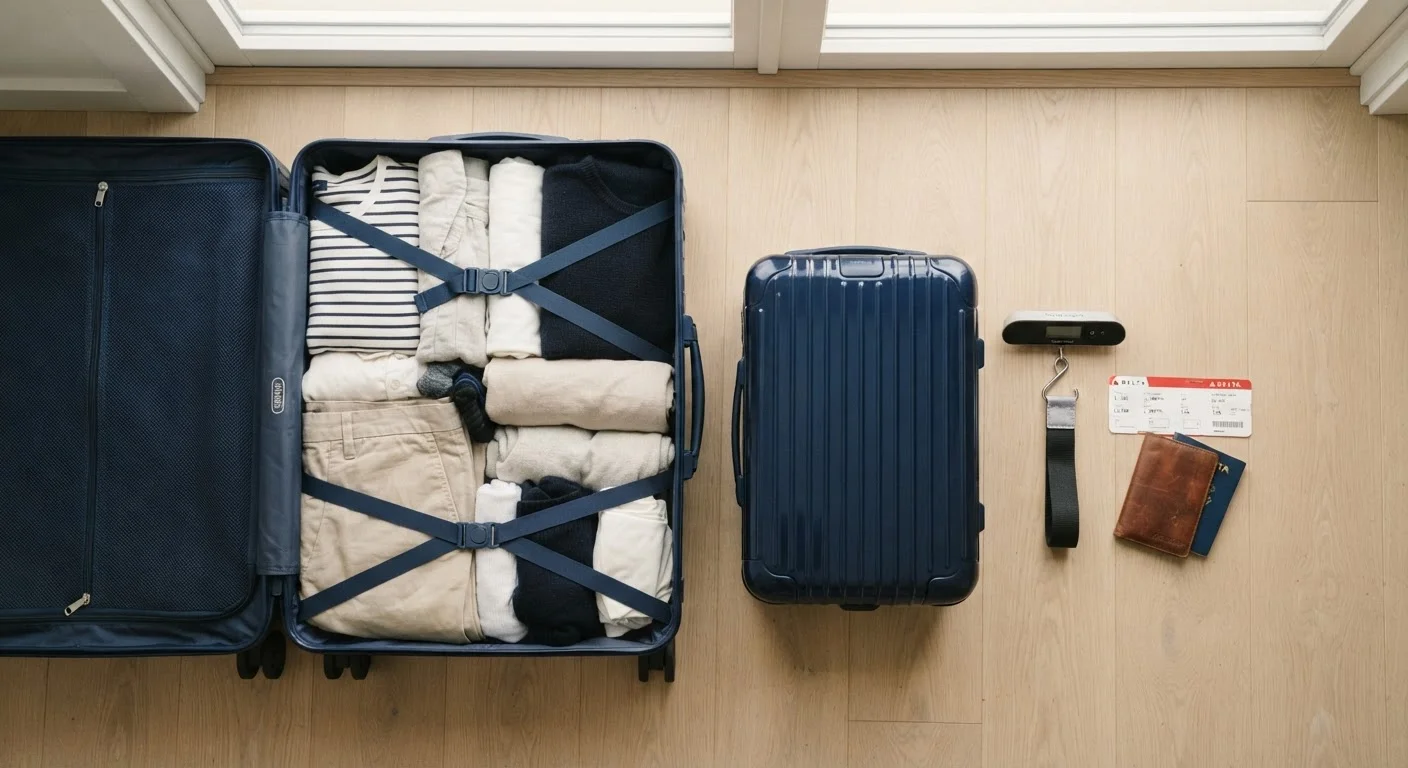
The Basic Framework: Carry-On, Personal Item, and Checked Bag
Most US airline tickets allow some combination of three bag types: a personal item, a carry-on bag, and one or more checked bags. What's included - and what costs extra - depends heavily on your fare class and carrier.
A personal item is almost universally included at no extra charge. It must fit under the seat in front of you, and common examples include a small backpack, tote, or laptop bag. A carry-on bag goes in the overhead bin and faces stricter size enforcement, particularly on smaller regional aircraft where bins fill quickly.
Checked baggage is where fees get significant. On most US domestic flights, the first checked bag runs roughly $30-$40 each way, with the second bag costing more. International routes - especially long-haul economy - may include one or two checked bags, but this depends entirely on the airline and route.
If you're weighing whether to check a bag at all, our comparison of checked luggage versus carry-on options walks through the real tradeoffs by trip type.
| Typical carry-on size limit (US domestic) | 22 x 14 x 9 in (56 x 36 x 23 cm) (Common across major US carriers; verify with your specific airline.) |
| Standard checked bag weight limit | 50 lbs (23 kg) (Applies to most US domestic and international economy fares.) |
| Typical first checked bag fee (US domestic) | $30-$40 one way (Varies by carrier and fare class; frequent flyer status may waive fees.) |
| Overweight surcharge threshold | 51-70 lbs: ~$100; 71-100 lbs: ~$200 (General range; exact amounts differ by airline and route.) |
| Personal item size limit (common guideline) | 18 x 14 x 8 in (45 x 36 x 20 cm) (Policies vary widely; always check your carrier's published limit.) |
| International checked bag limit (long-haul economy) | 1-2 bags, 50 lbs (23 kg) each (Depends on airline, route, and fare class.) |
Size and Weight Limits: The Numbers That Matter
Dimension limits for carry-on bags cluster around 22 x 14 x 9 inches for major US carriers, but budget carriers and international airlines can be tighter - sometimes as small as 18 x 14 x 8 inches. Critically, that measurement usually includes wheels and handles, not just the bag shell. If your roller bag is borderline, measure it fully packed.
Checked bags have a standard weight limit of 50 lbs (23 kg) on most economy fares. Exceeding this triggers overweight fees that escalate steeply: most carriers charge roughly $100 for bags between 51-70 lbs, and $200 or more above 70 lbs. A basic luggage scale - used at home before you leave - eliminates this risk entirely.
Size also matters for checked bags. Most carriers cap the total linear dimensions (length + width + height) at 62 inches (158 cm). Oversized bags incur separate fees on top of overweight charges, so large sporting equipment or bulky items often require advance coordination with the airline.
For passengers who want to eliminate checked bags entirely, our guide to the one-bag carry-on approach outlines what that commitment actually involves.
How Fare Class and Status Change the Rules
The single biggest variable in baggage policy isn't the airline - it's the fare you booked. Basic Economy tickets on major US carriers frequently restrict carry-on bags to a personal item only, or charge separately for overhead bin access. Reading the fare rules before purchase is essential, not optional.
Conversely, premium fare classes (Business, First) typically include two checked bags, higher weight limits (often 70 lbs), and no carry-on restrictions. Frequent flyer status - even mid-tier - commonly waives the first or second checked bag fee, which can represent meaningful savings on a round trip.
Airline co-branded credit cards sometimes include a free checked bag benefit for the cardholder and companions on the same reservation. This is a bundled card benefit, not something this guide can recommend - but it's worth factoring into your total trip cost if you already hold such a card.
Baggage fees add up faster than most travelers expect. For a fuller picture of how to account for these costs upfront, see our reference on building a realistic travel budget.
Always Verify Directly with Your Airline
Baggage policies change frequently and can differ by route, aircraft type, codeshare partner, and even the booking channel you used. The figures in this guide reflect common industry standards, not guarantees. Before you travel, check your specific carrier's baggage policy page and review your booking confirmation for the exact terms that apply to your ticket.
Common Edge Cases: Liquids, Special Items, and Codeshares
A few scenarios consistently catch travelers off guard:
- Liquids in carry-ons: The 100ml / 3.4 oz rule applies to liquids, gels, and aerosols in carry-on bags regardless of container size. Our explainer on what carry-on liquid restrictions actually mean covers the full detail.
- Sports equipment and musical instruments: Bikes, skis, golf clubs, and musical instruments each have carrier-specific rules. Most require advance notice, specific packaging, and often a flat fee separate from standard baggage charges. Check your airline's sports equipment policy before assuming a standard checked bag applies.
- Codeshare and partner flights: When your itinerary includes a segment operated by a partner airline, the baggage rules of the operating carrier - not the one you booked through - may apply on that leg. This can produce unexpected restrictions or fees mid-journey.
- International connections: Baggage rules can reset at the point of connection, particularly when crossing between domestic and international segments. Always confirm allowances for each leg separately.
When in doubt, verify directly with each operating carrier before you pack - not just at check-in.
Carry-on bag
A bag small enough to fit in the overhead bin or under the seat in front of you. Most carriers enforce specific dimension limits, typically around 22 x 14 x 9 inches, though this varies.
Personal item
A second, smaller bag - such as a purse, laptop bag, or small backpack - that must fit under the seat in front of you. Nearly all airlines allow this in addition to a carry-on.
Checked baggage
Luggage handed over at check-in and stored in the aircraft hold. Subject to weight limits (commonly 50 lbs / 23 kg per bag on US domestic routes) and often incurs a per-bag fee.
Overweight fee
A surcharge applied when a checked bag exceeds the carrier's weight limit. Fees typically increase sharply above 70 lbs / 32 kg, often reaching $100-$200 per bag.
Basic Economy
A restricted fare class common on US carriers that often excludes a full-size carry-on or checked bag, or charges separately for either. Terms vary significantly by airline.
Fare class
A booking tier (e.g., Basic Economy, Main Cabin, Business) that determines which services - including baggage - are bundled into the ticket price.
The content on this site is for informational purposes only and is not a substitute for professional advice. Always consult a qualified professional for guidance specific to your situation.