

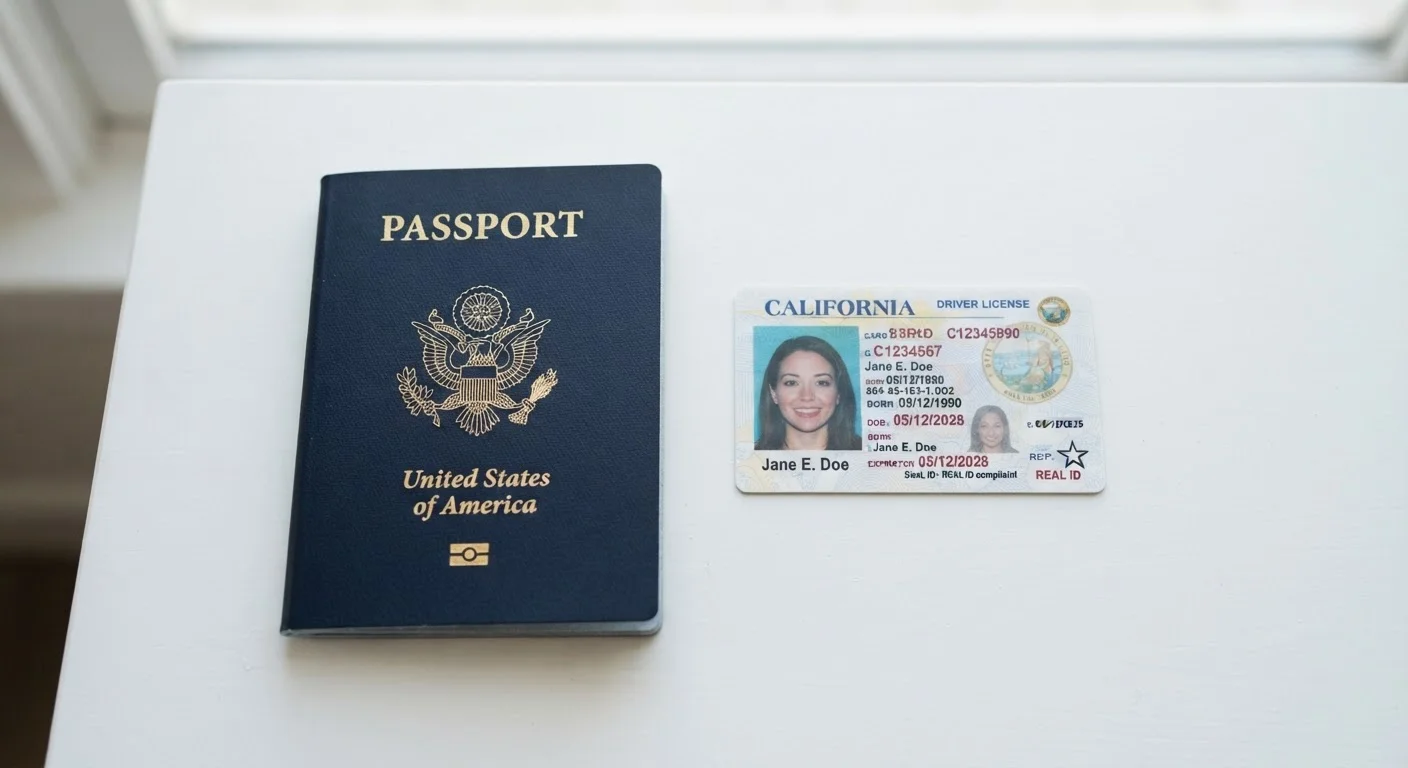
Option A
REAL ID
The domestic-ready, wallet-friendly option.
Best for: Americans who fly primarily within the U.S. and need a compliant, convenient form of federal identification.
Option B
U.S. Passport
The universal key for international travel.
Best for: Travelers heading abroad, or anyone who wants a single document that covers both domestic and international needs.
What Is a REAL ID — and What Does It Actually Do?
REAL ID is a federal compliance standard established by the REAL ID Act of 2005. It sets minimum security requirements for state-issued driver's licenses and ID cards. A REAL ID-compliant card displays a gold or black star in the upper corner — that star signals it meets federal standards.
Starting May 7, 2025, the Transportation Security Administration (TSA) requires a REAL ID-compliant document — or another accepted federal ID — to board domestic commercial flights. Without one, you may face additional screening or be denied boarding. REAL ID is also accepted for access to certain federal facilities and military bases.
To get a REAL ID, visit your state's Department of Motor Vehicles (DMV) with proof of identity, Social Security number, and two documents showing your state address. The process and fees vary by state, but it typically costs under $40 and is renewed on your regular license cycle.
What REAL ID cannot do: It is not valid for international travel. You cannot use it to cross into Canada, Mexico, or any other country.
What a U.S. Passport Covers — and Why It's More Flexible
A U.S. passport is issued by the federal government and serves as both an international travel document and proof of U.S. citizenship. It comes in two forms: a passport book (required for international air travel) and a passport card (valid only for land and sea crossings to Canada, Mexico, the Caribbean, and Bermuda).
Crucially, a U.S. passport book is also accepted by TSA as a valid form of ID for domestic flights — so it doubles as a REAL ID alternative. If you already have a valid passport, you do not need a separate REAL ID to fly domestically.
Passport applications are handled through the U.S. Department of State. First-time adult applicants typically pay around $130–$165 in fees (application plus execution fee), and routine processing currently takes several weeks. Expedited processing is available for an additional fee. Learn about passport validity rules and renewal timelines before you book any international trip — many destinations require six or more months of remaining validity.
| Criterion | REAL ID | U.S. Passport (Book) |
|---|---|---|
| Domestic flights | Yes — TSA accepted | Yes — TSA accepted |
| International air travel | No | Yes — required |
| Land/sea border crossings | No | Yes |
| Proof of U.S. citizenship | No | Yes |
| Typical cost | Under $40 (varies by state) | ~$130–$165 (first-time adult) |
| Issuing authority | State DMV | U.S. Department of State |
| Validity period | Tied to driver's license cycle | 10 years (adults) |
| Processing time | Same day at DMV | Several weeks (routine) |
When You Need One, the Other, or Both
The short answer: your travel destination determines which document you need.
- Domestic flights (U.S. only): REAL ID or passport both work. Either satisfies TSA.
- International flights: Passport book only. REAL ID is not accepted at foreign borders or by international airlines for entry purposes.
- Land or sea crossings to neighboring countries: A passport card or book works. REAL ID does not.
- Federal buildings and military bases: REAL ID is accepted; a passport also works.
If your travel plans ever expand beyond the U.S. — even for a cruise that stops in the Bahamas or a road trip into Canada — you'll need a passport. For that reason, many travel experts suggest obtaining a passport even if you only travel domestically today. Understanding entry requirements before you travel is always a smart first step, because rules vary by destination and can change with little notice.
Passport Card vs. Passport Book: Know the Difference
A passport card is a wallet-sized alternative to the passport book, but it has significant limitations. It is only valid for land and sea border crossings between the U.S., Canada, Mexico, the Caribbean, and Bermuda — not for international flights. If you plan to fly internationally, you must have a passport book. The card can be a useful and affordable complement, but it should not replace the book for air travelers.
If you do travel internationally, knowing what additional paperwork to carry is just as important as the passport itself. See our guide to travel documents every American should carry abroad for a full breakdown.
Practical Tips for Managing Both Documents
Many travelers find it useful to carry both a REAL ID and a passport when going abroad. Here's why: if your passport is lost or stolen internationally, your REAL ID won't get you home by itself — but it can serve as a secondary proof of identity when working with the U.S. Embassy to get an emergency replacement.
At home, keeping your REAL ID as your everyday wallet ID and your passport stored securely (but accessibly) means you're not risking passport wear-and-tear on daily errands.
Whether you store digital scans or rely on physical copies, having backups of both documents matters. Weigh the trade-offs of digital vs. physical document copies so you have a plan before you need one.
56%
Americans holding a valid passport
According to U.S. State Department data, roughly half of Americans currently hold a valid passport, leaving many without the option for international travel.
May 7, 2025
REAL ID enforcement deadline for domestic flights
The TSA confirmed this date as the federal deadline after which non-compliant IDs will no longer be accepted at airport security checkpoints.
Finally, don't overlook the passport card as a low-cost complement to your passport book if you frequently cross into Mexico or Canada by land. At around $65 for a first-time adult applicant (or $35 if you already have a book), it fits in your wallet and simplifies routine border crossings without risking your full passport book.
The content on this site is for informational purposes only and is not a substitute for professional advice. Always consult a qualified professional for guidance specific to your situation.