

Our Verdict
For most domestic and short international trips, a carry-on-only approach delivers real savings in money, time, and stress. The upfront discipline of packing smarter pays off almost immediately — often covering the cost of a meal or activity at your destination. However, it isn't a universal fit: longer trips, formal occasions, or travel with young children may legitimately require more space.
Carry-on-only packing is ideal for solo travelers, couples, and frequent flyers taking trips of one to two weeks who want to reduce fees, move faster through airports, and simplify their travel experience.
The Real Cost of Checked Baggage
Baggage fees are one of the most predictable — and most overlooked — travel expenses. Many major U.S. airlines charge $35 or more for a first checked bag each way on domestic flights, meaning a round trip can cost $70 per bag before you've even left the terminal. For a family of four, that figure can exceed $280 on a single trip.
These fees aren't static, either. Some carriers charge more for heavier bags or additional bags, and international itineraries often carry their own fee schedules. Over the course of several trips a year, the cumulative spend on checked luggage can be substantial — money that could fund an extra night at your destination or cover a day of activities.
For a fuller picture of how pre-trip decisions quietly drain travel budgets, see overlooked ways travelers blow their budget before leaving home. Baggage fees are almost always on that list.
$7.0B+
U.S. airline baggage fee revenue in a recent year
U.S. Department of Transportation data shows domestic carriers collectively collect billions annually in checked baggage fees, underscoring how routine the charge has become.
20–40 min
Average baggage claim wait time
Industry estimates suggest passengers wait between 20 and 40 minutes at baggage claim after landing, time that carry-on-only travelers reclaim entirely.
Advantages of Going Carry-On Only
The financial case is compelling, but carry-on-only travel offers a range of benefits that go beyond dollars saved.
Eliminates checked baggage fees entirely
On a round-trip domestic flight with a $35-per-bag fee each way, one traveler saves $70 per trip — savings that compound quickly for frequent flyers or families.
Bypasses baggage claim wait times
Deplaning and walking straight to ground transportation instead of waiting 20–40 minutes at the carousel can meaningfully reshape the start and end of any trip.
Eliminates the risk of lost or delayed luggage
Airlines mishandle millions of bags each year. A carry-on that stays with you in the cabin faces none of that risk, which matters especially on tight connections or international arrivals.
Greater mobility during the trip itself
A single manageable bag makes navigating transit systems, stairs, cobblestone streets, and smaller accommodations significantly easier — especially in cities without elevators.
Faster check-in and security process
Without a bag to drop, many travelers can check in via app and proceed directly to security, trimming the overall airport experience by 20 minutes or more.
Encourages intentional, lighter packing habits
The discipline of fitting a trip into a carry-on forces travelers to identify what they actually need versus what they habitually over-pack, reducing decision fatigue at the destination.
For packing strategies that hold up regardless of trip type or length, these packing principles offer a practical foundation to build from.
Where the Carry-On Strategy Falls Short
Honest packing advice acknowledges the limits. A carry-on-only approach isn't the right fit for every traveler or every trip.
Strict size and weight limits vary by airline
Carry-on dimensions and weight allowances differ across carriers, and some budget airlines treat a standard carry-on as a paid upgrade. Always verify the specific airline's policy before packing.
Liquids are subject to TSA restrictions
The TSA's 3-1-1 rule limits liquids in carry-ons to containers of 3.4 oz (100 ml) or less, all fitting in one quart-sized bag — a real constraint for travelers who rely on specific toiletries or medications.
Overhead bin space isn't guaranteed
On full flights, passengers boarding late may be forced to gate-check their carry-on anyway, negating the time and fee savings the strategy was designed to deliver.
Not practical for extended or multi-climate trips
A three-week trip spanning both warm and cold destinations, or one requiring formal attire, may genuinely require more clothing and gear than a standard carry-on can reasonably hold.
Some items cannot travel in the cabin
Certain items — including some sporting equipment, oversized gifts, or tools — are restricted from carry-on bags by TSA rules or airline policy, requiring a checked bag regardless of preference.
Trips with atypical packing needs — such as cruises with formal nights or beach vacations requiring bulky gear — may present a genuine challenge. If you're planning a cruise, the cruise packing list walks through what's actually worth bringing versus what you can skip.
Check Your Airline's Carry-On Policy First
Carry-on size and weight limits vary significantly by airline. Full-service carriers typically allow a standard-size bag plus a personal item at no extra charge, but some low-cost carriers charge for any bag placed in the overhead bin. Before you pack, look up the specific dimensions and weight limits for every airline on your itinerary — especially on international or codeshare flights where different rules may apply on connecting legs.
Making the Strategy Work in Practice
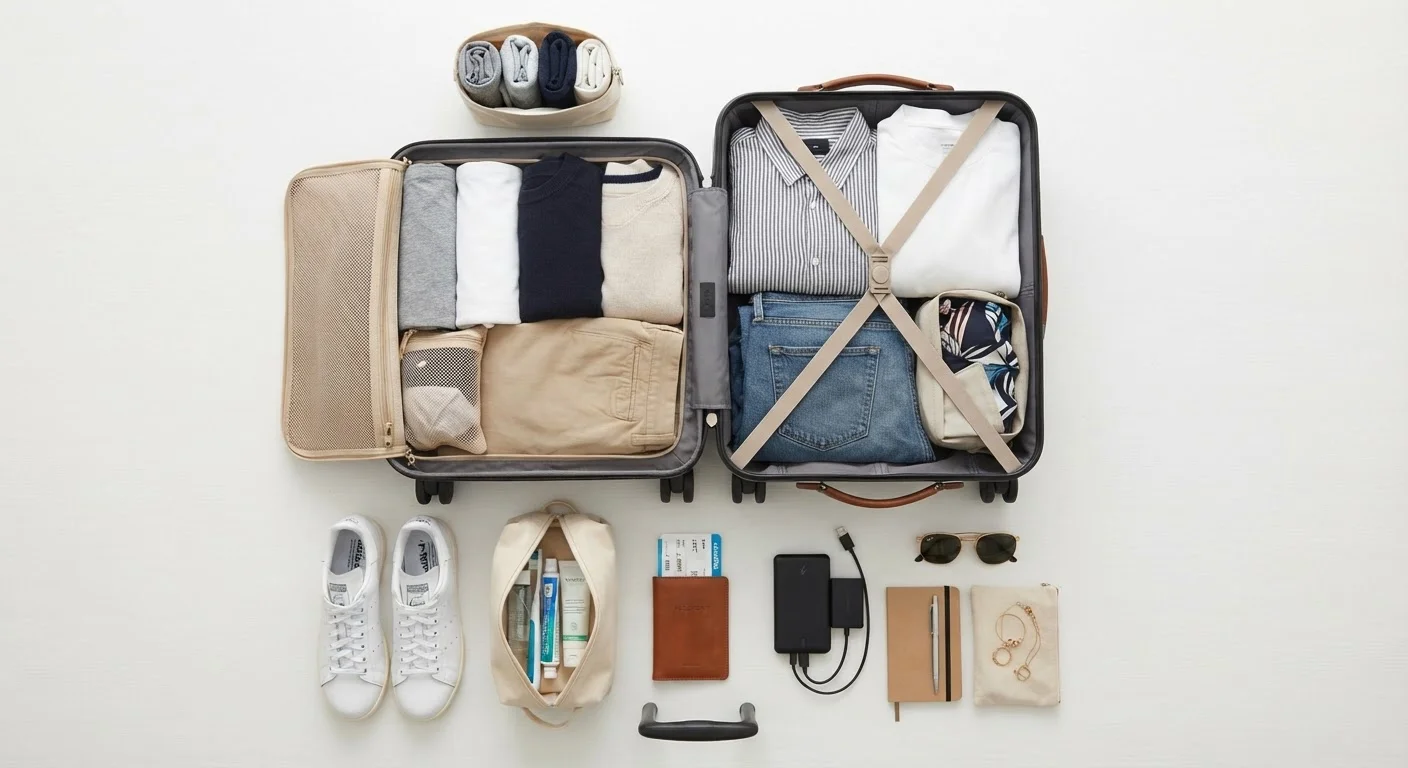
Switching to carry-on-only travel isn't just about owning a smaller bag — it's about building a smarter packing system. A few principles make it sustainable:
- Choose versatile clothing. Neutral colors and mix-and-match pieces let you create multiple outfits from fewer items. Fabrics that resist wrinkles and dry quickly are especially useful.
- Follow the 5-4-3-2-1 rule (or a variation). Many travelers find success with roughly five tops, four bottoms, three pairs of shoes, two layers, and one dress or outfit for a specific occasion — adjusted for trip length.
- Use packing cubes. These compressible organizers aren't just tidy — they make it easier to find items quickly and squeeze more into a given space.
- Plan laundry into longer trips. Even a single mid-trip laundry stop can halve your clothing needs. Many hotels offer laundry services, and self-service laundromats are widely available abroad.
- Wear your bulkiest items on travel days. Heavy shoes, a thick jacket, and layered sweaters don't count against your bag allowance when they're on your body.
Before your next trip, run through the pre-departure checklist for occasional travelers to make sure nothing important gets left behind in the effort to pack light. And if you're still weighing whether to fly at all, the flying vs. driving cost comparison can help put baggage savings in broader context.
The content on this site is for informational purposes only and is not a substitute for professional advice. Always consult a qualified professional for guidance specific to your situation.