

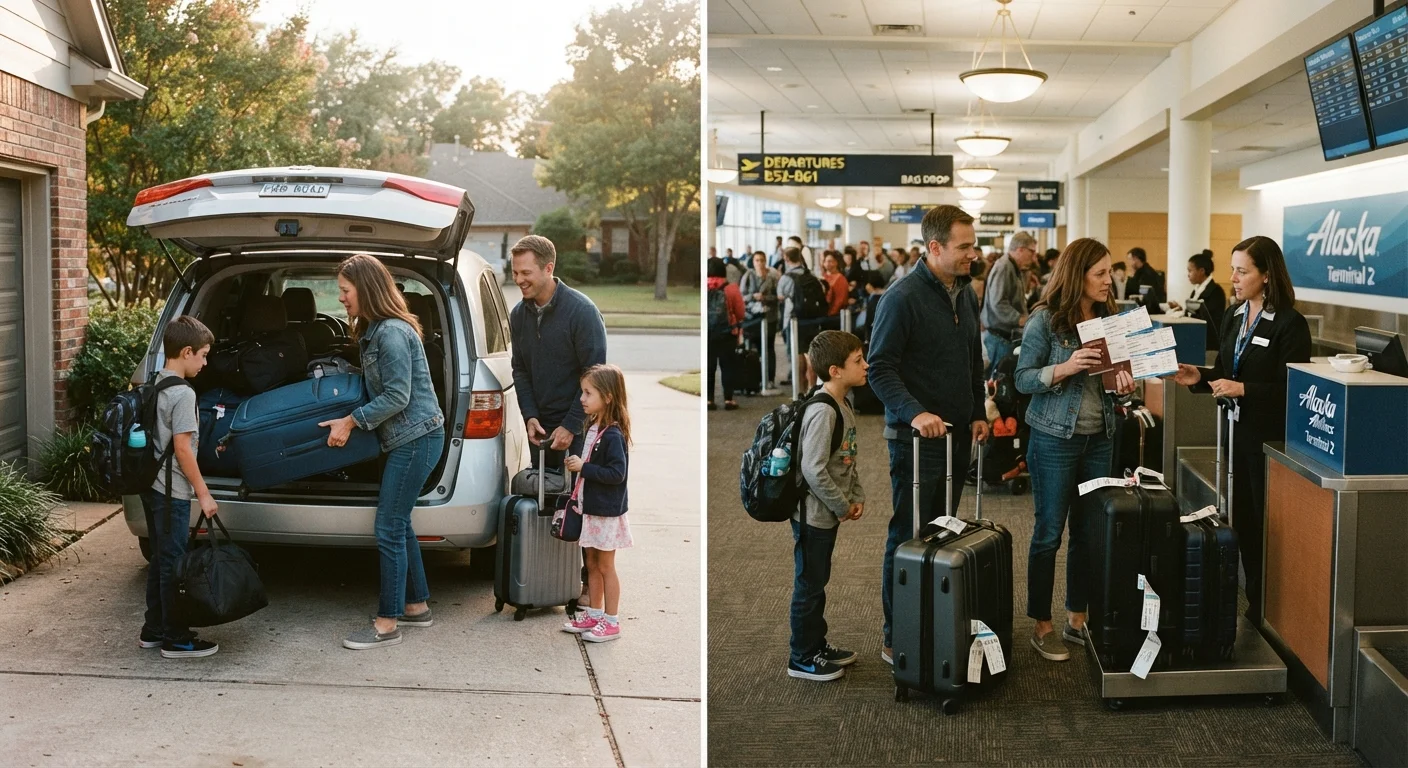
Option A
Flying
The faster, fee-heavy option that scales poorly with family size.
Best for: Families traveling long distances (700+ miles) where time savings outweigh the compounding cost of multiple airline tickets and fees.
Option B
Driving
The flexible, cost-stable choice that rewards larger families.
Best for: Families covering short to mid-range distances who can absorb the time cost and want to avoid per-person airline pricing.
Why the Sticker Price Lies to You
Most families start the trip-planning process by comparing a flight price to a gas estimate — and that comparison is almost always incomplete. The real cost of each option only emerges when you account for every dollar spent getting your family from door to destination.
For flying, that means adding: airline tickets for each traveler, checked baggage fees (typically $30–$40 per bag, per leg on many U.S. carriers), airport parking or rideshare to the terminal, a rental car at the destination if needed, and food purchased inside the airport. A family of four flying a round trip can easily spend $300–$600 in fees and ground costs on top of the base fares.
For driving, the honest tally includes fuel (calculated against your vehicle's actual MPG, not the window sticker), tolls, food on the road, and any overnight lodging if the trip spans multiple days. Neither option is as cheap as the headline number suggests. See our travel budgeting basics guide for a full breakdown of expense categories to plan for.
| Criterion | Flying | Driving |
|---|---|---|
| Base cost scaling | Multiplies per person | Stays roughly flat per trip |
| Baggage | $30–$40 per bag, per leg | No added cost |
| Ground transport at destination | Often requires rental car | Your car is already there |
| Travel time (500 miles) | ~3–4 hrs total door-to-door | ~7–8 hrs driving |
| Flexibility | Low — changes cost extra | High — detours at no cost |
| Food costs en route | High (airport pricing) | Moderate (pack your own) |
| Best for family size | 1–2 travelers | 3+ travelers |
Running the Real Numbers by Distance
Distance is the single biggest variable in this comparison. Here's how the math tends to shake out for a family of four:
Under 300 miles: Driving is nearly always cheaper. Even with fuel, tolls, and a restaurant stop, the total cost rarely approaches four airline tickets plus fees. The time difference is also modest — by the time you factor in arriving early, security, boarding, and deplaning, a 3-hour drive may take less total time than a 1-hour flight.
300–700 miles: This is the grey zone. Fuel costs climb, and a multi-day drive may add a hotel night. Flying becomes more competitive on time, but fees still stack up fast for families. Run the numbers both ways before deciding.
700+ miles: Flying typically wins on time by a wide margin, but families should still calculate full costs carefully. A cross-country flight for four, with bags and a rental car, can easily exceed $2,000 round trip. Driving the same distance requires 2–3 days each way and significant fuel and lodging expense — so neither option is cheap.
$30–$40
Average checked bag fee per leg on major U.S. carriers
Based on publicly listed fees from major U.S. airlines; fees vary by carrier and fare class.
~$0.16–$0.21
Estimated per-mile driving cost for a typical family vehicle
The AAA's annual Your Driving Costs study provides per-mile estimates that include fuel, maintenance, and depreciation for average vehicles.
400–500 miles
Distance threshold where flying typically becomes time-competitive
Below this range, total door-to-door travel time for flying often equals or exceeds driving once airport procedures are factored in.
For a deeper look at where vacation money typically disappears, our guide on where your vacation money actually goes identifies the categories with the most realistic room for savings.
The Hidden Costs Families Overlook
Several costs tend to fall out of the initial comparison but show up on the credit card statement later.
Baggage fees: A family of four checking two bags each way on a round trip can pay $240–$320 in baggage fees alone — before touching the ticket price. Packing light and flying carry-on only can recover a meaningful portion of that. Our article on carry-on-only travel strategies makes the financial case in detail.
Airport food and incidentals: Airport dining typically costs 30–50% more than comparable meals elsewhere. A family eating one meal inside an airport terminal can spend $60–$100 without much effort.
Ground transportation at the destination: Renting a car negates a major cost advantage of flying. If your destination requires a vehicle — which most U.S. road trip destinations do — the rental cost must factor into the flying total.
Pre-trip decisions that drain the budget: Many families also spend more than they realize in the planning phase. Our piece on overlooked pre-trip budget mistakes covers decisions that quietly raise trip costs before you've packed a bag.
Don't Forget the Car at Home
If you fly, you still need to deal with your car. Long-term airport parking typically costs $15–$30 per day depending on the airport and lot. For a week-long trip, that's $105–$210 added to the flying total before you've bought a single ticket. A rideshare or having someone drop you off can reduce this, but it's a cost that often goes unplanned.
Time as a Cost — and When It Changes the Equation
Time is real money for families with limited vacation days. If a cross-country drive requires three days of travel each way, that's six days of your trip spent in a car — potentially a significant share of your total time off.
When evaluating time cost, think in full trip days, not just driving hours. A 10-hour drive that requires an overnight stop consumes two calendar days. Factor in whether those days would otherwise be usable vacation time or pure transit.
That said, for many families, the drive is part of the experience. Roadside stops, flexibility to change plans, and not having to manage airport logistics with young children all carry real value that doesn't show up in a spreadsheet. The right answer depends on your family's priorities — and being honest about both the financial and time trade-offs is the only way to make a genuinely informed choice.
This article provides general travel cost information for educational purposes. Prices, fees, and fuel costs vary significantly by route, carrier, season, and vehicle. Always verify current rates directly with airlines, rental companies, and fuel cost calculators before making travel decisions.
The content on this site is for informational purposes only and is not a substitute for professional advice. Always consult a qualified professional for guidance specific to your situation.