

Start here
Why a Budget Matters Even on a Modest Income
Next
Step 1: Add Up Your Real Take-Home Income
Then
Step 2: List Every Spending Category
Core skill
Step 3: Assign Dollar Amounts and Balance the Budget
Practice it
Step 4: Track Spending Through the Month
Troubleshoot
What to Do When Your Budget Doesn't Balance
Why a Budget Matters Even on a Modest Income
A budget is not a punishment or a sign that something has gone wrong. It's simply a written plan for your money — one that tells every dollar where to go before the month starts rather than wondering where it went afterward. People at every income level benefit from having one.
Without a plan, most spending happens on autopilot. Small purchases add up, bills arrive unexpectedly, and it becomes hard to save for anything. A budget doesn't eliminate those realities, but it gives you a clearer picture so you can make better decisions. If you've ever reached the end of the month feeling like your paycheck evaporated, a budget is the tool that explains why — and helps prevent it.
This walkthrough asks nothing of you except a few numbers and a willingness to be honest about your spending. No financial background required.
This article is for general informational purposes only and does not constitute personalized financial advice. For guidance specific to your situation, consider speaking with a licensed financial professional.
Step 1: Add Up Your Real Take-Home Income
The starting point for any budget is knowing exactly how much money actually lands in your bank account each month — not your salary before taxes, but your take-home pay after federal and state taxes, Social Security, and any other withholdings.
Take-home pay
The amount of money you actually receive after taxes and other deductions have been subtracted from your paycheck. This is the number your budget must be built around.
Fixed expense
A cost that stays the same amount every month, like rent, a car loan payment, or an insurance premium. These are usually the least flexible part of a budget.
Variable expense
A cost that can change month to month, like groceries, gas, or dining out. These categories typically offer the most room to adjust when a budget needs to be trimmed.
50/30/20 guideline
A simple budgeting framework that suggests allocating roughly 50% of take-home pay to needs, 30% to wants, and 20% to savings or debt repayment. It's a starting guide, not a rigid rule.
Budget surplus
The money remaining after all planned expenses are covered. A surplus is best directed toward savings, an emergency fund, or paying down debt faster.
Miscellaneous buffer
A small category set aside for minor unexpected purchases that don't fit neatly elsewhere. It prevents small surprises from throwing off the rest of the budget.
If your income is consistent (the same paycheck every two weeks), multiply one paycheck by the number of paychecks you receive per month. For most people paid biweekly, that's roughly 2 paychecks most months, with two months a year delivering 3. Use the 2-paycheck figure as your baseline.
If your income varies — freelance work, hourly shifts, tips — use a conservative average based on your last 3 to 6 months of deposits. It's smarter to budget on a lower estimate and end up with extra than to plan on a higher figure and come up short.
Include all reliable income streams: a side job, regular rental income, child support received. Leave out windfalls like tax refunds or bonuses — those are better handled separately so you don't build a budget that depends on money that might not arrive.
Step 2: List Every Spending Category
Once you know your income, list every category where money goes out. Split them into two groups:
- Fixed expenses — the same amount every month: rent or mortgage, car payment, insurance premiums, loan minimums.
- Variable expenses — amounts that change: groceries, gas, utilities, dining out, clothing, entertainment, personal care.
Don't rely on memory alone. Pull up two or three months of bank and credit card statements and look for categories you might forget — annual subscriptions billed monthly, streaming services, gym memberships, or irregular costs like car registration. Our budget categories reference covers the full list of expenses most households need to plan for.
It also helps to create a catch-all category — often called a miscellaneous or buffer category — for small unpredictable purchases. Setting aside even $20–$50 here prevents small surprises from blowing the whole plan.
Pull Statements Before You Estimate
It's tempting to guess at spending amounts from memory, but most people underestimate variable costs — especially groceries, dining, and small daily purchases. Spending 10 minutes reviewing two months of actual bank or card statements before filling in your budget will give you far more accurate starting numbers.
Step 3: Assign Dollar Amounts and Balance the Budget
Now give every category a dollar amount for the month. Your goal is simple: total spending should not exceed total income.
A widely used starting framework is the 50/30/20 guideline: roughly 50% of take-home pay toward needs (housing, food, utilities, transportation), 30% toward wants (dining, entertainment, hobbies), and 20% toward savings and debt repayment beyond minimums. These percentages are a starting point, not a hard rule — adjust them to reflect your real situation.
Add up all your planned expenses and compare that total to your income. If expenses exceed income, you need to reduce something. Start with variable expenses — they tend to offer the most flexibility. If you have room left over after all expenses are covered, assign that surplus to savings or debt. Think of savings as a line item, not an afterthought. For practical steps on building up a financial cushion, see our guide on starting an emergency fund on a tight budget.
Step 4: Track Spending Through the Month
A budget written on the first of the month and never looked at again won't help much. The real value comes from checking actual spending against your plan as the month unfolds.
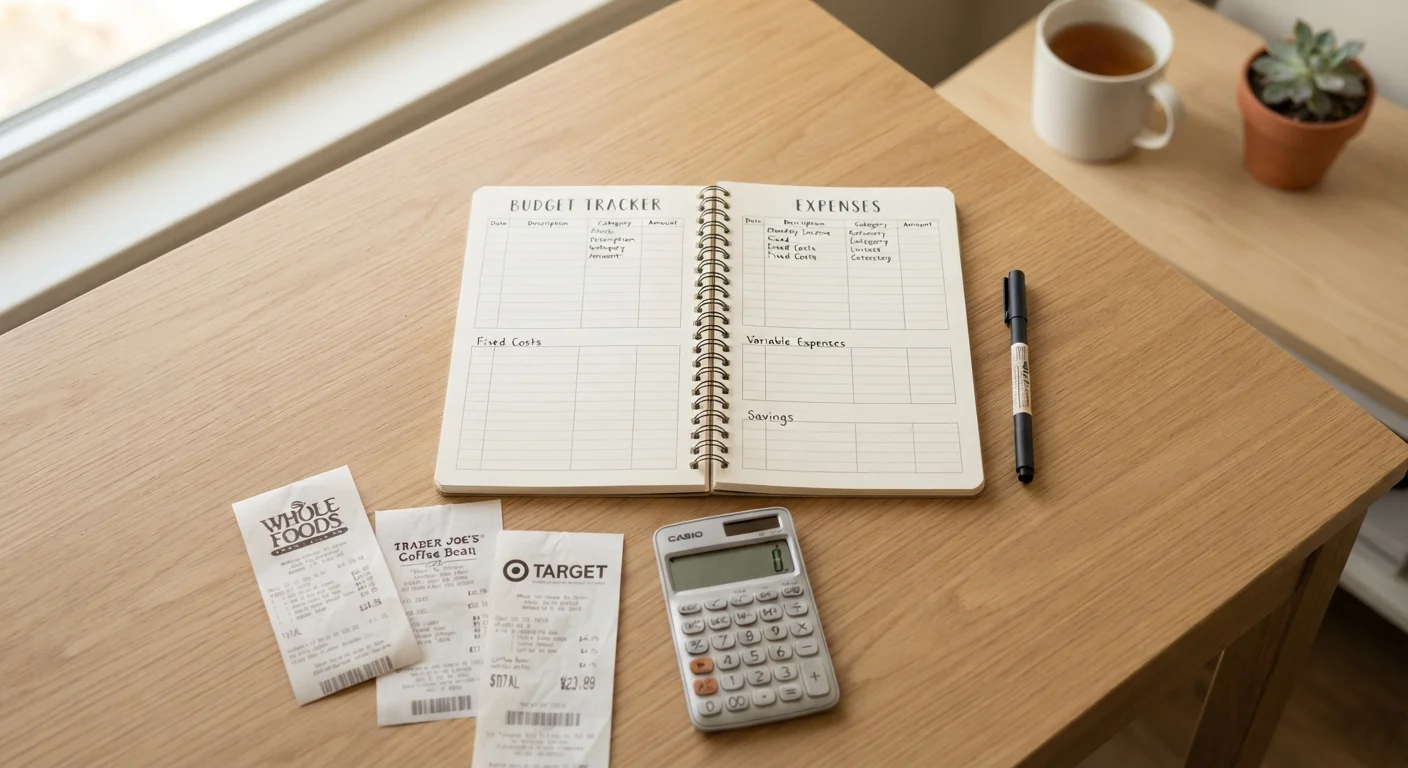
You don't need sophisticated tools. A small notebook, a notes app on your phone, or a simple spreadsheet all work. The goal is to record purchases in their category and check whether you're on track. If you've spent $180 of a $200 grocery budget by the 20th, you know to be careful for the rest of the month.
Some people prefer checking in weekly; others do a quick daily tally. Either habit works. What matters is the regularity. If paper appeals to you, our article on notebook budgeting explains how to make a handwritten system effective.
At month's end, compare your planned budget to your actual spending. This review is the foundation of improving over time — and it usually only takes 10 to 15 minutes. Our guide on setting up a monthly budget review routine shows you how to build that habit.
What to Do When Your Budget Doesn't Balance
Nearly everyone's first budget has a gap. Expenses almost always look bigger on paper than expected. This is not failure — it's information.
Start by reviewing variable expenses for obvious reductions: subscriptions you forgot you had, dining that crept higher than you realized, or convenience spending that adds up fast. Even trimming three or four categories by $15–$20 each can close a meaningful gap.
If cuts alone aren't enough, the longer-term path involves either reducing fixed costs (like refinancing debt or moving to lower-cost housing) or increasing income. Neither happens overnight, but knowing the size of your gap gives you a concrete target to work toward.
Understanding why budgets struggle is just as useful as knowing how to build one. Our article on why so many budgets fail before February covers the most common pitfalls and how to sidestep them. And if debt repayment is straining your budget, a clear framework can help — see our guide on building a realistic debt repayment plan.
Don't Make Your First Budget Too Strict
A common mistake is cutting every category to the bone on paper, leaving no room for the small purchases that are simply part of real life. Budgets that feel punishing get abandoned quickly. Build in realistic amounts — including a modest allowance for fun or flexibility — so the plan is actually livable. You can tighten specific categories gradually once you see how spending plays out.
Your first budget is a draft. Each month you refine it based on real numbers, and over time it becomes a genuinely accurate picture of your financial life.
Frequently Asked Questions
You can start budgeting with any income level. A budget is simply a plan for whatever money you have coming in. Even a modest income benefits from a spending plan because it helps you direct dollars intentionally rather than wondering where they went.
The 50/30/20 guideline suggests putting roughly 50% of take-home pay toward needs, 30% toward wants, and 20% toward savings or debt repayment. It's a helpful starting point, but it doesn't have to be followed exactly — adjust the percentages to fit your real situation.
No. A pen and a piece of paper work perfectly well. Many people find handwritten budgets easier to stick with than digital tools. Use whatever method you'll actually return to each week.
This is common when you first write everything down. Review your variable expenses first — dining, subscriptions, entertainment — for room to cut. If fixed costs are the problem, that's a longer-term conversation about housing or debt, but small reductions elsewhere can still help.
At minimum, do a quick review at the end of each month to compare what you planned with what you actually spent. Life changes — income shifts, new bills, seasonal costs — so updating the plan regularly keeps it useful.
Yes. Treating savings as a regular line item — just like rent or groceries — makes it far more likely you'll actually save. Even a small, consistent monthly amount builds meaningful habits over time.
The content on this site is for informational purposes only and is not a substitute for professional advice. Always consult a qualified professional for guidance specific to your situation.