

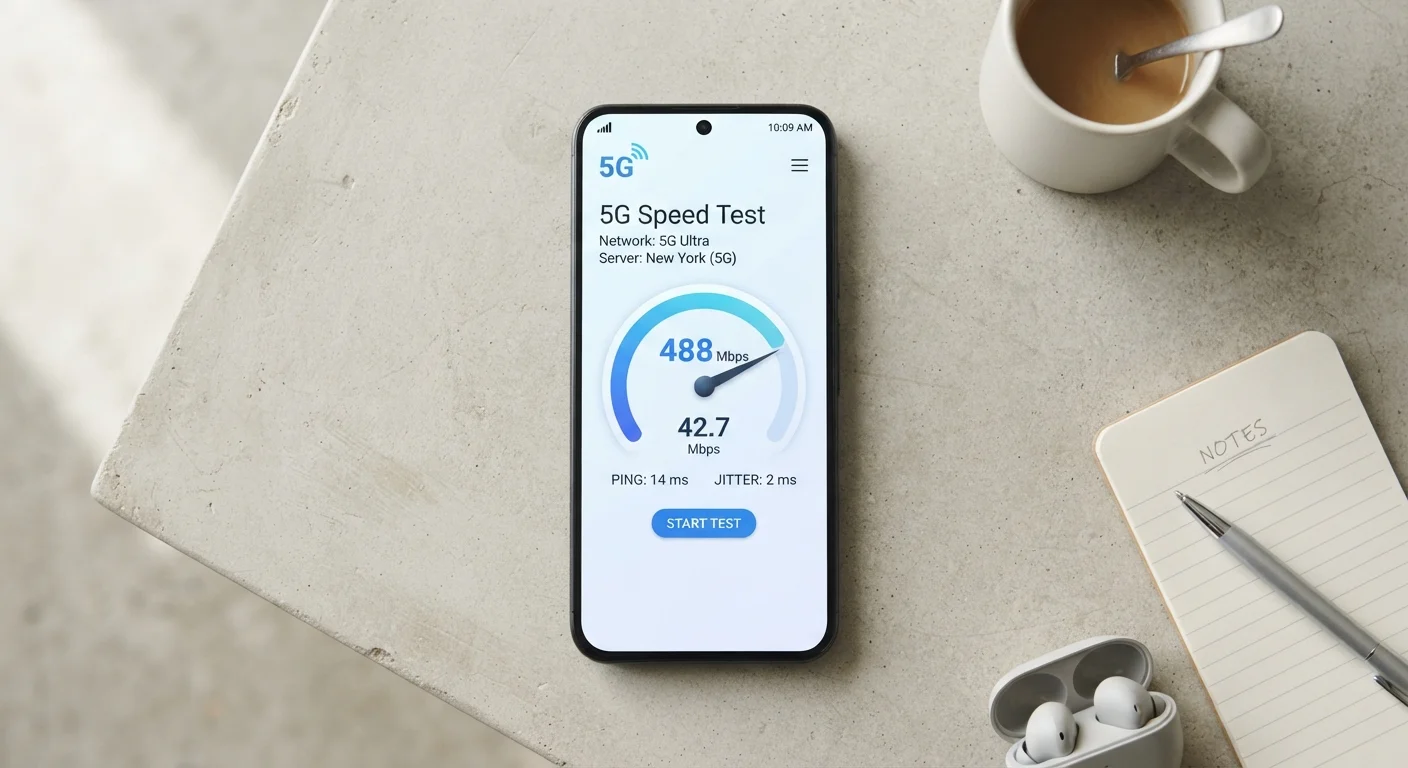
What the G in 5G Actually Means
The "G" simply stands for generation. Each generation represents a new technical standard for mobile networks. 1G brought voice calls, 2G added text messaging, 3G introduced basic mobile internet, and 4G LTE made video streaming and app-heavy smartphones practical. 5G is the fifth generation — designed to handle far more devices simultaneously, reduce delays, and push peak speeds well beyond what LTE can reach.
The jump from 4G to 5G isn't like flipping a switch. It's a gradual rollout across different frequency bands, each behaving differently in the real world. Understanding this distinction is key to making sense of what you see on your phone's status bar. For a deeper look at how speed metrics translate into real-life performance, see our guide to download speed, upload speed, and latency.
The Three Flavors of 5G Coverage
This is where many people are surprised. 5G isn't one uniform experience — it runs on three distinct radio frequency bands:
- Low-band 5G: Travels long distances and penetrates buildings well, giving it the widest coverage footprint. Speeds are typically only modestly faster than LTE — often in the 30–100 Mbps range. This is what most Americans experience when their phone shows a 5G icon.
- Mid-band 5G: Strikes a balance between speed and range. Speeds can reach 100–400 Mbps in good conditions, and coverage is expanding in many mid-sized and large cities. This is considered the "sweet spot" for most users.
- High-band 5G (mmWave): Extremely fast — capable of exceeding 1 Gbps — but the signal only travels a short distance and struggles to pass through walls. It's found in select dense urban locations like sports stadiums and busy transit hubs.
~30–100 Mbps
Typical low-band 5G speed range
According to network testing organizations, low-band 5G — the most common type in the US — delivers speeds only modestly above LTE averages.
1 Gbps+
Peak mmWave 5G speed potential
High-band mmWave 5G can theoretically exceed 1 Gbps, but only within very short range of a tower in dense urban deployments.
10–75 Mbps
Typical LTE speed range for US users
LTE remains consistent across most of the US, with average real-world speeds sufficient for HD streaming and video calls.
When you see 5G on your phone, you're almost certainly on low-band unless you're in a specific high-density area with mid- or high-band deployment. Your phone may not distinguish between them on the status bar.
LTE: Still the Workhorse of US Mobile
LTE — which stands for Long-Term Evolution — is the 4G standard that most US mobile users have relied on for years. It's mature, widely deployed, and capable of delivering 10–75 Mbps in typical conditions, which comfortably handles HD streaming, social media, video calls, and most everyday tasks.
In many rural and suburban areas, LTE still offers more consistent and reliable coverage than 5G simply because the 5G network hasn't been fully built out there yet. A strong LTE signal will usually outperform a weak or congested 5G signal in practice. To understand how US wireless networks differ in coverage and reliability, our breakdown of major US wireless networks is a useful reference.
Check Your Signal, Not Just the Label
Before assuming a speed problem is your plan's fault, check your signal strength indicator. A weak signal — even on 5G — will underperform a strong LTE connection. Moving closer to a window or stepping outside can sometimes make a noticeable difference in speed and reliability.
What Actually Determines Your Real-World Speed
Your data speed at any moment is shaped by multiple factors working together — not just the generation label:
- Distance from the tower
- The further you are from a cell tower, the weaker your signal and the lower your effective speed.
- Network congestion
- During peak hours — like evenings in a city — many users share the same tower capacity, which can slow everyone down.
- Physical obstacles
- Walls, buildings, and terrain absorb or reflect signals. High-frequency signals (like mmWave 5G) are especially sensitive to obstruction.
- Your device hardware
- Older phones may not support newer 5G bands even if coverage exists in your area.
- Carrier throttling
- Some plans reduce your data speed after you reach a certain usage threshold — a practice called deprioritization or throttling.
If you're curious about how your phone manages different types of connections depending on context, our guide to Bluetooth, Wi-Fi, and mobile data explains when each connection type is the smarter choice.
“The promise of 5G is real, but it's being delivered in stages. For most people today, the meaningful question isn't whether they have 5G — it's whether they have a reliable signal where they actually spend their time.”
— Communications technology analyst, Wireless industry researcher and commentator
Setting Realistic Expectations for Your Plan
Marketing around 5G often emphasizes peak theoretical speeds, which rarely reflect everyday use. A practical way to think about it: for most common tasks — browsing, social media, email, and standard video calls — even a modest LTE connection is sufficient. Mid-band 5G becomes noticeably better for downloading large files, high-resolution video streaming, or using your phone as a mobile hotspot for multiple devices.
If you're seeing unfamiliar abbreviations in your phone settings related to network type — such as VoLTE, LTE-A, or NR — our guide to common phone settings terms can decode those for you. The bottom line: focus on coverage consistency and plan features rather than chasing a 5G label alone.
Frequently Asked Questions
Most 5G users in the US are on low-band 5G, which offers only modest speed improvements over LTE. Network congestion, distance from a tower, and building materials can all reduce your effective speed regardless of the network label shown.
Yes. A solid LTE connection typically delivers 10–50 Mbps, which is more than enough for HD video streaming, video calls, and everyday browsing. LTE remains widely available and covers far more of the US than 5G.
Low-band 5G covers wide areas but is only slightly faster than LTE. Mid-band 5G offers a meaningful speed boost and reasonable coverage. High-band (mmWave) 5G can reach gigabit speeds but only works within a very short range of a tower, typically in dense urban areas.
Not necessarily. Many carriers include 5G access on standard plans if you're in a covered area and have a compatible device. However, plan pricing and features vary, so it's worth reviewing what your specific plan includes.
Latency is the delay between sending a request and receiving a response — measured in milliseconds. Lower latency improves real-time activities like gaming, video calls, and loading interactive web pages. 5G is designed to reduce latency significantly compared to LTE.
The content on this site is for informational purposes only and is not a substitute for professional advice. Always consult a qualified professional for guidance specific to your situation.