

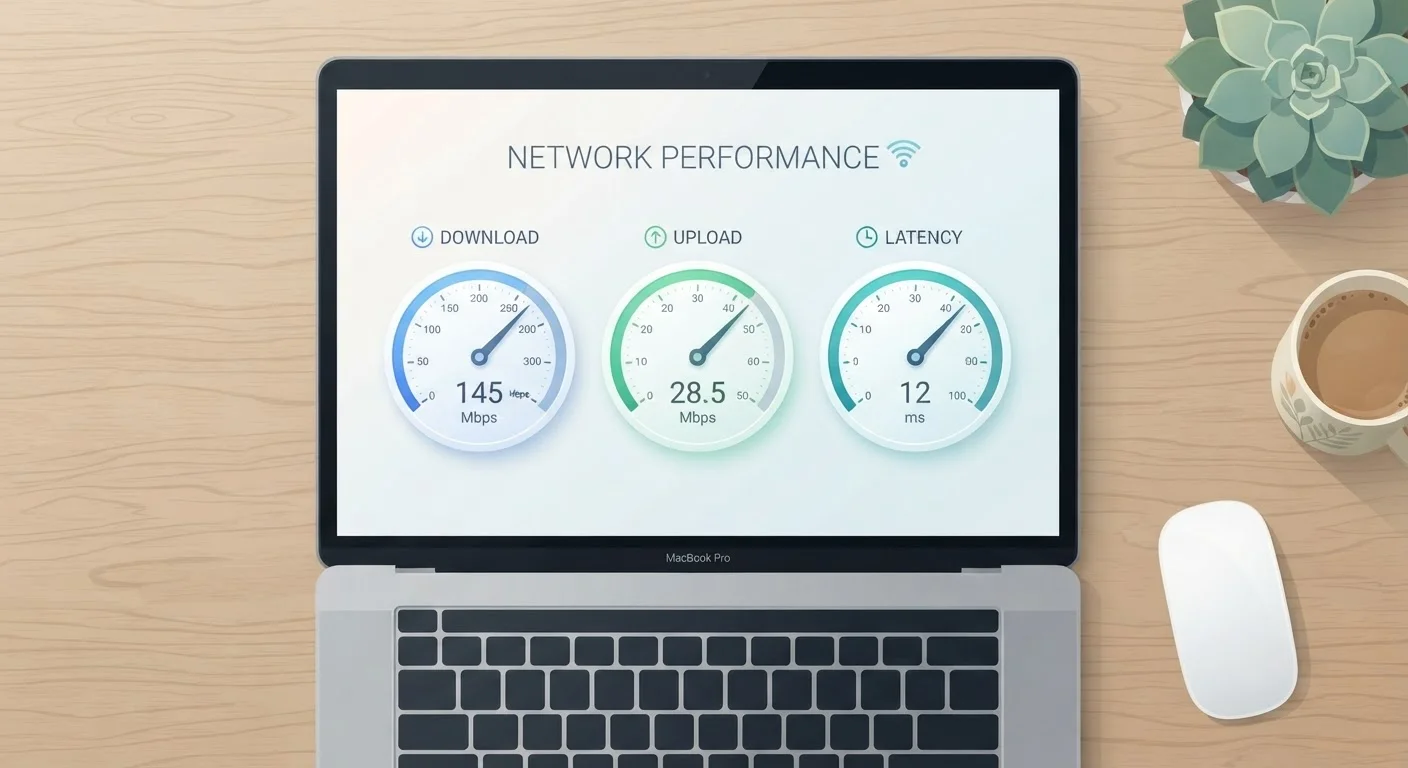
Download Speed: What It Controls
Download speed is what most people picture when they think of "internet speed." It measures how much data your device can pull from the internet per second, expressed in megabits per second (Mbps). The higher the number, the faster content arrives on your screen.
Download speed directly affects:
- Streaming video — buffering happens when your download speed can't keep up with the data demand of the video quality you've selected.
- Loading websites — pages with lots of images or scripts pull more data, so low speeds mean slower load times.
- Downloading files, apps, and software updates — a larger file finishes faster with higher download speeds.
To understand what's happening behind the scenes when you visit a site, see what actually happens when you type a web address into your browser.
Speeds Don't Need to Be Huge for Most Tasks
Streaming HD video typically needs 5–25 Mbps of download speed. Browsing and email require even less. If you live alone or with one other person, a moderate download plan often meets everyday needs. Where speeds matter more is when multiple devices are active simultaneously.
Upload Speed: The Overlooked Half
Upload speed measures how fast your device sends data to the internet. Many internet plans advertise much lower upload speeds than download speeds — this is called an asymmetric connection — because historically, most home users consumed more data than they sent. That assumption no longer fits how people use the internet today.
Upload speed matters most when you are:
- On a video call — your camera feed streams outward, and poor upload speed causes pixelated or frozen video for the other participants.
- Backing up files to the cloud — photos, documents, and system backups all require sustained upload throughput.
- Live streaming or content creation — broadcasting video to any platform is upload-intensive, even at modest quality settings.
- Working from home — sharing large files, using remote desktop tools, or collaborating through cloud platforms all draw heavily on upload capacity.
Fiber Plans Often Offer Symmetrical Speeds
Unlike cable and DSL plans, many fiber internet connections offer equal download and upload speeds — called a symmetrical connection. If your household does a lot of video calling, content creation, or remote work, a symmetrical fiber plan can make a noticeable difference in day-to-day performance.
Latency: The Delay That Changes Everything
Latency is the time it takes for a signal to travel from your device to a server and back. It's measured in milliseconds (ms) and often called ping on speed tests. Unlike download and upload speeds, latency isn't about volume — it's about responsiveness.
Why does this distinction matter? Imagine shouting a question across a room versus whispering it through a wall. Even if both voices are loud (high bandwidth), the delay through the wall (high latency) makes the conversation frustrating.
~20 ms
Typical latency on a fiber connection
Fiber connections commonly achieve round-trip latency under 20 milliseconds, compared to 600+ ms for many satellite internet services.
600+ ms
Latency on traditional satellite internet
Traditional geostationary satellite internet can have latency exceeding 600 ms due to the signal's travel distance to and from orbit.
Latency is most noticeable in:
- Online gaming — every player input must travel to the game server and back in near-real time. High ping causes lag, missed actions, and disconnections.
- Video and voice calls — a delay of even 150–200 ms makes conversations feel unnatural and causes people to talk over each other.
- Web browsing — each element on a page can require a separate request-response cycle, so high latency multiplies page load times even with fast speeds.
Connection type plays a major role in latency. Fiber and cable generally deliver lower latency than satellite internet. For a deeper look, see how broadband types compare in real-world performance.
How They Work Together — and When One Matters More
Understanding all three metrics together gives you a clearer picture of your actual internet experience:
| Activity | Download Speed | Upload Speed | Latency |
|---|---|---|---|
| Streaming video | High impact | Low impact | Moderate impact |
| Video calls | Moderate impact | High impact | High impact |
| Online gaming | Low–moderate impact | Low impact | Very high impact |
| File downloads | High impact | No impact | Low impact |
| Cloud backup | No impact | High impact | Low impact |
Speed test numbers can be misleading if you only look at one figure. A plan advertising 500 Mbps download might still frustrate gamers if latency is consistently high. Similarly, fast download speeds won't help a remote worker whose video calls stutter due to a weak upload connection.
For mobile users, these trade-offs also vary by network generation. See how 5G and LTE differ in real-world speed and latency to understand how your phone's connection compares. And if your speeds seem inconsistent, learn what typically causes internet slowdowns to identify what's actually in your control.
“Bandwidth is about capacity; latency is about speed of response. Conflating the two leads users to buy more bandwidth when what they actually need is a lower-latency connection.”
— Internet performance researchers, Cited across network engineering literature on user-perceived quality of service
Frequently Asked Questions
High latency is often the culprit. Even with strong download speeds, a high ping causes noticeable delays in web browsing, gaming, and video calls. Check <a href="/internet-mobile/internet-basics/why-your-internet-slows-down-and-whats-usually-behind-it">why your internet slows down</a> for more possible causes.
Most video conferencing apps recommend at least 1–3 Mbps of upload speed per stream for standard quality. High-definition calls or multi-person conferences may require more. Unstable upload connections cause choppy audio and frozen video even when download speeds look fine.
Generally, a ping under 50 milliseconds is considered good for online gaming, and under 20 ms is excellent. Anything over 100 ms tends to produce noticeable lag. Latency depends heavily on your connection type and proximity to game servers.
Yes. Streaming HD video typically requires around 5–25 Mbps of download speed depending on resolution. If your speed dips below that threshold, the service will automatically lower quality or buffer. A stable connection matters as much as raw speed.
No — they measure entirely different things. Bandwidth (speed) is about volume: how much data can flow per second. Latency is about time: how long it takes for a signal to travel to a server and back. You can have high bandwidth and still suffer from high latency.
The content on this site is for informational purposes only and is not a substitute for professional advice. Always consult a qualified professional for guidance specific to your situation.