

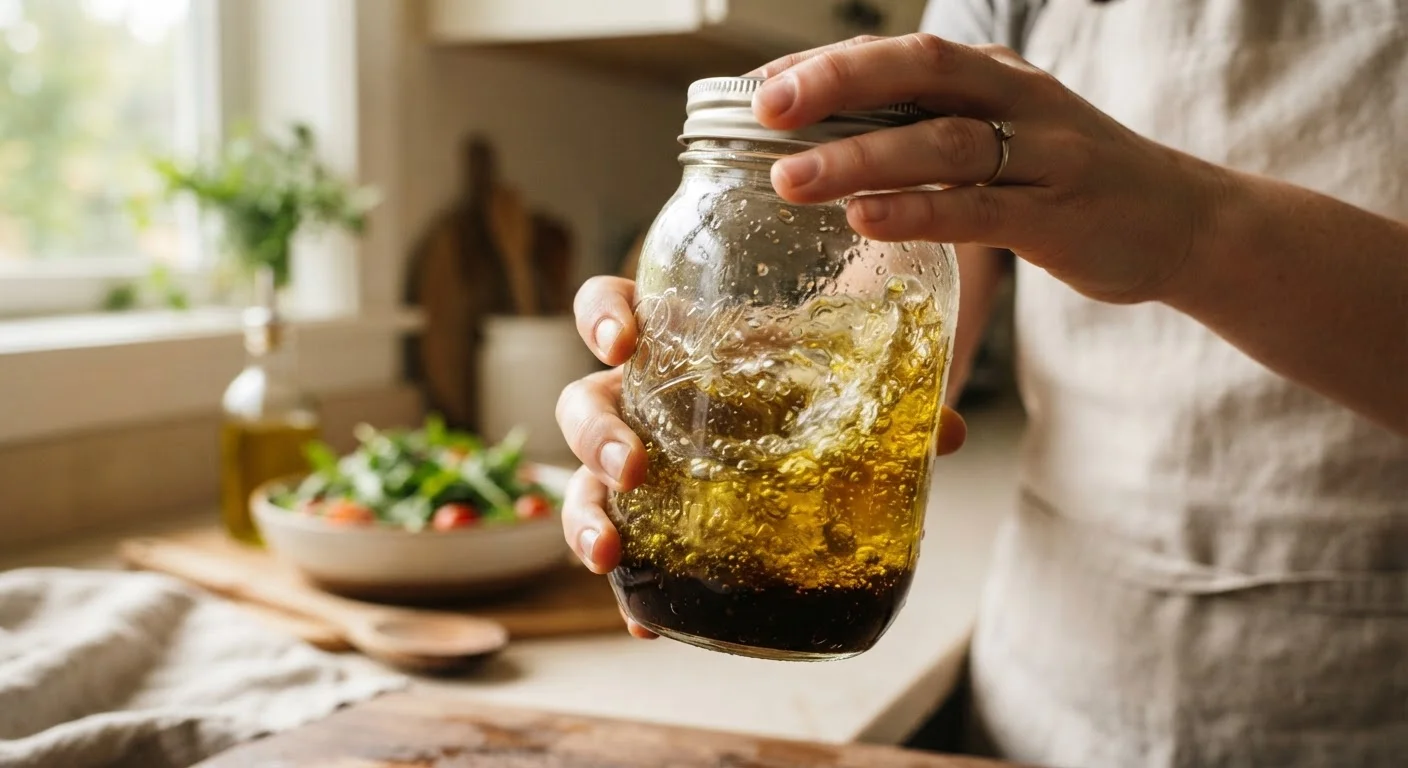
Why Oil and Water Won't Play Nice
Pour a splash of olive oil into a bowl of vinegar and watch what happens - the oil immediately floats to the top and refuses to mix, no matter how vigorously you stir. This isn't stubbornness; it's chemistry. Oil is nonpolar, meaning its molecules don't carry an electrical charge. Water is polar, with a slight charge imbalance that makes its molecules strongly attracted to each other. The two simply have no chemical reason to mingle.
This is the fundamental challenge that emulsification solves. Understanding it explains a surprising amount of what's actually happening when you make a salad dressing, a classic hollandaise, or even a simple pan sauce. It also connects to broader kitchen fundamentals - just as heat and motion define techniques like sautéing and stir-frying, the science of emulsification is what separates a smooth, cohesive sauce from a greasy separated mess.
The Role of an Emulsifier
An emulsifier is the key player in any successful emulsion. These are ingredients whose molecules have a split personality: one end is attracted to water, the other to fat. When you add an emulsifier and apply mechanical energy - whisking, shaking, or blending - it wraps itself around tiny droplets of oil and suspends them throughout the water-based liquid.
Egg yolk is one of the most powerful natural emulsifiers in the kitchen. It contains a phospholipid called lecithin, which is particularly effective at stabilizing oil-in-water mixtures. That's why mayonnaise - essentially oil emulsified into egg yolk and a small amount of acid - holds together so reliably.
Mustard is another useful emulsifier. It contains mucilage compounds from mustard seeds that help bind oil and vinegar, which is why a teaspoon of Dijon stirred into a vinaigrette keeps it mixed noticeably longer than one without.
Add Oil Slowly for a Better Emulsion
Whether you're making a vinaigrette or mayonnaise, drizzle the oil in gradually rather than pouring it all at once. Adding oil too quickly overwhelms the emulsifier before it can coat the droplets, making separation far more likely. A slow, steady stream while whisking or blending gives you the smoothest, most stable result.
Temporary vs. Stable Emulsions
Not all emulsions are created equal. A classic vinaigrette - three parts oil to one part acid, no emulsifier - is what's known as a temporary emulsion. Shaking the bottle breaks the oil into droplets that disperse throughout the vinegar, but within minutes they coalesce back into a separate layer. There simply isn't enough emulsifier to keep them apart.
Add a small amount of mustard or a minced garlic clove, though, and you get a semi-stable emulsion that stays together for an hour or more. Mayonnaise, with its generous ratio of egg yolk to oil, is a stable emulsion that can last days in the refrigerator without separating.
The difference between these comes down to two things: how much emulsifier is present and how finely the oil is broken up during mixing. The smaller the oil droplets, the more surface area the emulsifier has to coat - and the more stable the result. This is also why controlling heat carefully matters in emulsified sauces like hollandaise - too much heat can cause the egg proteins to seize and the emulsion to break apart.
~80%
Fat content of a typical mayonnaise
Most commercial and homemade mayonnaises consist of roughly 70-80% oil by volume, making a stable emulsifier essential to the texture.
3:1
Classic oil-to-vinegar ratio in vinaigrette
The traditional French vinaigrette ratio is three parts oil to one part acid - a balance that affects both flavor and how well the emulsion holds.
Putting Emulsification to Work in Your Kitchen
You don't need to memorize any chemistry to use emulsification well - just a few practical habits. When making a vinaigrette, add your mustard or garlic to the vinegar first, then drizzle the oil in slowly while whisking. Slow addition gives the emulsifier time to surround each new wave of oil droplets before they can clump together.
For mayonnaise or a hollandaise, the same principle applies: add fat gradually and keep mixing consistently. If your emulsion breaks - the sauce looks greasy and curdled - don't panic. For mayonnaise, you can often rescue it by starting fresh with a new egg yolk in a clean bowl and slowly whisking the broken sauce back into it.
Emulsification also quietly explains some common kitchen puzzles. Pasta water, enriched with starch, helps fat from butter or olive oil stay suspended in a pan sauce - a low-key emulsification trick used in Italian cooking. Understanding this kind of kitchen science makes you a more intuitive cook, even if you never think about it in those terms. If you're curious about other claims that get attached to cooking and food, it's worth knowing how to spot the difference between real food science and marketing noise - something our piece on nutrition claims that sound scientific but aren't covers in detail.
Frequently Asked Questions
Without an emulsifier, oil and water-based liquids like vinegar cannot stay combined. Shaking creates a temporary mixture, but the two liquids quickly separate back into distinct layers. Adding an emulsifier - like mustard or egg yolk - keeps them blended much longer.
Egg yolks are the most well-known natural emulsifier, thanks to a compound called lecithin. Mustard, honey, and garlic also contain compounds that help oil and water mix. These are all common ingredients in vinaigrettes and creamy sauces.
A stable emulsion, like mayonnaise, stays combined for days or weeks because it has enough emulsifier to hold the oil droplets in suspension. An unstable emulsion, like a basic vinaigrette, separates within minutes or hours and needs to be re-shaken before use.
Yes - emulsions can break if they get too hot, too cold, or if the oil is added too quickly. A broken mayonnaise, for example, can sometimes be rescued by whisking it slowly into a fresh egg yolk to re-establish the emulsion from scratch.
Not at all. Emulsification shows up in hollandaise sauce, mayonnaise, butter sauces, chocolate ganache, and even ice cream. Any time you see a smooth, creamy mixture that combines fat and liquid, emulsification is likely at work.
The content on this site is for informational purposes only and is not a substitute for professional advice. Always consult a qualified professional for guidance specific to your situation.