

Our Verdict
Sautéing, stir-frying, and pan-frying overlap in equipment and ingredients but diverge sharply in heat level, fat volume, and how much you move the food. Knowing which method to use shapes whether your food turns out tender, crispy, or somewhere in between.
| Best for | Recommended |
|---|---|
| Quick weeknight vegetables or proteins with minimal fat | Sauté |
| Fast, high-heat cooking of small, uniform pieces with bold flavors | Stir-Fry |
| Thicker cuts that need a crispy exterior and fully cooked interior | Pan-Fry |
Why These Three Methods Get Confused
Sauté, stir-fry, and pan-fry all happen in a skillet or wok on a burner with some form of fat. That shared setup makes them easy to mix up - but the mechanics behind each are genuinely different, and those differences show up clearly on the plate.
The key variables are heat level, how much fat you use, and how actively you move the food. Adjust any one of those three and you shift from one method to another. Understanding that framework makes it much easier to follow a recipe - or to improvise confidently when you don't have one.
For context on how heat differences affect other cooking fundamentals, see our piece on boiling vs. simmering - the same principle of precise heat control applies across the stove.
Sautéing: Quick Cook, Small Amount of Fat
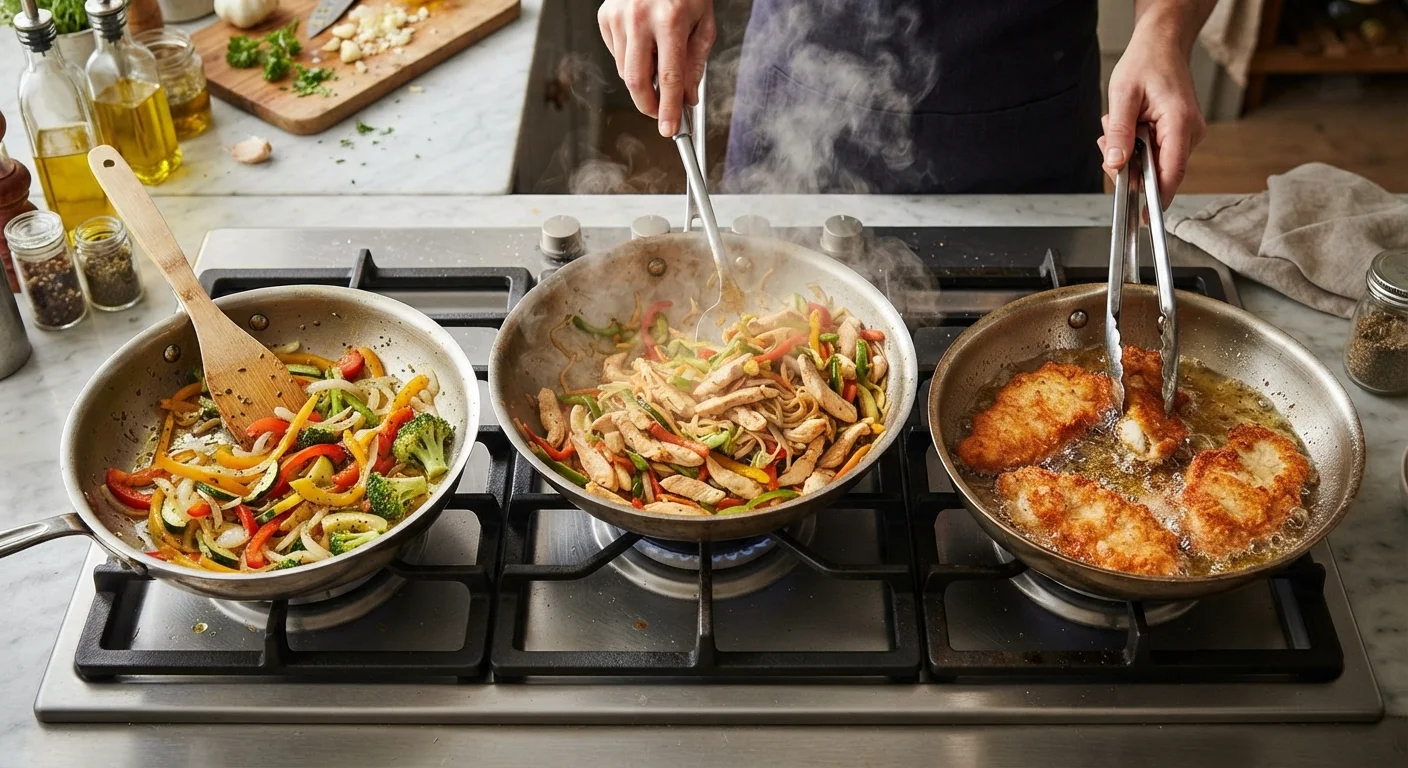
The word sauté comes from the French verb meaning "to jump" - which hints at the occasional tossing motion involved. In practice, sautéing means cooking relatively small, tender pieces of food in a thin layer of fat over medium-high heat. Think sliced mushrooms, diced onions, shrimp, or thin chicken strips.
You're not looking for a deep crust here. The goal is even cooking with some light browning at the edges. Fat is present but modest - enough to coat the pan and prevent sticking, not to submerge the food. You'll stir or toss occasionally, but you're not constantly in motion.
A wide, shallow pan works well because it lets moisture escape. If you crowd the pan, food steams instead of browns - one of the most common sautéing mistakes beginners make.
| Sauté | Stir-Fry | Pan-Fry | |
|---|---|---|---|
| Heat level | Medium-high | Very high (maximum) | Medium |
| Fat quantity | Small (thin coating) | Minimal (1 tbsp or less) | Moderate (partial submersion) |
| Food movement | Occasional toss or stir | Constant motion | Minimal - flip once or twice |
| Best food types | Thin slices, tender veg | Small uniform pieces | Thick cuts, breaded items |
| Typical result | Light browning, tender | Crisp, bright, fast-cooked | Crispy crust, cooked through |
| Ideal pan | Wide skillet | Carbon-steel wok | Cast-iron or heavy skillet |
Stir-Frying: Maximum Heat, Maximum Motion
Stir-frying pushes the heat as high as your burner will go. Originally developed for wok cooking over extremely powerful flames, the method relies on intense heat to cook food almost instantly while preserving texture and color. That's why stir-fried vegetables tend to stay crisp and bright rather than going limp.
Fat quantity is minimal - often just a tablespoon or less - and the food is cut into small, uniform pieces so it cooks through before the outside burns. The constant stirring isn't just tradition; it's necessary because at that heat level, leaving food stationary for even a few seconds risks scorching.
If your home burner doesn't hit restaurant-level BTUs, there are a few adjustments that help: cook in smaller batches, get the pan fully preheated before adding anything, and make sure your ingredients are dry. Moisture is the enemy of proper stir-fry browning. This technique also pairs naturally with understanding how to get a proper sear - many of the same surface-browning principles apply.
Pan-Frying: More Fat, Less Movement
Pan-frying uses noticeably more fat than the other two methods - enough to come partway up the sides of the food, though not enough to fully submerge it (that would be deep-frying). The fat acts as a heat conductor, surrounding the food for more even cooking while creating a crispy, browned exterior.
This method suits thicker items: bone-in chicken pieces, pork chops, fish fillets, breaded cutlets. Because these need time to cook through, the heat is typically medium rather than screaming hot. You flip the food once or twice rather than stirring continuously, letting each side develop a proper crust.
The result is distinctly different from a sauté - more substantial surface texture, higher fat absorption, and a cooked interior that doesn't rely on thin slicing to get there. If you want to understand what's happening at that browned surface, salt plays a surprising role in how that crust forms and how moisture is managed before the food even hits the pan.
Choosing the Right Method for What You're Cooking
The food itself usually signals which technique fits. Thin and tender? Sauté. Small and fast-cooking with bold seasoning? Stir-fry. Thick, breaded, or needing a substantial crust? Pan-fry. When a recipe calls for one of these methods, it's not arbitrary - the expected texture and doneness depend on it.
Equipment matters too. A carbon-steel wok excels at stir-frying because it heats unevenly in a useful way, with the hottest zone concentrated at the bottom. A cast-iron skillet holds heat steadily for pan-frying. A stainless-steel or nonstick skillet works well for sautéing. You can improvise with what you have, but matching the tool to the method reduces the chances of food sticking, burning, or steaming when it should be browning.
Mastering these three methods gives you a flexible foundation for cooking a wide range of ingredients. They're building blocks - once they feel intuitive, moving between them becomes second nature.
The content on this site is for informational purposes only and is not a substitute for professional advice. Always consult a qualified professional for guidance specific to your situation.