

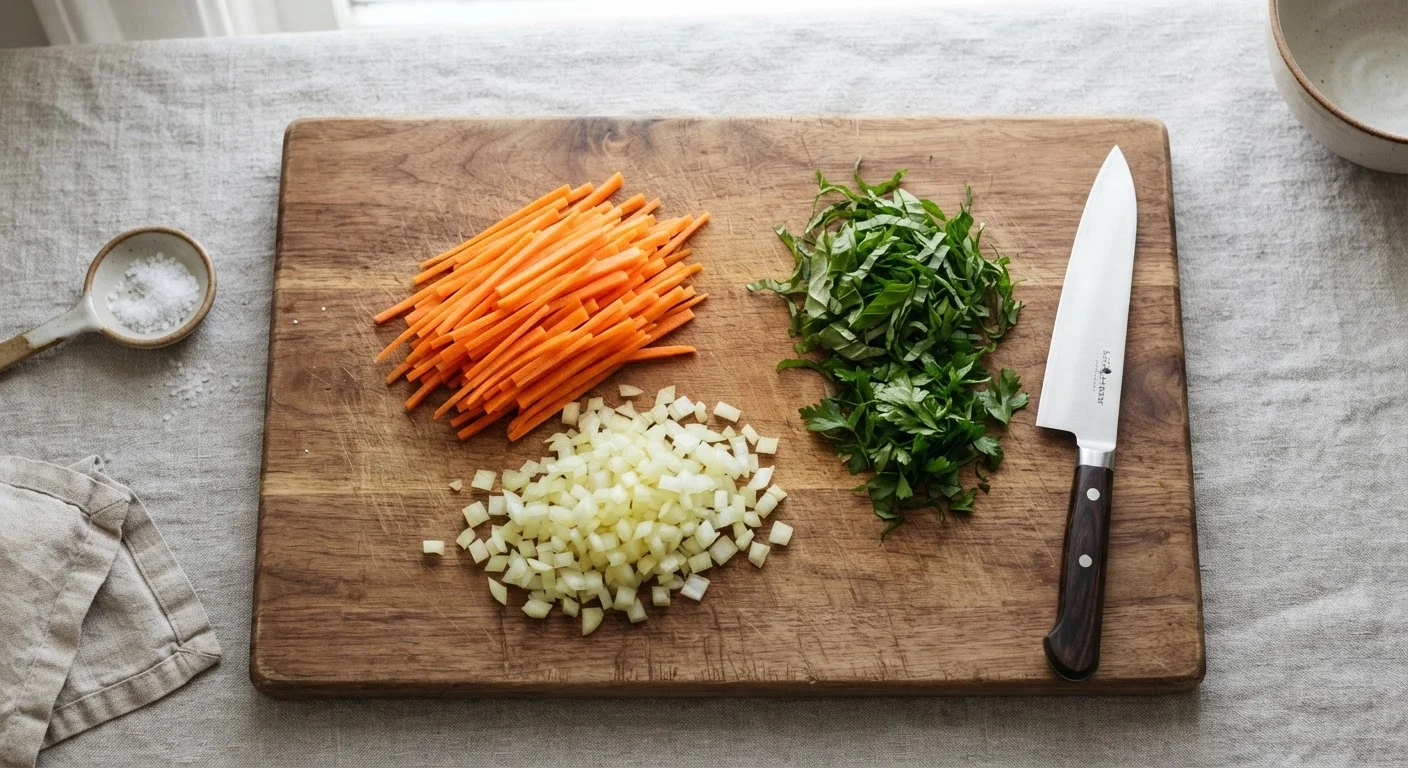
Why Knife Cut Names Actually Matter
Ever followed a recipe that called for a "fine julienne" and just... guessed? You're not alone. Knife cut terminology can feel like a culinary foreign language, but it exists for a genuinely practical reason: cut size and shape directly affect how food cooks and tastes. A chunky rough chop and a precise small dice may be the same ingredient, but they'll behave very differently in the pan.
This glossary covers the cuts you're most likely to encounter in recipes - no culinary school required. Think of it as a quick lookup tool you can return to whenever a term trips you up. And once you've got knife language sorted, pairing it with good prep habits makes a real difference - see how mise en place applies at home for a natural next step.
Chiffonade
Thin ribbons cut from stacked, rolled leafy herbs or greens. Achieved by rolling leaves tightly and slicing crosswise. Common for basil and mint.
Brunoise
Very small, precise cubes approximately 3mm on each side. Created by julienning an ingredient first, then cutting across the strips. Used for refined garnishes and sauces.
Julienne
Long, thin matchstick-shaped strips about 3mm wide and 5-6cm long. A standard cut for stir-fries, slaws, and garnishes.
Batonnet
Stick-shaped cuts roughly 6mm wide and 5-6cm long - thicker than julienne and the starting point for a medium dice. Similar in shape and size to a french fry.
Mince
Chopping an ingredient into very fine, irregular pieces, almost to a paste. Most often used for garlic, ginger, and fresh herbs.
Dice (small/medium/large)
Uniform cubes cut to a specific size: small (~6mm), medium (~12mm), or large (~20mm). Consistent sizing ensures even cooking throughout a dish.
Rough Chop
An informal, imprecise cut producing irregular pieces. Used when shape and size don't matter - typically for soups, stews, or anything that will be blended.
Bias Cut (or Diagonal Cut)
Slicing at an angle rather than straight across. Often used for vegetables like scallions and asparagus to expose more surface area and create an attractive presentation.
The Essential Cuts, Explained
Below are the knife cuts that show up most often in everyday cooking, organised from the most common to the more precise.
| Smallest named cut | Brunoise (~3mm cubes) |
| Julienne dimensions | ~3mm wide, 5-6cm long |
| Batonnet dimensions | ~6mm wide, 5-6cm long |
| Medium dice size | ~12mm (½ inch) cubes |
| Chiffonade best for | Leafy herbs and greens (basil, mint, spinach) |
| Mince vs. fine dice | Mince = irregular near-paste; fine dice = tiny uniform cubes |
Chop & Rough Chop
The most informal cut - no precision needed. Pieces are uneven and irregular, typically used when texture doesn't matter (soups, stews, or anything blended). A rough chop signals even less precision: just get it into manageable pieces.
Slice
A straightforward crosswise or lengthwise cut producing flat pieces of uniform thickness. Thickness matters here - a thin slice of garlic melts into a sauce while a thick slice holds its shape in a roast.
Dice
Cubes cut to a specific size. Recipes will often specify small dice (about 6mm/¼ inch), medium dice (about 12mm/½ inch), or large dice (about 20mm/¾ inch). Consistent sizing means everything cooks evenly.
Mince
Very finely chopping an ingredient until the pieces are almost paste-like. Garlic and fresh ginger are minced most often. The goal is tiny, irregular bits that will dissolve into a dish rather than stand out as chunks.
Julienne
Long, thin matchstick-shaped strips, typically about 3mm wide and 5-6cm long. Classic for stir-fries and slaws. A fine julienne is thinner still - almost thread-like.
Chiffonade
A technique specifically for leafy herbs and greens. Stack the leaves, roll them into a tight cylinder, then slice crosswise into thin ribbons. Basil and mint are the most common candidates.
Brunoise
Tiny, precise cubes - typically about 3mm on each side. You get there by julienning first, then cutting across the strips. It's a finishing cut used in refined sauces, garnishes, or dishes where you want the ingredient present but subtle.
Batonnet
Thicker than julienne, these are stick-shaped cuts roughly 6mm wide and 5-6cm long - essentially the starting point for a medium dice. Think of the size of a classic french fry.
Having the right knife makes all of this easier. If you're still setting up your kitchen, a first-kitchen equipment guide can help you figure out which tools are worth investing in early.
Putting It All Together
Once you can name a cut, you can also adapt it when needed. If a recipe calls for a brunoise but you're short on time, a fine mince often works. If julienne feels fiddly, batonnet gives you a similar effect with less precision. The goal is always even cooking - whatever cut gets you closest to uniform pieces is the right one for that moment.
Knife skills also connect to broader cooking fundamentals. Understanding safe cooking temperatures and heat levels pairs naturally with knowing how cut size affects cooking time. And if you're curious about the nutritional side of the ingredients you're prepping, a plain-language nutrition glossary is a handy companion reference.
The more familiar these terms become, the more confidently you'll read and adapt any recipe - and the better your food will turn out.
The content on this site is for informational purposes only and is not a substitute for professional advice. Always consult a qualified professional for guidance specific to your situation.