
Start here
What Is the U.S. Travel Advisory System?
Next
Breaking Down the Four Advisory Levels
Go deeper
What Advisories Don't Tell You
Apply it
How to Use Advisories to Plan Smarter
Before you go
Steps to Take Before Traveling to a Higher-Risk Destination
What Is the U.S. Travel Advisory System?
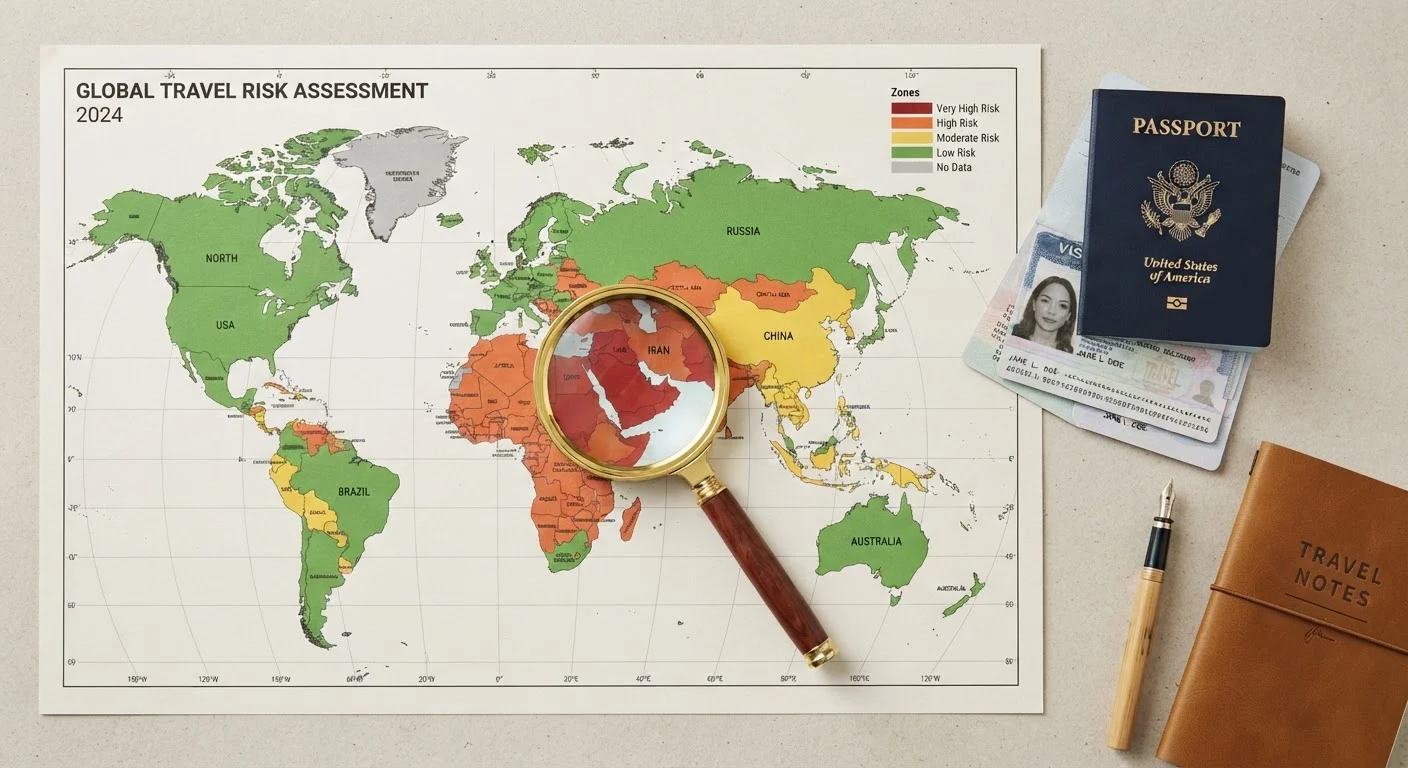
The U.S. Department of State publishes travel advisories for every country in the world. These advisories give American travelers a standardized risk assessment based on factors like crime rates, political instability, terrorism, natural disasters, and health threats. Think of them as an official safety briefing — one written specifically for U.S. citizens traveling abroad.
Advisories are housed at travel.state.gov and are freely accessible to anyone. Each country page includes the current advisory level, a plain-language explanation of the risks behind that rating, and often region-by-region breakdowns when conditions differ significantly within a country's borders.
Understanding how to read these advisories — rather than just glancing at a number — is one of the most practical skills an international traveler can develop. For a broader look at the official documents you'll want in hand, see our guide to travel documents every American should carry abroad.
Travel Advisory
An official government assessment of the risks facing its citizens in a foreign country, published to help travelers make informed decisions before they go.
STEP Program
The Smart Traveler Enrollment Program — a free State Department service that registers your trip with the nearest U.S. embassy so officials can contact you in an emergency.
Level 4 — Do Not Travel
The State Department's highest-risk advisory level, used when conditions are so dangerous that the U.S. government may be unable to provide assistance to citizens in that country.
Sub-national Advisory
A risk rating that applies to a specific region, state, or city within a country rather than the country as a whole — meaning conditions can vary sharply within borders.
Medical Evacuation
Emergency transportation to move an injured or ill traveler from a foreign location to a facility capable of providing adequate care, often covered (with conditions) by certain travel insurance policies.
Breaking Down the Four Advisory Levels
The State Department uses a four-level scale. Each level comes with a standard phrase that signals how seriously to weigh the risks:
- Level 1 — Exercise Normal Precautions: The lowest risk designation. This doesn't mean risk-free — it means conditions are comparable to what you'd encounter in many domestic settings. Standard situational awareness applies.
- Level 2 — Exercise Increased Caution: Some areas or aspects of the destination carry heightened risk. The advisory will specify what those risks are — petty crime, civil unrest, specific regions — so you know what to watch for.
- Level 3 — Reconsider Travel: Conditions in the country pose serious risks. The State Department recommends reconsidering whether the trip is necessary. Travel insurance coverage may be affected at this level, so check your policy carefully.
- Level 4 — Do Not Travel: Reserved for the most dangerous conditions — active armed conflict, terrorism, or situations where the U.S. government has limited or no ability to assist its citizens. This is the State Department's strongest warning.
Crucially, these levels often apply at a sub-national level. A country may receive an overall Level 2 rating but contain specific provinces or cities flagged at Level 4. Always read the full advisory text, not just the headline number.
Use the Region Map, Not Just the Headline
Many country advisory pages on travel.state.gov include a breakdown of risk by internal region. Before dismissing or accepting a country's overall level, scroll down to see whether your specific destination city or province carries its own separate designation. A Level 2 country can contain Level 4 zones — and vice versa.
What Advisories Don't Tell You
Travel advisories are a useful starting point, not a complete picture. Several important limitations are worth keeping in mind:
- They are not real-time: Advisories reflect conditions at the time of the last review. A situation can deteriorate quickly between updates. Cross-reference advisories with current news sources and, where relevant, alerts from destination country governments.
- They don't cover every risk equally: Advisories focus on macro-level threats. They may not address neighborhood-level safety variation in a major city or risks specific to activities like solo hiking, nightlife, or LGBTQ+ travelers in certain regions.
- They don't tell you what to pack or how to prepare: An advisory may note health risks without detailing vaccination requirements or entry health rules. Always verify entry requirements directly with the destination country's official sources.
For help parsing dense official information without getting overwhelmed, our article on how to read a destination's entry and safety information walks through this step by step.
Insurance Coverage Can Change With Advisory Level
Traveling to a Level 3 or Level 4 destination may void certain coverage provisions in your travel insurance policy. Some insurers will not reimburse trip cancellation, medical treatment, or evacuation costs if the State Department had issued a high-level advisory before you booked or departed. Always read your policy terms and contact your insurer directly with questions — coverage details vary significantly by provider and plan.
How to Use Advisories to Plan Smarter
Rather than treating an advisory as a green light or a stop sign, use it as one layer of a broader research process. Here's a practical approach:
- Read the full advisory text — not just the level. The written explanation identifies the specific risks (carjacking, kidnapping, flooding season, civil unrest in the north) so you can assess which apply to your actual itinerary.
- Check region-specific warnings. Many country pages include interactive maps or tables breaking conditions down by state or province. Your destination city may carry a different risk profile than the national average.
- Compare with allied government advisories. The UK Foreign Office, Canada's travel advisories, and Australia's Smart Traveller program sometimes assess conditions differently. A pattern across multiple governments carries more weight.
- Factor in your personal risk profile. Health conditions, citizenship status, religious identity, gender, and profession can all affect risk levels in specific destinations. Advisories are written for a general audience — your circumstances may differ.
Also review common travel safety oversights that frequently catch first-time international travelers off guard, many of which become especially consequential at higher-risk destinations.
Steps to Take Before Traveling to a Higher-Risk Destination
If you've reviewed the advisory and decided to travel to a Level 2 or Level 3 destination, a few concrete preparations can meaningfully improve your safety margin:
- Enroll in STEP. The Smart Traveler Enrollment Program (STEP) registers your trip with the nearest U.S. embassy. In a crisis — a natural disaster, civil unrest, or medical emergency — embassy staff can reach you directly. Our guide on registering with the U.S. Embassy before you travel explains exactly how to enroll.
- Review your travel insurance carefully. Confirm that your policy covers the destination given its advisory level, and understand the claims process for medical evacuation. This is general information — consult your insurer for specifics about your policy.
- Leave a detailed itinerary with someone at home. Include accommodation addresses, local contact numbers, and the nearest U.S. embassy location.
- Identify local emergency services numbers. Don't assume 911 works abroad — research the equivalent numbers for police, ambulance, and fire before you arrive.
- Keep digital and physical copies of your key documents. Store passport data pages, insurance cards, and emergency contacts separately from your originals.
This article is for general informational purposes only. Travel conditions change rapidly — always verify current advisories and entry requirements with official government sources before making travel decisions.
Frequently Asked Questions
In most cases, yes — the State Department cannot legally bar adults from traveling abroad. However, Level 4 advisories signal conditions so dangerous that the U.S. government may be unable to assist you if something goes wrong. Always verify current entry restrictions and consult official sources before making any decision.
Advisories are reviewed regularly and can be updated at any time in response to evolving security, health, or political conditions. It's good practice to check travel.state.gov within 72 hours of your departure date, even if you checked earlier in your planning process.
It can. Many travel insurance policies limit or exclude coverage for destinations under a Level 3 or Level 4 advisory. Review your policy terms carefully and contact your insurer to understand exactly what is and isn't covered before you book.
All current advisories are published at travel.state.gov. Search by country name to find the current level, a written explanation of the risks, and region-specific notes where applicable.
STEP (Smart Traveler Enrollment Program) is a free State Department service that registers your trip with the nearest U.S. embassy. It allows the embassy to contact you during emergencies and helps family members reach you in a crisis. It's strongly recommended for any international travel, especially to higher-risk destinations.
No. Advisory levels are informational guidance based on safety assessments — they are not legal bans. Travel bans are separate legal restrictions that apply in limited circumstances, such as destinations sanctioned by the U.S. government. Check official government sources to confirm any restrictions that may apply.
The content on this site is for informational purposes only and is not a substitute for professional advice. Always consult a qualified professional for guidance specific to your situation.