
How the Screening Process Actually Works
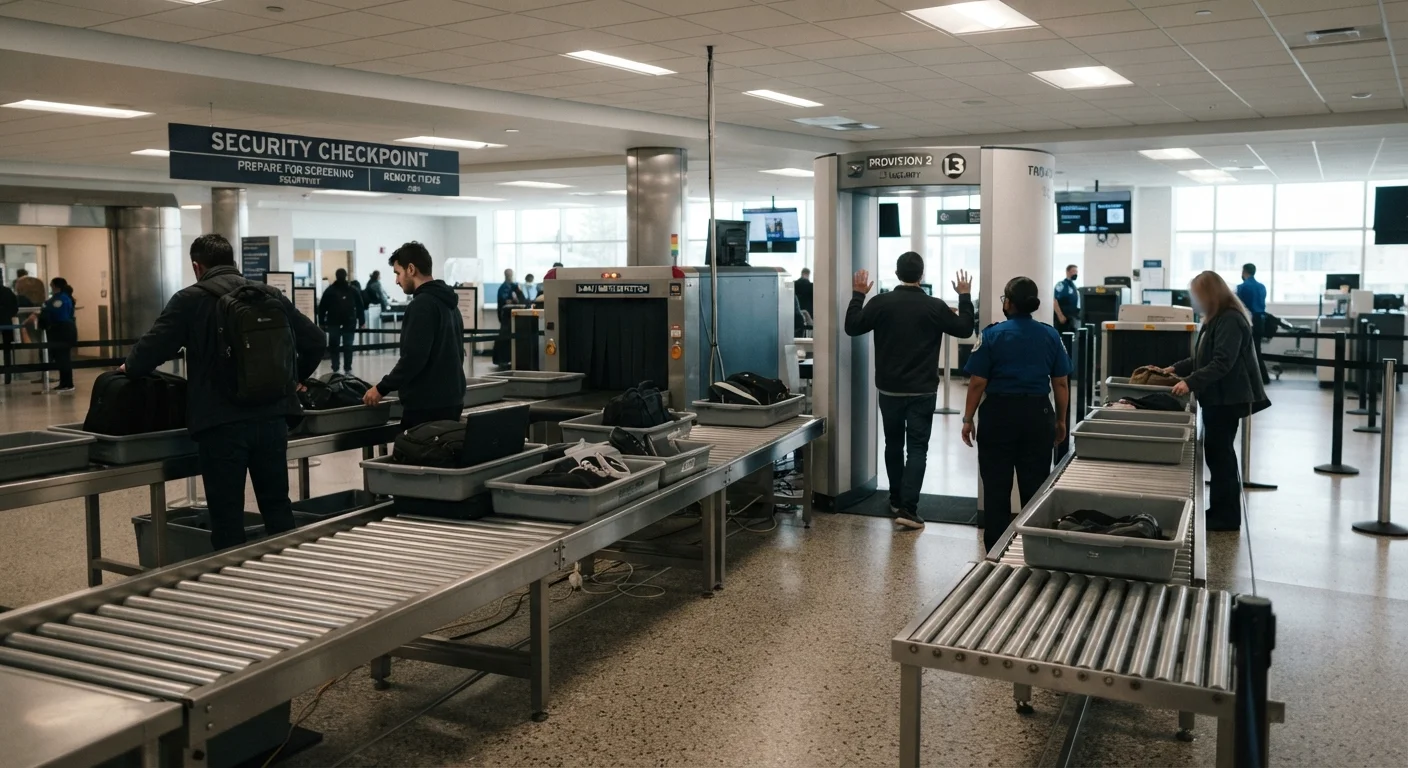
When you reach a TSA checkpoint, the process follows a predictable sequence. First, an officer checks your boarding pass and government-issued ID — or, at REAL ID-compliant airports, your REAL ID or passport. Once your identity is confirmed, you move to the baggage and body screening lanes.
Your carry-on bags go through an X-ray machine. You'll place items in gray bins: shoes, belts, jackets, laptops (unless you have PreCheck), and your liquids bag. Meanwhile, you step through either a walk-through metal detector or a millimeter-wave body scanner — the tall booth-shaped machine you step into with arms raised.
Body scanners generate a generic outline image, not a photo of your body. A remote officer reviews the image and clears you or flags an area for follow-up. No actual image of you is stored or shared under current TSA policy.
Speed Up Your Screening Before You Arrive
Pack your quart-sized liquids bag at the top of your carry-on so it's easy to pull out. Wear slip-on shoes and avoid a belt if possible. Place your phone, keys, and wallet inside your carry-on before the bin — not in a bin of their own — to reduce the chance of items being left behind on the belt.
If the scanner flags something, an officer will conduct a targeted pat-down of that specific area. This is standard and does not mean you are under suspicion of a crime.
What TSA Is — and Is Not — Allowed to Do
TSA's legal authority is focused on transportation security, not general law enforcement. Understanding this distinction helps you know your rights.
TSA can:
- Screen your body using scanners or pat-downs
- X-ray and hand-search your carry-on and checked bags
- Swab your hands or bags for explosive residue
- Deny boarding if you refuse all screening
- Refer you to law enforcement if they find evidence of a crime
TSA cannot:
- Conduct searches based solely on your race, religion, ethnicity, or national origin — this is prohibited discrimination
- Conduct a criminal investigation (that falls to local police or the FBI)
- Search the content of your phone or laptop at a domestic checkpoint as standard procedure
- Detain you beyond what is needed to resolve a screening concern
Filing a Complaint About TSA Conduct
If you believe a TSA officer acted improperly, you can file a complaint through TSA's Civil Rights and Liberties office. Document the time, location, and the officer's badge number if possible. You may also contact the TSA Contact Center or speak with a supervisor at the checkpoint before you leave the area.
If you believe a TSA officer acted improperly, you can file a complaint through TSA's Civil Rights and Liberties office. Document the time, location, and officer's badge number if possible.
The Liquids Rule, Prohibited Items, and Common Surprises
The 3-1-1 liquids rule applies to all standard checkpoint lanes: each liquid, gel, or aerosol container must be 3.4 ounces (100 ml) or less, all containers must fit in one quart-sized, clear, zip-top bag, and each traveler gets one such bag. This includes toothpaste, shampoo, sunscreen, and beverages.
Items that frequently surprise travelers at checkpoints include:
- Snow globes — treated as liquids if they contain water
- Peanut butter and jams — classified as gels, subject to the 3.4 oz limit
- Lithium batteries — spare batteries must go in carry-ons, not checked bags
- Wrapped gifts — TSA may unwrap them; consider shipping gifts or wrapping after arrival
Medications in quantities exceeding 3.4 oz are allowed but should be declared separately. Medical devices such as insulin pumps, CPAP machines, and prosthetics have specific procedures — informing the officer before screening begins reduces delays significantly. Baby formula and breast milk are also exempt from the standard liquids limit.
Before you travel, it's worth reviewing your full document checklist. See our guide to travel documents every American should carry to make sure your ID and paperwork are in order before you reach the checkpoint.
Your Rights During a Pat-Down or Additional Screening
A pat-down is a physical check conducted by a same-gender officer (unless you request otherwise). Officers are required to explain each step of the process before they perform it. You have the right to:
- Request a private screening room
- Have a companion, witness, or travel partner present
- Ask for a new pair of gloves to be used
- Ask questions about what the officer is doing and why
Pat-downs follow a defined protocol and are not arbitrary. Officers use the back of their hands in sensitive areas. If at any point you feel the screening crosses a line, you can ask for a supervisor on the spot.
Children under 12 are subject to modified screening procedures designed to minimize invasiveness. Travelers with disabilities or medical conditions can request a Passenger Support Specialist — a specially trained TSA officer — to assist them through the process.
~2.5M
Passengers screened by TSA daily
TSA publicly reports screening approximately 2.5 million passengers on an average day across more than 400 U.S. airports.
3.4 oz
Maximum liquid container size allowed
The 3-1-1 liquids rule has been in effect since 2006 and applies at all standard TSA checkpoints in the United States.
~15 min
Typical TSA PreCheck wait time
TSA states that more than 85% of PreCheck passengers wait under 10 minutes, compared to longer standard lane wait times during peak hours.
Being informed and prepared is the simplest way to move through security without friction. If you are also thinking ahead to international entry requirements, our entry requirements explainer covers what you need to verify before departure.
Frequently Asked Questions
TSA cannot force you to use a body scanner. You may opt out and request a pat-down instead. However, some form of physical screening is required to board a flight, so a pat-down is not optional — only the scanner is.
Firearms, explosive devices, and large sharp objects (such as full-size knives) are always prohibited in carry-ons. Some items, like small pocket knives, have changed rules over the years, so checking the TSA website before you pack is the most reliable approach.
TSA can ask you to power on a device to confirm it works, but a content search of your phone or laptop at a domestic checkpoint is not part of standard TSA protocol. Note that Customs and Border Protection (CBP) — a separate agency — has broader authority to inspect devices at international entry points.
An officer will flag your bag for a hand search. You have the right to observe that search. If a prohibited item is found, TSA may confiscate it, refer the matter to law enforcement, or both, depending on what was discovered.
No. TSA PreCheck allows you to use dedicated lanes where you typically keep shoes, belts, and laptops in your bag. You still pass through a metal detector and your bags are still X-rayed. TSA can still conduct additional screening at its discretion.
You can refuse, but doing so means you will not be permitted to board your flight. All passengers must complete some form of screening. If you have concerns about the process, you can request a private room, a same-gender officer, and a witness.
The content on this site is for informational purposes only and is not a substitute for professional advice. Always consult a qualified professional for guidance specific to your situation.