

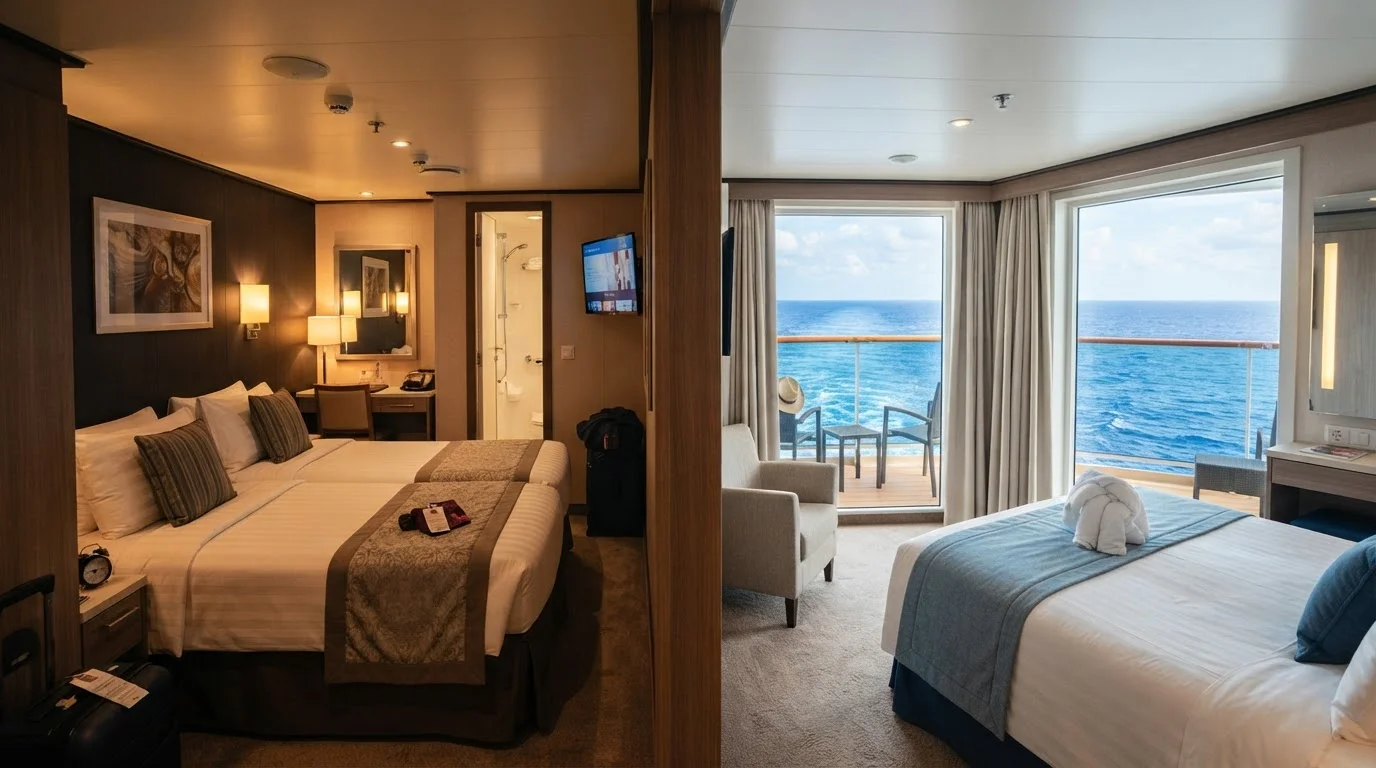
Option A
Inside Cabin
The budget-friendly, sleep-focused stateroom.
Best for: Cost-conscious travelers who plan to spend most of their time exploring ports, dining, and ship amenities rather than relaxing in their room.
Option B
Balcony Cabin
The private outdoor retreat with panoramic views.
Best for: Travelers who want a private outdoor space to enjoy sea views, fresh air, and quieter moments — and are willing to pay more for that experience.
What Separates These Two Stateroom Types
Cruise ships organize staterooms into several categories, and the most fundamental divide is between inside cabins (also called interior cabins) and balcony cabins (sometimes listed as veranda or oceanview with balcony). Inside cabins have no windows or exterior access — they rely entirely on artificial light and ventilation. Balcony cabins have floor-to-ceiling glass doors that open onto a small private outdoor deck, typically large enough for two chairs and a small table.
The price gap between these two categories is often substantial. On many mainstream cruise lines, a balcony cabin runs anywhere from $50 to $150 more per person, per night than an equivalent inside cabin on the same sailing — though the exact difference varies widely by ship, route, and booking timing. That adds up quickly on a seven-night voyage. For a fuller picture of how stateroom costs fit into your overall cruise budget, see our guide on budgeting for onboard and port costs.
| Criterion | Inside Cabin | Balcony Cabin |
|---|---|---|
| Typical price premium | Lower base fare | $50–$150+ more per person/night |
| Natural light | None | Full — glass balcony doors |
| Private outdoor space | No | Yes — small deck with seating |
| Darkness for sleeping | Excellent — fully dark | Depends on curtains/blackout blinds |
| Noise exposure | Generally quieter | More wind and exterior noise |
| Best itinerary fit | Caribbean, short sailings | Alaska, fjords, scenic routes |
| Room size | Typically smaller | Slightly larger with balcony sq ft |
| Ideal traveler | Budget-focused, active explorers | View-seekers, relaxation-oriented |
The Real Advantages of Each Option
Inside cabins have genuine strengths beyond price. Because they have no exterior wall exposure, they stay cooler and darker — ideal conditions for sleep, especially on overnight sailings or for travelers who are sensitive to light. Many experienced cruisers deliberately choose inside cabins because they simply don't use their room as a living space; the pool deck, restaurants, and entertainment venues are where they spend their time.
Balcony cabins offer something no other onboard space can match: a private, uncrowded outdoor area. On sea days, being able to step outside whenever you want — for fresh air, to watch a sunrise, or to read in the open — is a qualitatively different experience from sharing public deck chairs. This advantage grows significantly on scenic itineraries. If your route passes through places like Alaska's Inside Passage or coastal fjords, the scenery visible from a private balcony at 6 a.m. is genuinely hard to replicate from an interior lounge.
70%+
First-time cruisers who book inside cabins
Industry observers note that the majority of first-time cruisers opt for inside cabins, often upgrading on return sailings once they understand their own preferences.
7–10 nights
Average voyage length where balcony value increases
Travel advisors commonly suggest balcony cabins become more cost-justified on voyages of a week or longer, when passengers spend more passive time aboard.
It's also worth considering the length of your voyage. On a three- or four-night cruise, you'll likely spend very little time in your stateroom. On a 10- or 14-night sailing, a balcony provides meaningful daily value.
What to Watch Out For With Each Choice
Inside cabins have one notable drawback: the total absence of natural light makes it easy to lose track of time. Some passengers find this disorienting, particularly on longer sailings. The workaround is simple — use your phone or an alarm clock — but it's worth anticipating.
Balcony cabins come with their own caveats. Balconies on lower decks may be partially obstructed by lifeboats or structural overhangs. On some ship layouts, balconies are not fully private — neighbors on adjacent cabins may be able to see in depending on partition design. Check deck plans carefully before booking if privacy matters to you. Balcony cabins are also typically located on higher decks, which can mean more noticeable ship movement in rough weather — relevant if you're prone to seasickness.
Security is another point: cruise lines advise against leaving valuables on balconies and generally discourage smoking on them unless the ship has designated areas. Review your cruise line's specific balcony policies before booking. For travelers managing health conditions, cabin location and accessibility can intersect in important ways — our article on cruising with a health condition covers what to research before you commit.
Cabin Location Matters Too
Whether you choose an inside or balcony cabin, where it sits on the ship affects your experience. Mid-ship cabins on lower decks typically feel the least motion — a plus for anyone prone to seasickness. Cabins directly above or below entertainment venues or the galley can be noisier than their category suggests. Review the ship's deck plan carefully when selecting your specific stateroom, not just your cabin category.
How to Make the Final Call
The right choice depends on three things: your itinerary, your travel style, and your budget priorities. Ask yourself honestly how much time you'll spend in your stateroom. If the answer is "just to sleep," an inside cabin is almost certainly the smarter financial move — those savings can fund a meaningful shore excursion or two. For guidance on planning port time wisely, see shore excursions: ship vs. booking on your own.
If your itinerary features dramatic natural scenery, or if you're the kind of traveler who genuinely recharges with quiet outdoor time, the cost of a balcony cabin is easier to justify. The same logic applies if you're traveling with a partner and want a shared private space that isn't the main bed area.
One practical middle ground: some ships offer oceanview cabins — a category between inside and balcony that includes a porthole or fixed window but no outdoor access. These offer natural light without the full balcony premium, and they're worth checking when they're available. Whatever you decide, be aware that hidden cruise costs like gratuities, drink packages, and Wi-Fi fees can affect your total spend regardless of cabin type. And for broader strategies on managing travel expenses, the Travel on a Budget hub offers practical guidance across every stage of trip planning.
Pricing, availability, and cabin specifications vary by cruise line, ship, and sailing date. Always verify current details directly with your cruise line or a licensed travel professional before booking.
The content on this site is for informational purposes only and is not a substitute for professional advice. Always consult a qualified professional for guidance specific to your situation.