

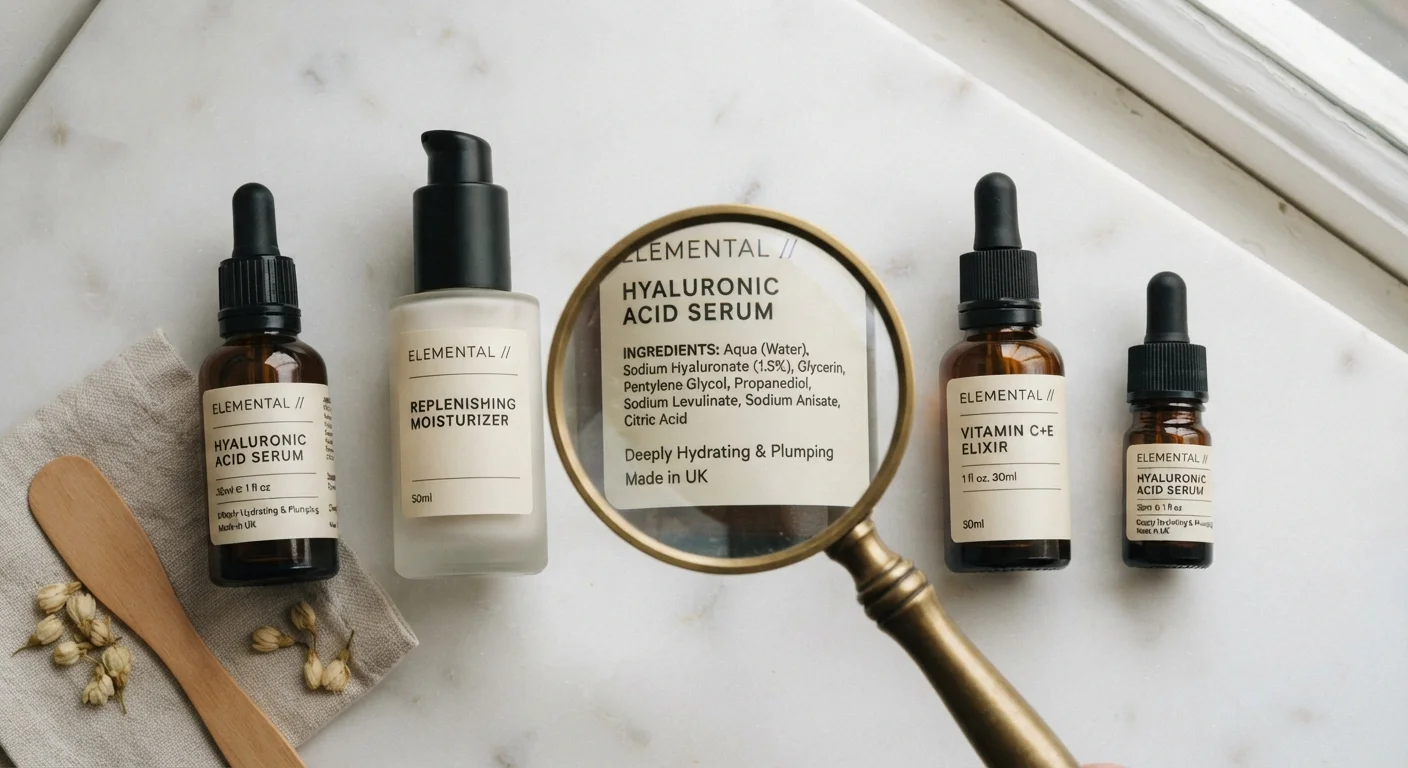
Why Skincare Labels Look So Complicated
Pick up almost any serum or moisturizer and you'll find an ingredient list that reads like a grad school chemistry quiz. Names like sodium hyaluronate, ascorbyl glucoside, and tocopheryl acetate can make even curious shoppers give up and just go with whatever smells nice. But those names follow predictable rules, and once you learn a few patterns, the list starts to make sense.
Skincare ingredients in the U.S. are listed using INCI — International Nomenclature of Cosmetic Ingredients. This is a standardized naming system, which means the same ingredient carries the same name on every product label worldwide. The order matters too: ingredients are listed from highest to lowest concentration. Whatever appears first makes up the bulk of the formula. Whatever appears at the very end is present in tiny amounts — often less than 1%.
Before diving into specific ingredients, it helps to know that the FDA regulates cosmetic labeling in the U.S., but most marketing terms like "clean" or "gentle" are not legally defined. For a closer look at how those phrases can mislead, check out how marketing language on labels actually works.
INCI
International Nomenclature of Cosmetic Ingredients — the global standardized system for naming cosmetic ingredients on product labels. It ensures that the same ingredient has the same name no matter which brand uses it.
Humectant
An ingredient that attracts and retains water molecules, either from the environment or from deeper skin layers. Hyaluronic acid and glycerin are common examples used to keep skin hydrated.
Emollient
An ingredient that softens and smooths the skin's surface by filling in gaps between skin cells. Oils, shea butter, and ceramides are typical emollients found in moisturizers.
Retinoid
A broad category of Vitamin A derivatives used in skincare. Retinol is the over-the-counter form; prescription retinoids like tretinoin are stronger and regulated differently.
Antioxidant
A molecule that neutralizes free radicals — unstable compounds caused by sun exposure and pollution that can damage skin cells. Vitamins C and E are well-known antioxidants used in skincare.
Occlusant
An ingredient that forms a physical barrier on the skin to lock in moisture and prevent water loss. Petrolatum and dimethicone are common occlusants found in thicker creams and ointments.
The Ingredients You'll See Most Often — Decoded
Here's a plain-English breakdown of the ingredients that show up repeatedly across skincare products, what they actually do, and who they're generally suited for.
Hyaluronic Acid (Sodium Hyaluronate)
Despite the word "acid," this one doesn't exfoliate. Hyaluronic acid is a naturally occurring molecule that draws moisture from the environment into the skin — a process called humectancy. It works best when applied to damp skin, then sealed in with a moisturizer. Sodium hyaluronate is a smaller salt form of the molecule that may penetrate slightly deeper into the skin's surface layers.
Niacinamide (Vitamin B3)
One of the most versatile ingredients in skincare. Niacinamide is well-studied for its ability to support the skin's barrier, reduce the appearance of enlarged pores, and even out uneven skin tone over time. It plays well with most other ingredients and is generally tolerated by sensitive skin types.
Retinol (and the Retinoid Family)
Retinol is a form of Vitamin A and one of the most researched ingredients in cosmetic dermatology. It encourages faster skin cell turnover, which is why it's associated with smoothing texture and minimizing fine lines over time. It also comes with a learning curve — dryness, flaking, and sun sensitivity are common when starting out. If you're new to it, get the full picture on retinol before you begin.
Vitamin C (Ascorbic Acid and Its Derivatives)
Vitamin C is an antioxidant that helps neutralize free radical damage from UV exposure and pollution. Pure ascorbic acid is the most studied form but also the least stable — it oxidizes quickly when exposed to air and light. Derivatives like ascorbyl glucoside or sodium ascorbyl phosphate are more stable, though potentially less potent.
AHAs and BHAs (Chemical Exfoliants)
Alpha hydroxy acids (AHAs) like glycolic acid and lactic acid work on the skin's surface to dissolve the bonds between dead skin cells. Beta hydroxy acids (BHAs) — most commonly salicylic acid — are oil-soluble, meaning they can penetrate into pores. AHAs tend to suit dry or dull skin; BHAs are often recommended for acne-prone or oily skin.
| Ingredient list order | Listed highest to lowest concentration (FDA cosmetic labeling regulations) |
| Naming standard used on U.S. labels | INCI (International Nomenclature of Cosmetic Ingredients) |
| Typical effective niacinamide range | 2%–10% concentration in studied formulas (Published cosmetic dermatology literature) |
| Retinol skin sensitivity note | Increased sun sensitivity is common when starting use (American Academy of Dermatology general guidance) |
| Hyaluronic acid best-use tip | Apply to damp skin before sealing with moisturizer |
| AHAs vs. BHAs | AHAs work on the surface; BHAs penetrate pores |
How to Use This Knowledge When Shopping
Knowing what an ingredient does is only half the equation. Concentration matters enormously — a product listing niacinamide in the second-to-last spot likely won't deliver noticeable results. Effective niacinamide concentrations in studied formulas typically fall between 2% and 10%, but few labels tell you the exact percentage.
Ingredient interactions matter too. Most popular skincare ingredients layer well together, but a few combinations deserve some care. For example, high-strength Vitamin C and benzoyl peroxide may counteract each other. Layering multiple exfoliating acids at once can irritate skin, especially when starting out.
If you're just building your routine from scratch, ingredient knowledge is a great foundation, but the order and method you apply products matters just as much. Start with the basics of a simple skincare routine before layering in actives.
Finally, keep in mind that marketing language on packaging can obscure what's really in a formula. Terms like "infused with," "featuring," or "powered by" don't tell you whether an ingredient is present in a meaningful amount. Many popular skincare beliefs don't hold up to scrutiny — approaching labels with a little healthy skepticism is always a good call.
This article is for general informational purposes only and is not a substitute for personalized advice from a licensed dermatologist or healthcare provider. If you have a skin condition or concerns about a specific ingredient, consult a qualified professional.
The content on this site is for informational purposes only and is not a substitute for professional advice. Always consult a qualified professional for guidance specific to your situation.