

Where the Rule Comes From
The 50/30/20 framework was introduced by Elizabeth Warren and Amelia Warren Tyagi in their 2005 book All Your Worth. Their argument was straightforward: most budgeting systems are too complicated for people to stick with. A three-category split is easy enough to remember and flexible enough to actually use.
The idea caught on because it doesn't require tracking every receipt or categorizing dozens of line items. You simply look at your take-home pay, do three pieces of math, and know roughly where your money should land each month. That simplicity is the point.
“The secret to having it all is knowing that you already do — but only if you give every dollar a job. A simple framework beats a complicated one you abandon after two weeks.”
— Amelia Warren Tyagi, Co-author of 'All Your Worth' and personal finance researcher
Breaking Down the Three Buckets
50% — Needs: This covers essentials — the bills and expenses your life genuinely depends on. Rent or mortgage payments, utilities, groceries, transportation to work, health insurance premiums, and minimum debt payments all belong here. A useful test: if skipping it would put your housing, health, or job at risk, it's a need. For a more detailed look at drawing that line, see Needs vs. Wants: Drawing the Line in Your Own Budget.
30% — Wants: This is the spending that makes life enjoyable but isn't strictly necessary. Dining out, streaming subscriptions, gym memberships, travel, clothing beyond the basics, and hobby expenses fit here. Wants aren't frivolous — they matter for quality of life — but they're where you have the most flexibility when money is tight. Curious where vacation spending lands? Our breakdown of where your vacation money actually goes is a useful companion.
20% — Savings and Debt Repayment: This slice builds your financial safety net. It includes contributions to an emergency fund, retirement accounts like a 401(k) or IRA, and extra payments on high-interest debt beyond the minimums. Prioritizing this category is how you make progress toward financial stability over time.
57%
Americans living paycheck to paycheck
According to a 2023 LendingClub report, roughly 57% of U.S. consumers described themselves as living paycheck to paycheck, highlighting how many households lack a structured spending plan.
$1,000
Emergency fund gap for many Americans
A Bankrate survey found that fewer than half of U.S. adults could cover a $1,000 emergency expense from savings alone, underscoring the importance of building the 20% savings habit.
30%
Recommended housing cost ceiling
Financial planners commonly suggest keeping total housing costs at or below 30% of gross income — a figure that aligns closely with the needs portion of the 50/30/20 framework.
Applying It to a Real Paycheck
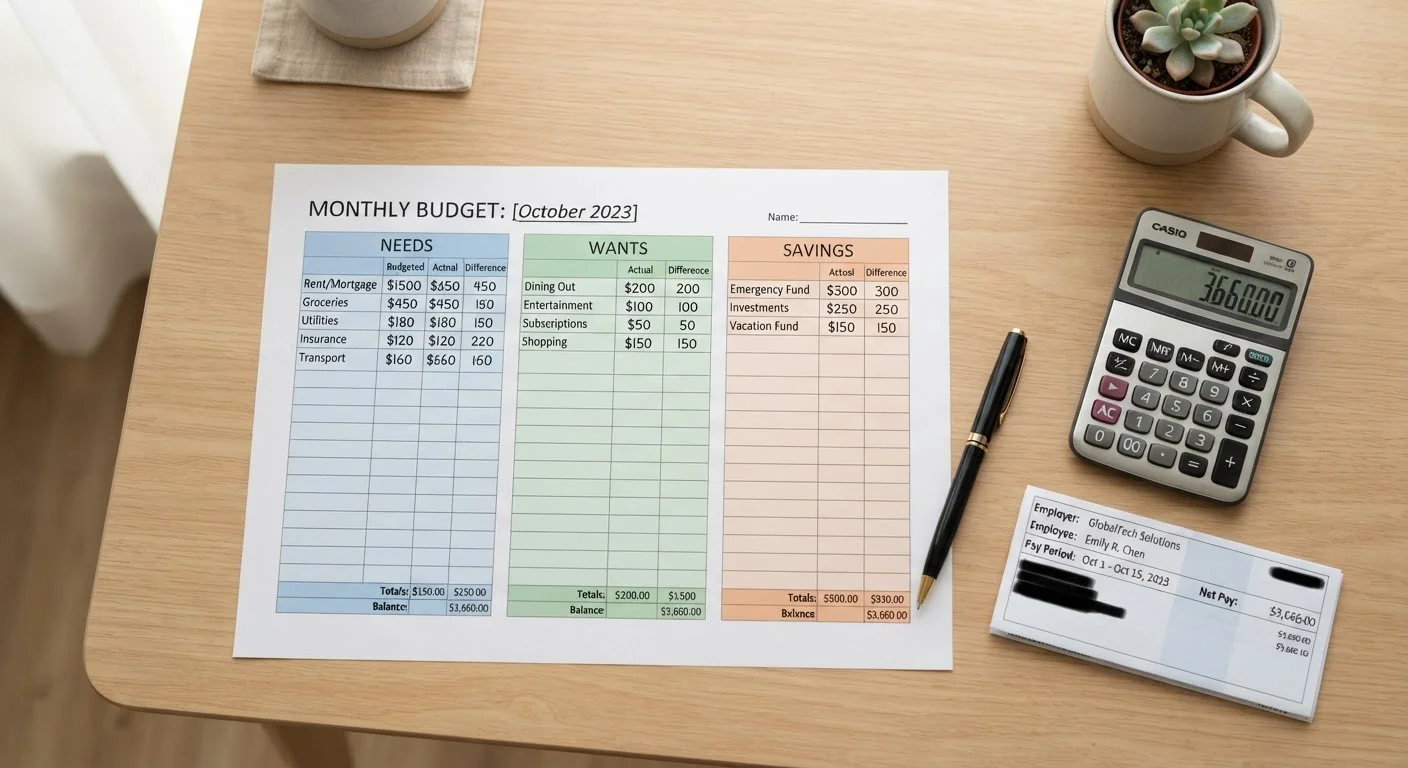
Say your take-home pay is $3,500 per month. Here's how the rule maps out:
| Category | Percentage | Dollar Amount |
|---|---|---|
| Needs | 50% | $1,750 |
| Wants | 30% | $1,050 |
| Savings / Debt | 20% | $700 |
Start by totaling your fixed needs — rent, utilities, minimum loan payments, insurance. If that number is under $1,750, you're within range. If it's over, you'll need to trim wants or look for longer-term ways to reduce fixed costs.
Not sure where your spending currently stands? It helps to trace your cash flow first. Where Does Your Money Actually Go Each Month? walks through exactly how to do that.
Automate the 20% First
Set up an automatic transfer to your savings or retirement account on the same day your paycheck lands. When the money moves before you can spend it, hitting the 20% target becomes much easier. Even a small automated transfer builds the habit and grows over time.
When to Adjust the Percentages
The 50/30/20 split is a starting point, not a law. Several real-world situations call for modification:
- High cost-of-living areas: Rent alone can consume more than 50% of take-home pay in expensive cities. In these cases, many people shift to something like 60/20/20 and work to grow income or reduce housing costs over time.
- Carrying high-interest debt: If you have credit card balances at 20%+ interest, it may make sense to temporarily reduce the wants category and push more toward debt repayment within the 20% bucket — or even expand it.
- Low income: When income is very tight, needs may naturally crowd out wants entirely. The rule still provides a direction: protect the savings slice as much as possible even if the amounts are small.
- Variable income: Apply the percentages to actual monthly earnings rather than a fixed number. See Saving Consistently When Your Income Varies for approaches built around irregular paychecks.
Once you've been using the framework for a few months, a monthly savings audit can help you check whether the 20% goal is actually being met and where gaps are appearing.
The Rule Works Best as a Starting Point
No single percentage split fits every income level, family size, or cost of living. The 50/30/20 rule is a widely used guideline — not a prescription. Use it to identify where your spending is out of balance and make intentional adjustments, rather than treating it as a pass/fail test.
This article is for general informational and educational purposes only and does not constitute personalized financial advice. For guidance specific to your situation, consider speaking with a licensed financial professional.
Frequently Asked Questions
It uses your take-home pay — the amount deposited into your account after taxes and other payroll deductions. Using gross income would give you inflated numbers that don't reflect what you can actually spend or save.
Needs are expenses you cannot reasonably avoid: rent or mortgage, utilities, groceries, minimum debt payments, basic transportation, and health insurance. If your lifestyle would be seriously disrupted without it, it's likely a need. See <a href="/personal-finance/budgeting-basics/needs-vs-wants-drawing-the-line-in-your-own-budget">our guide on needs vs. wants</a> for a deeper breakdown.
That's common, especially in high-cost cities or on lower incomes. When needs exceed 50%, trim the wants category first, then look for ways to reduce fixed costs over time — like refinancing debt or seeking lower-cost housing. The percentages are targets, not rules you'll be penalized for missing.
Yes. The 20% bucket covers emergency savings, retirement contributions, and any debt payments above the required minimum. Minimum required payments are typically counted as 'needs,' but extra payments toward debt come from this savings slice.
It can work, but requires adaptation. Instead of fixed dollar amounts, apply the percentages to whatever you earn each month. Our article on <a href="/personal-finance/saving-and-credit/saving-consistently-when-your-income-varies-month-to-month">saving on a variable income</a> covers practical strategies for uneven paychecks.
The framework is widely associated with U.S. Senator Elizabeth Warren and her daughter Amelia Warren Tyagi, who described it in their 2005 book 'All Your Worth.' It has since been popularized as a general personal finance guideline.
The content on this site is for informational purposes only and is not a substitute for professional advice. Always consult a qualified professional for guidance specific to your situation.