

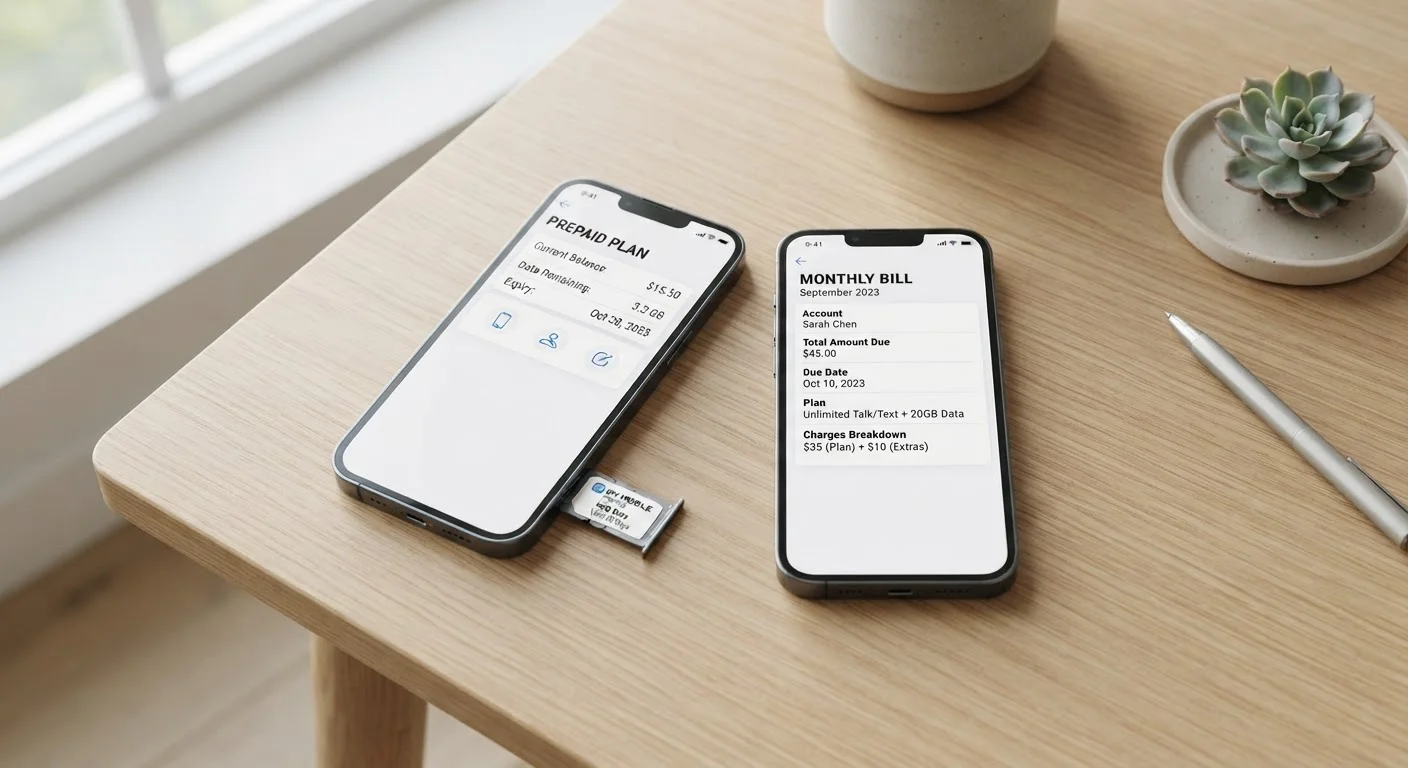
Option A
Prepaid Plans
The pay-upfront, no-commitment option.
Best for: People who want cost control, flexibility, or don't need a financed device.
Option B
Postpaid Plans
The traditional monthly-bill, full-service option.
Best for: People who want premium network access, device financing, and family plan features.
How Each Billing Model Actually Works
The core difference between prepaid and postpaid comes down to when money changes hands. With a prepaid plan, you buy your service before you use it — you load a balance or purchase a monthly bucket of data, calls, and texts ahead of time. When that allowance runs out or the period ends, service stops unless you top up or renew.
With a postpaid plan, the carrier extends you a month of service on credit, then bills you at the end of the billing cycle. That bill reflects your base plan cost plus any taxes, fees, or overages that accumulated during the month. Because the carrier is effectively trusting you to pay, a credit check is usually required to open a postpaid account.
This billing structure has a direct effect on how predictable your monthly expenses are. Prepaid amounts are fixed in advance — you cannot spend more than you loaded. Postpaid bills can vary if you go over your data limit or add international calls. For context on how fixed versus variable costs affect your broader budget, see how fixed and variable expenses work.
| Criterion | Prepaid | Postpaid |
|---|---|---|
| When you pay | Before service is used | After the billing cycle ends |
| Credit check required | No | Typically yes |
| Contract or commitment | None | Often month-to-month or device term |
| Network deprioritization | More likely during congestion | Less likely during congestion |
| Device financing | Rarely available | Widely available via installments |
| Family/multi-line plans | Limited options | Robust shared-plan options |
| Monthly cost (general) | Often lower base price | Often higher, with more bundled perks |
Network Access, Priority, and What Deprioritization Means
One difference that often surprises people: prepaid and postpaid customers on the exact same carrier's network can experience different service quality. Carriers use a practice called deprioritization — when a cell tower is congested, they temporarily slow down certain users to manage traffic. Prepaid subscribers are almost always deprioritized before postpaid subscribers on the same carrier.
In practical terms, this usually only matters in crowded areas like stadiums, city centers at rush hour, or large events. Day-to-day, most prepaid users notice no difference. But if you rely on consistent data speeds in dense urban environments, it is worth factoring in. You can find a plain-English explanation of deprioritization and related terms in our glossary of mobile plan terms.
~40%
US mobile subscribers on prepaid service
Industry analysts have estimated that roughly four in ten US wireless subscribers use prepaid or MVNOs (mobile virtual network operators) rather than traditional postpaid accounts.
24–36 months
Typical postpaid device installment term
Most major US carriers now spread smartphone financing across 24 or 36 monthly payments tied to a postpaid account, effectively replacing two-year contracts.
Flexibility, Contracts, and Device Financing
Prepaid plans are inherently flexible. There is no contract, no early termination fee, and no credit obligation. You can switch carriers, change plans, or pause service with minimal friction. This makes prepaid particularly useful for people who travel internationally and want a temporary domestic SIM, or anyone whose usage needs change from month to month.
Postpaid plans trade some of that flexibility for additional capabilities. The most significant is device financing. Carriers offer installment plans that spread a phone's cost over 24 or 36 months, billed directly on your monthly statement. This model is nearly exclusive to postpaid accounts. Additionally, postpaid accounts tend to support more sophisticated family plan structures — multiple lines under one account with shared data and per-line pricing discounts.
Before settling on either type, it is worth running through a checklist of practical factors. Our guide on what to verify before committing to a mobile plan covers coverage maps, contract terms, and account features worth confirming ahead of time.
One more consideration: if you are choosing a newer phone, check whether it uses an eSIM. Both prepaid and postpaid service can work with eSIM technology, but the activation process differs by carrier type. See eSIM vs. physical SIM explained for more detail.
MVNOs: A Third Path Worth Knowing
Many prepaid plans are sold by MVNOs — Mobile Virtual Network Operators — which lease network capacity from the major carriers rather than owning towers themselves. An MVNO prepaid plan might run on the same physical network as a postpaid plan from a large carrier, but at a lower price point. The trade-off is typically lower priority during congestion and less direct customer support. For a broader overview of how these plan types fit together, see our guide to mobile plans for first-time buyers.
The content on this site is for informational purposes only and is not a substitute for professional advice. Always consult a qualified professional for guidance specific to your situation.