

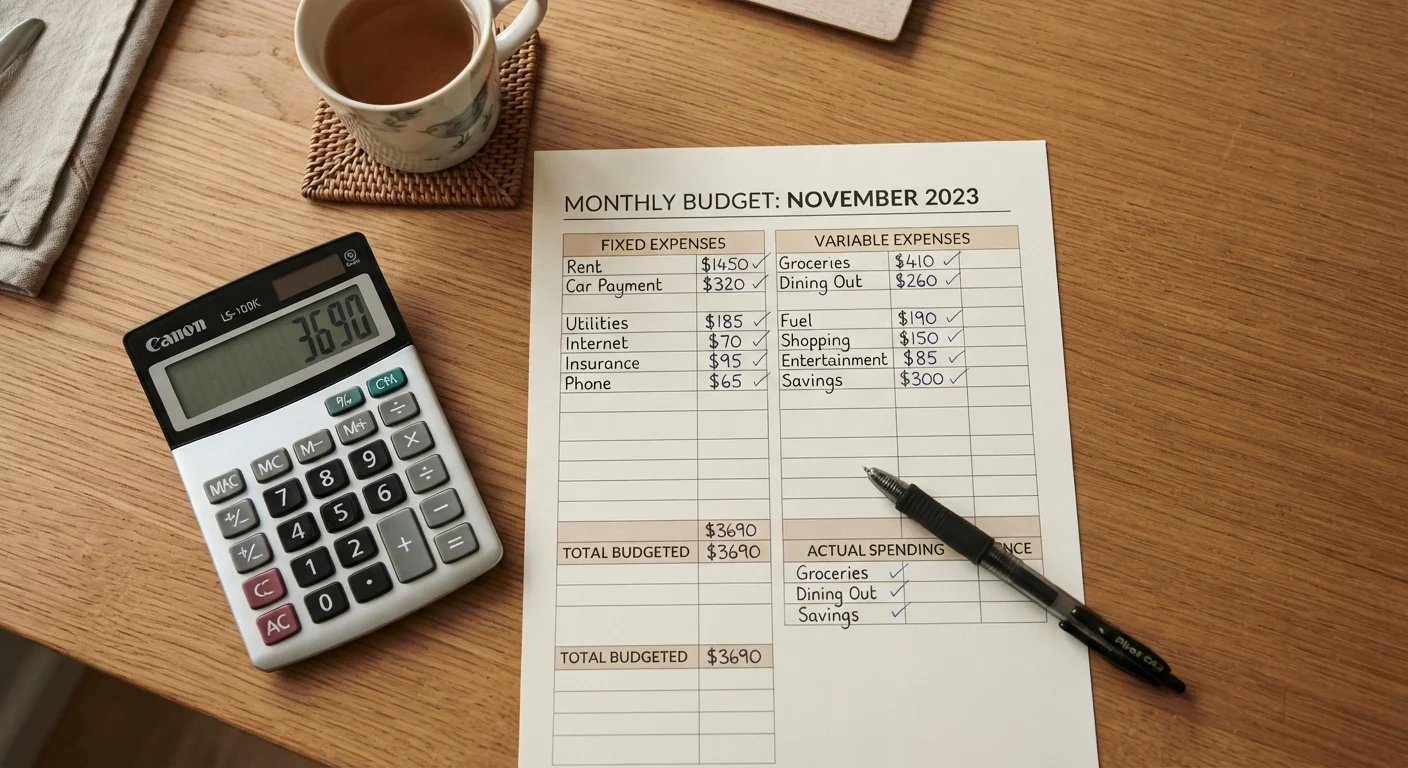
Option A
Fixed Expenses
The predictable, non-negotiable costs you can plan around.
Best for: Building a reliable budget baseline because the amount stays the same every billing cycle.
Option B
Variable Expenses
The flexible costs that shift month to month.
Best for: Finding the spending categories where you have the most real-world control over your budget.
What Makes an Expense Fixed or Variable?
When you look at your monthly spending, every cost falls into one of two buckets. Fixed expenses are bills that come in at the same amount every single month — your rent or mortgage payment, a car loan, and any subscription with a locked-in rate. You know exactly what they'll be before the month even starts.
Variable expenses, by contrast, shift from one month to the next. Groceries, gas, utility bills, dining out, and clothing are common examples. Some months you spend more; some months less. The total depends on your habits, the season, and what life throws at you.
Neither category is inherently good or bad. The goal is simply to know which is which — because you manage them very differently. For a deeper look at a related distinction, see our guide to separating needs from wants in your own budget.
Fixed vs. Variable: A Side-by-Side Look
Seeing the two categories compared directly makes the differences concrete. The table below covers the most important dimensions to understand before you start building a budget.
| Criterion | Fixed Expenses | Variable Expenses |
|---|---|---|
| Amount each month | Same every billing cycle | Changes month to month |
| Common examples | Rent, mortgage, car loan, insurance premium | Groceries, gas, utilities, dining out |
| Predictability | High — easy to plan around | Low to moderate — requires tracking |
| Control you have | Low — set by contract or agreement | High — driven by daily decisions |
| Where to start in a budget | List first; subtract from income | Estimate from past spending; track actively |
| Room to cut quickly | Limited without major life changes | Significant — many options to reduce |
How Each Type of Expense Affects Your Budget
Fixed expenses give your budget its skeleton. Because these amounts don't change, you can subtract them from your monthly income immediately and know exactly how much is left for everything else. Most financial educators recommend listing all fixed costs first, before assigning a single dollar to discretionary spending.
Variable expenses require a different approach. Rather than treating them as fixed-and-forgotten, you estimate based on past spending — then track actively throughout the month. This is where budget categories like groceries, gas, and utilities live.
~33%
Average share of income spent on housing alone
The U.S. Bureau of Labor Statistics Consumer Expenditure Survey consistently finds housing is the largest single fixed expense for American households.
~15%
Average share of income spent on food
Food — a classic variable expense — typically accounts for roughly 12–17% of household spending according to USDA data, with significant variation by income level.
Variable costs are also where the most budget flexibility hides. If money is tight one month, you can trim the grocery bill, skip a restaurant meal, or delay a clothing purchase. You generally cannot do the same with your rent or car payment without serious consequences.
If your paycheck itself changes from month to month, understanding this distinction becomes even more critical. Our article on budgeting on an irregular income walks through strategies built specifically for that situation.
A Third Category Worth Knowing: Irregular Expenses
Once you understand fixed and variable costs, you'll quickly notice a third category that trips up most budgets: irregular expenses. These are costs that don't show up every month — car repairs, annual insurance premiums, medical bills, holiday gifts — but are entirely predictable if you zoom out over a full year.
They aren't truly variable in the everyday sense, and they aren't fixed either. The practical solution is to average them out monthly and set that amount aside in advance. This is sometimes called a sinking fund — a dedicated savings bucket for known future costs.
For a full breakdown of how to handle these outliers, see our article on budgeting for irregular expenses.
Some Expenses Can Be Both
Utility bills like electricity or gas are often called variable expenses because the dollar amount shifts with usage. But they're also a regular, recurring necessity — which puts them in a gray zone. For budgeting purposes, track these for two or three months and use your average as a planning estimate. That turns an unpredictable number into something you can work with.
This article is for general informational purposes only and does not constitute personalized financial advice. For guidance tailored to your situation, consider consulting a licensed financial professional.
The content on this site is for informational purposes only and is not a substitute for professional advice. Always consult a qualified professional for guidance specific to your situation.