

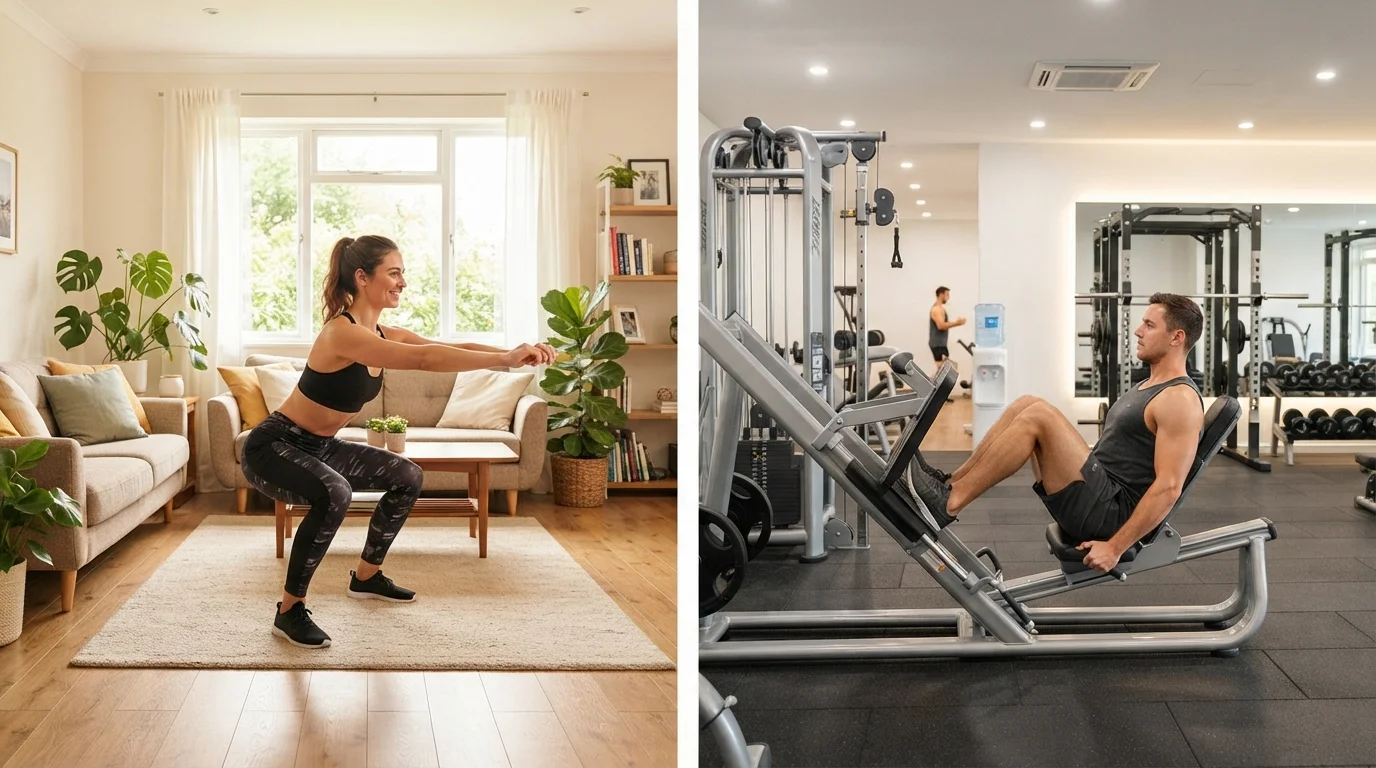
Our Verdict
Both home and gym workouts can build real fitness for beginners — neither has a built-in advantage. The right choice depends on what removes friction and keeps you showing up. If cost or commute is a barrier, home is a great starting point. If you need equipment variety or thrive on social energy, a gym may keep you more consistent.
| Best for | Recommended |
|---|---|
| Those with tight budgets or unpredictable schedules | Home Workouts |
| Beginners who need variety, equipment, or in-person guidance | Gym Workouts |
| People who struggle with self-motivation at home | Gym Workouts |
| Those who want maximum flexibility with minimal commitment | Home Workouts |
The Real Question for Beginners
When you're just getting started with exercise, the hardest part usually isn't the workout itself — it's actually showing up. That's why choosing between a home workout and a gym membership deserves more thought than a quick Google search. The "best" option is simply the one you'll do consistently, week after week.
Before picking a side, it helps to understand what each environment genuinely offers and where each one falls short. As you read, keep in mind that this is general information to help you think through your own situation — not personalized fitness advice. For questions about your individual health, always check in with a qualified healthcare professional first. You may also want to review this readiness checklist before committing to any new routine.
Home Workouts: Honest Pros and Cons
Working out at home removes a lot of the logistical friction that stops beginners before they even start. There's no commute, no membership fee, and no anxiety about being watched by experienced gym-goers. You can exercise in whatever you're wearing, pause whenever you need to, and repeat the same beginner routine without feeling self-conscious.
Bodyweight exercises — think squats, push-ups, lunges, and planks — require zero equipment and can deliver a solid full-body workout. Free video resources and apps make it easier than ever to follow structured routines at home. For more ideas on structuring your week without a gym, see this home routine guide.
The drawbacks are real, though. Home environments are full of distractions — kids, laundry, the couch. Without a designated workout space or a set schedule, it's easy to keep postponing. Progression also has a natural ceiling without weights or machines, though resistance bands and adjustable dumbbells can extend that range affordably.
Start With What Removes the Most Friction
If the thought of packing a bag, driving to a gym, and finding parking feels exhausting before you've even started, that friction will quietly sabotage your routine. Beginning at home — even with just 15-minute bodyweight sessions — lets you build the habit first. You can always add a gym later once movement feels natural. Progress matters more than the setting.
Gym Workouts: Honest Pros and Cons
A gym gives you access to equipment that simply isn't practical at home — cable machines, barbells, rowing machines, and more. This variety makes it easier to balance cardio and strength training as your fitness develops. Many gyms also offer group fitness classes, which can be a powerful motivator for people who thrive on social energy and structure.
For some beginners, having a specific place designated for exercise creates a mental cue that makes it easier to stay in workout mode. The commute, while a barrier for some, actually acts as a commitment device for others — once you're there, you're less likely to cut the session short.
On the downside, memberships carry a monthly cost, and gyms can feel intimidating when you're new. Peak-hour crowds, complicated machines, and comparison to more experienced exercisers are common reasons beginners feel uncomfortable. Understanding common fitness myths can help dissolve some of that pressure before it derails your momentum.
| Home Workouts | Gym Workouts | |
|---|---|---|
| Cost | Low to none (optional small equipment) | Monthly membership fee required |
| Convenience | No commute, available anytime | Requires travel; limited by hours |
| Equipment variety | Limited without investment | Wide range of machines and free weights |
| Beginner-friendliness | Private, low-pressure environment | Can feel intimidating at first |
| Accountability | Relies on self-motivation | Classes and staff support available |
| Progression potential | Moderate (higher with bands/weights) | High with guided programming |
| Social element | Minimal unless virtual | In-person community and classes |
What Actually Predicts Success
Research consistently points to consistency — not intensity, not equipment — as the factor most tied to long-term fitness gains. A moderate home routine done three times a week will outperform an ambitious gym plan abandoned after two weeks. Steady, modest effort builds lasting habits in a way that all-or-nothing approaches rarely do.
Think honestly about these questions: Does traveling to a gym feel energizing or exhausting? Do you get distracted at home? Is budget a real constraint right now? Your answers matter more than any general recommendation. Many beginners also discover that a hybrid approach — a few home sessions plus one or two gym visits per week — gives them the flexibility of both worlds without fully committing to either. Whatever you choose, understanding why beginners quit can help you sidestep the most common pitfalls from day one.
This article is for general informational purposes only and is not a substitute for personalized medical or fitness advice. Consult a qualified healthcare professional before beginning any new exercise program, especially if you have an existing health condition.
The content on this site is for informational purposes only and is not a substitute for professional advice. Always consult a qualified professional for guidance specific to your situation.