

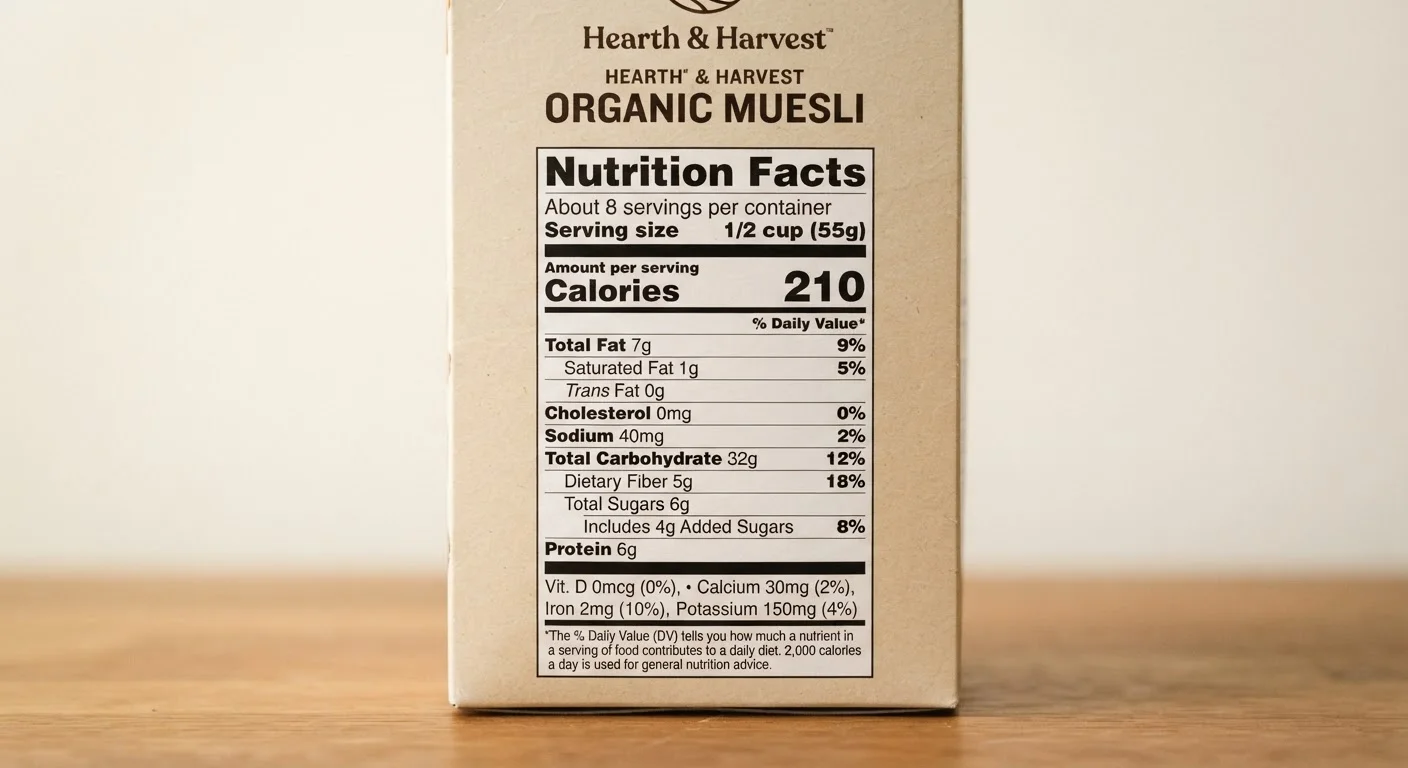
Start at the Top: Serving Size and Calories
The very first thing on a Nutrition Facts label — serving size — is also the most commonly misread. Serving size isn't a recommendation. It's a standardized reference amount the FDA sets so that every label can be compared on equal footing. If a bag of chips lists a serving size as 1 oz (about 28 chips) but you eat 2 oz, every number on that label doubles for your portion.
Calories appear just below serving size in large, bold type. They reflect the total energy in one serving from all three macronutrients: fat, carbohydrates, and protein. Calories are one data point — useful context, but not the whole story of a food's nutritional value.
Check Servings Per Container First
Before reading any other number, look at how many servings are in the whole package. A bottle of juice might list 110 calories per serving — but if there are 2.5 servings per container and you drink the whole thing, you're looking at 275 calories. This single check prevents the most common label misreads.
Understanding % Daily Value
The right-hand column of the label — labeled %DV — is one of the most practical tools on the panel. It answers the question: how much does one serving of this food contribute to a full day's intake? The FDA bases these percentages on a 2,000-calorie daily diet, which is used as a general reference standard.
The rule of thumb is straightforward: 5% DV or less is considered low for a nutrient; 20% DV or more is considered high. So if a food has 35% DV of sodium per serving, that's a significant portion of a full day's sodium in one go. If it has 15% DV of fiber, that's a meaningful contribution toward a nutrient many Americans fall short on.
~90%
Americans exceed recommended sodium intake
According to the CDC, about 90% of Americans ages 2 and older consume more sodium than recommended dietary guidelines suggest.
< 10%
Adults meeting daily fiber recommendations
Research published in the American Journal of Lifestyle Medicine found that fewer than 10% of U.S. adults meet recommended fiber intake levels.
2,000
Calorie baseline used for %DV calculations
The FDA uses a 2,000-calorie daily diet as the standard reference for calculating all % Daily Value figures on the Nutrition Facts label.
This framework helps you compare foods quickly — even if you never studied nutrition.
The Nutrients Worth Knowing
The label organizes nutrients into two informal groups. Nutrients to limit — saturated fat, sodium, and added sugars — appear toward the top of the nutrient list. Current dietary guidance suggests most Americans tend to consume too much of these, and chronic high intake is associated with various health concerns. For a deeper look at how fats are categorized, see our guide to dietary fats.
Nutrients to get enough of — dietary fiber, vitamin D, calcium, iron, and potassium — appear lower on the label. These are nutrients many Americans consume in insufficient amounts. For a closer look at one of the most commonly underconsumed, check out why fiber matters.
The label also separates total sugars from added sugars. Added sugars are those introduced during processing — not the naturally occurring kind found in whole fruit or plain dairy. Understanding this distinction matters for how you read a label. Our companion article on natural vs. added sugar walks through this in detail.
Using the Label as a Tool, Not a Scorecard
The Nutrition Facts label is most useful as a comparison and awareness tool — not a pass/fail grading system for your food choices. You might use it to compare sodium levels between two canned soups, check whether a snack has meaningful fiber, or understand why a small portion of a food feels surprisingly filling (hello, fat content).
What the label doesn't do is account for your full diet, your health history, your activity level, or the dozens of other factors that shape what nourishing eating looks like for you personally. For the ingredient-level view that sits just below the label, reading an ingredient list can help you decode what's actually in the food.
Labels Have Limits
The Nutrition Facts label covers required and voluntarily disclosed nutrients, but it doesn't capture everything about a food's nutritional profile. Phytonutrients, antioxidants, and many micronutrients don't appear. Think of the label as one useful lens — not the complete picture of a food's value in your diet.
This article is for general informational purposes only and is not a substitute for personalized nutrition or medical advice. If you have specific dietary needs or health conditions, consult a registered dietitian or qualified healthcare professional.
Frequently Asked Questions
% Daily Value (%DV) shows how much of a nutrient one serving of a food provides relative to a 2,000-calorie daily diet. A %DV of 5% or less is considered low, while 20% or more is considered high. It's a quick way to compare foods or gauge if a nutrient is abundant or scarce in a single serving.
Not necessarily. Serving sizes are standardized reference amounts set by the FDA to make label comparisons easier — they're based on typical consumption patterns, not dietary recommendations. You might eat more or less than the listed serving size, and that's perfectly normal.
Total sugars include both naturally occurring sugars (like those in fruit or milk) and sugars added during processing. Added sugars are the ones mixed in by manufacturers — like cane sugar or corn syrup. Limiting added sugars is a key focus of current dietary guidance, which is why they now have their own line on the label.
No. Calorie counts are just one piece of the label. Many people find the %DV column more useful for understanding nutrient balance without tallying numbers. The label is most helpful as a comparison tool — for instance, checking sodium between two soup brands — rather than a calorie-counting worksheet.
It depends on your personal health context, which is best discussed with a healthcare provider or registered dietitian. Generally, federal dietary guidance suggests most Americans benefit from paying attention to fiber, potassium, vitamin D, and calcium (nutrients often under-consumed) alongside saturated fat, sodium, and added sugars (often over-consumed).
Not everything. The label covers FDA-required nutrients and any nutrients a manufacturer voluntarily includes. It doesn't show every vitamin, mineral, or bioactive compound in the food. For full ingredient detail, the ingredient list below the label provides additional context.
The content on this site is for informational purposes only and is not a substitute for professional advice. Always consult a qualified professional for guidance specific to your situation.