

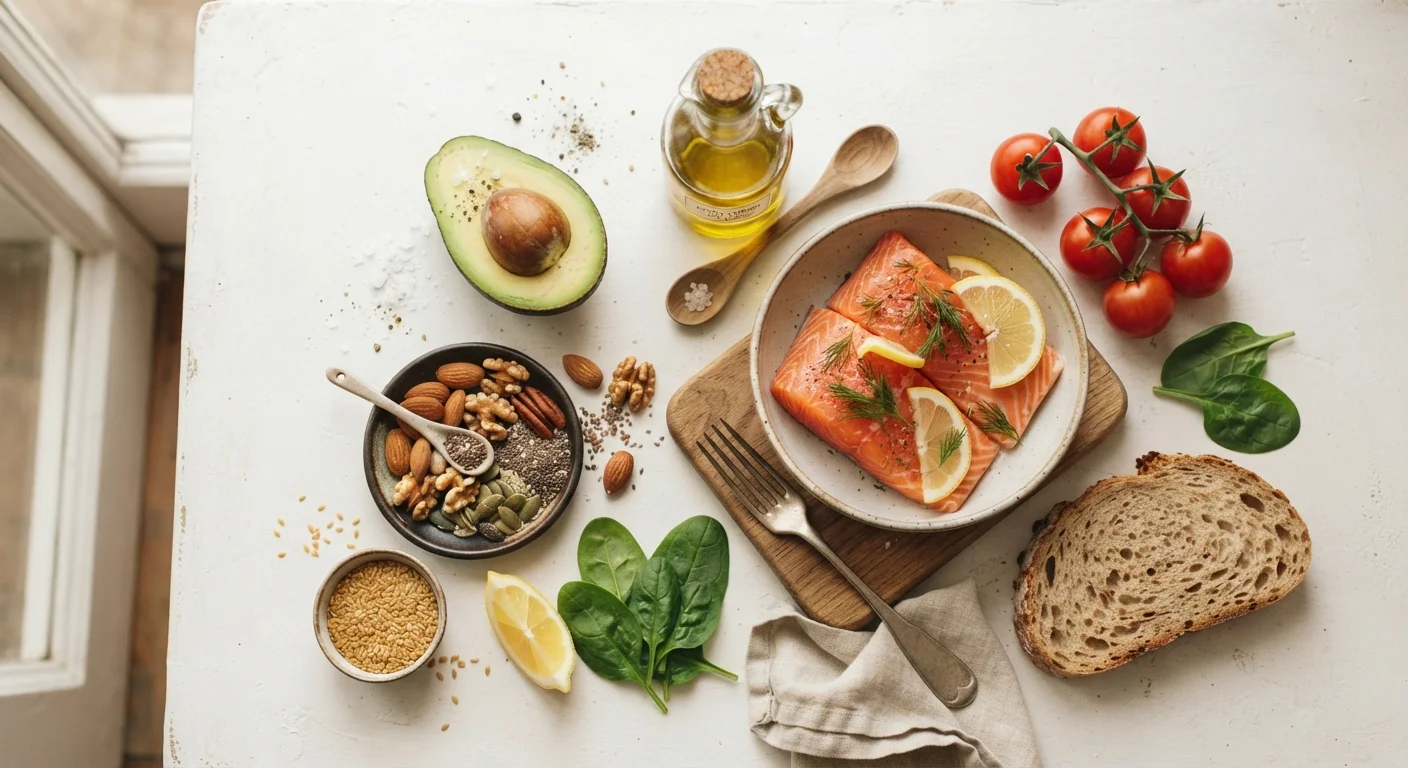
Why Fat Belongs in Your Diet
For years, fat was cast as the villain of healthy eating. That framing has largely been revised by nutrition science. Fat is a macronutrient — meaning your body needs it in meaningful amounts to function. It helps absorb fat-soluble vitamins (A, D, E, and K), supports cell membranes, and provides a sustained energy source. The real story is more nuanced than simply eating less fat: what kind you eat matters considerably more than the total amount alone.
This guide breaks down the main types of dietary fat in plain language — no diet-culture baggage, no fear. For more on reading these details on a package, see how to decode the Nutrition Facts label.
| Fat's role | Absorbs fat-soluble vitamins, supports cell function, provides energy |
| Main fat types | Saturated, monounsaturated, polyunsaturated, trans |
| Trans fat status (U.S.) | Industrial trans fats largely phased out of the food supply (U.S. Food and Drug Administration) |
| Essential fatty acids | Omega-3 and omega-6 must come from food (National Institutes of Health) |
| Fat-soluble vitamins | A, D, E, and K require dietary fat for absorption |
The Four Main Types of Dietary Fat
Most foods contain a mix of fat types rather than just one. Here's what each category means and where it tends to show up.
Saturated Fat
Saturated fats are solid at room temperature — think butter, the fat marbled through red meat, and coconut oil. The term "saturated" refers to their chemical structure: carbon chains fully loaded with hydrogen atoms. Current guidance from organizations like the American Heart Association suggests keeping saturated fat intake moderate, as higher consumption is associated with elevated LDL (low-density lipoprotein) cholesterol in some people. That said, the relationship is more complex than once believed, and research continues to evolve.
Unsaturated Fat
Unsaturated fats are generally liquid at room temperature and found in plant-based oils, nuts, seeds, and fatty fish. There are two subtypes:
- Monounsaturated fat — found in olive oil, avocados, and almonds. Associated with heart-friendly cholesterol patterns in research.
- Polyunsaturated fat — includes omega-3 and omega-6 fatty acids. Omega-3s, found in fatty fish like salmon and in walnuts and flaxseed, are among the most researched fats in terms of cardiovascular and anti-inflammatory effects.
Trans Fat
Artificial trans fats are created by partially hydrogenating vegetable oils — a process that extends shelf life but produces a fat the body handles poorly. The FDA moved to eliminate industrially produced trans fats from the U.S. food supply, and most have been phased out. Small amounts of naturally occurring trans fats exist in some animal products; these appear to behave differently than artificial versions, though research is ongoing.
Saturated Fat
A type of fat whose carbon atoms are fully bonded to hydrogen atoms, making it solid at room temperature. Found in animal products and some tropical oils like coconut and palm oil.
Unsaturated Fat
A fat with one or more double bonds in its carbon chain, typically liquid at room temperature. Includes both monounsaturated and polyunsaturated varieties, commonly found in plant oils, nuts, and fish.
Trans Fat
A fat formed through partial hydrogenation of vegetable oils. Industrially produced trans fats have been largely removed from the U.S. food supply due to their association with cardiovascular risk.
Omega-3 Fatty Acids
A type of polyunsaturated fat considered essential because the body cannot synthesize it. Found in fatty fish, walnuts, and flaxseed; widely studied for cardiovascular and anti-inflammatory effects.
LDL Cholesterol
Often called "bad" cholesterol, LDL (low-density lipoprotein) carries cholesterol through the bloodstream. Elevated LDL levels are associated with increased cardiovascular risk in some individuals.
Hydrogenation
An industrial process that adds hydrogen to liquid vegetable oils to make them more solid and shelf-stable, which can create artificial trans fats as a byproduct.
Understanding fat types pairs well with understanding other macronutrients. Common nutrition myths, including "all fat is bad," are addressed in our deeper look at what the science actually says.
Fat in Context: Practical Takeaways
Knowing these categories is useful, but food is rarely just one type of fat. A handful of peanuts contains monounsaturated, polyunsaturated, and some saturated fat together. A few grounding points:
- Replacing saturated fat with unsaturated fat — rather than eliminating fat entirely — is the pattern most supported by current cardiovascular research.
- Omega-3 fatty acids are considered essential because the body cannot produce them; they must come from food or supplements (consult a healthcare provider before adding supplements).
- Processed foods labeled "low fat" often replace fat with added sugar to maintain palatability. Understanding added versus natural sugar can help you spot this trade-off on labels.
- Fiber and fat often coexist in whole plant foods like legumes, nuts, and seeds — a useful pairing for satiety.
Fat Totals Vary Naturally by Food
Most whole foods — meat, dairy, nuts, fish — contain a blend of fat types rather than a single category. A food being high in saturated fat doesn't automatically make it harmful, and a food being high in unsaturated fat isn't automatically unlimited. Overall dietary patterns matter more than any single food or nutrient in isolation, according to mainstream nutrition science.
This article provides general nutrition information for educational purposes only and is not a substitute for personalized medical or dietary advice. Consult a qualified healthcare provider or registered dietitian for guidance specific to your health needs.
The content on this site is for informational purposes only and is not a substitute for professional advice. Always consult a qualified professional for guidance specific to your situation.