

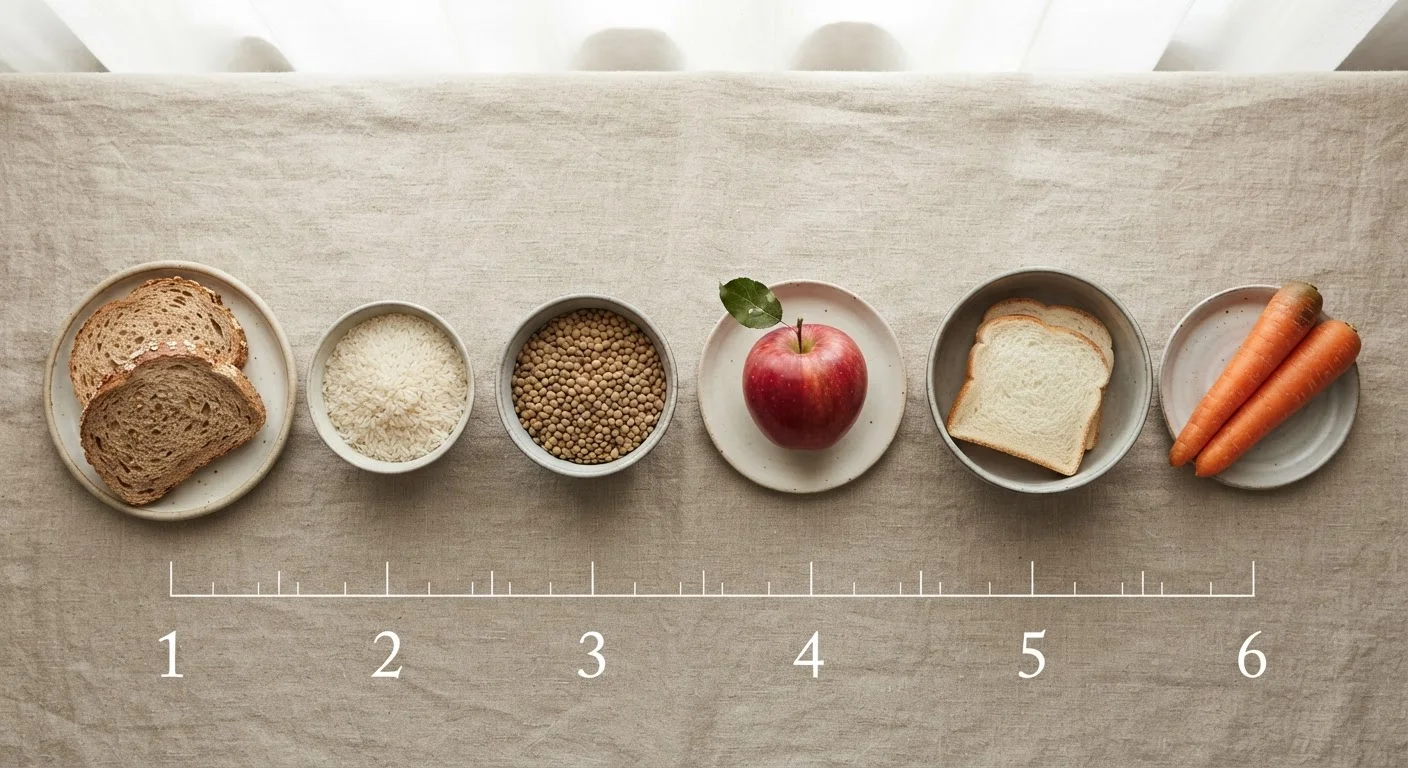
What the Glycaemic Index Actually Measures
At its core, the glycaemic index answers a specific, narrow question: how fast does a given carbohydrate food push blood glucose up, compared to pure glucose? Researchers measure this by having volunteers eat a fixed portion of a food containing 50 grams of digestible carbohydrate, then tracking their blood sugar over two hours. The resulting curve is compared to what happens after eating the same amount of pure glucose. That comparison becomes the GI score.
It's a useful starting point for understanding carbohydrate quality. White rice and brown rice both contain starch, but they digest at different speeds - and the GI captures that difference. Similarly, the index helps explain why two foods with identical calorie counts can affect the body quite differently in terms of energy release.
The index is part of a broader set of nutrition concepts worth understanding. If you want a fuller picture of the numbers behind food labels, our guide to reading a nutrition label covers how carbohydrate figures are reported on standard packaging.
Where the GI Score Falls Short
The GI's biggest limitation is built into how it's designed. The score comes from a single food eaten on its own, in a controlled amount, under lab conditions. That's rarely how anyone actually eats.
When you pair a high-GI food with fat, protein, or fibre - which is what most meals involve - digestion slows down and the blood sugar response changes. A bowl of white rice eaten plain has a different glycaemic effect than white rice eaten with grilled fish, vegetables, and a little olive oil. The GI of the rice doesn't change, but your body's response to the meal does.
0-100
GI scale range for carbohydrate foods
Pure glucose sets the benchmark at 100; all other carbohydrate foods are scored relative to this reference point.
~72
GI score of watermelon
Despite its high GI, a standard serving of watermelon contains few enough carbohydrates to keep its glycaemic load low.
~38
Typical GI score of lentils
Legumes like lentils consistently score in the low-GI range, partly due to their high fibre and protein content slowing digestion.
Portion size is another gap. The GI is measured using a standardised 50-gram carbohydrate dose, regardless of how much of that food a person would typically eat. Watermelon has a high GI score (around 72), which can sound alarming - but a normal slice contains relatively few digestible carbohydrates, so the real-world blood sugar impact is modest. This is where glycaemic load (GL) - which adjusts for serving size - becomes more informative than the GI alone.
Food preparation matters too. Cooking method, degree of ripeness, and even food temperature can shift a GI score by meaningful amounts. Published GI tables can't account for every variation in your kitchen.
Foods That Tend to Surprise People
Some common foods land in unexpected places on the GI scale. Carrots sit in the high-GI range (around 70-80) despite being widely considered nutritious. As explained above, their actual carbohydrate content per normal serving is low enough that their glycaemic load stays modest - the score alone is misleading without that context.
On the flip side, some foods with a low GI aren't necessarily health-promoting. Certain highly processed snack foods, including some types of chocolate and crisps, score lower than you might expect because their fat content slows digestion. A low GI is not a proxy for nutritional quality.
Legumes - lentils, chickpeas, black beans - consistently score low on the GI scale and are also high in fibre and plant protein, making them genuinely multi-dimensional nutritionally. Dietary fibre plays a particularly important role in slowing carbohydrate digestion, which is part of why whole, minimally processed plant foods tend to cluster toward the lower end of the GI scale.
How to Use GI as One Tool Among Many
The GI isn't useless - it's just not the complete story people sometimes treat it as. For researchers comparing carbohydrate quality across food groups, it's a valuable standardised measure. For individuals managing blood sugar, it can be a helpful reference when used alongside portion guidance from a qualified healthcare professional.
For everyday eating decisions, a more practical approach is to think about the whole meal rather than individual food scores. A plate that combines a carbohydrate source with vegetables, protein, and some healthy fat will typically produce a more gradual blood sugar response than the same carbohydrate eaten alone - regardless of what GI number is published for it.
“The glycaemic index is a property of a food, not of a diet. A diet's overall effect on blood glucose depends on the mixture of foods eaten, their portions, preparation methods, and individual variation - none of which the GI alone captures.”
— Walter Willett, Professor of Epidemiology and Nutrition, Harvard T.H. Chan School of Public Health
It's also worth understanding how sugar fits into this picture. Not all sweeteners and sugars behave identically - our article on natural versus added sugar explains the distinctions in straightforward terms. And for anyone who wants definitions of glycaemic index alongside other common nutrition terms in one place, the everyday nutrition glossary is a useful reference.
This article is for general informational purposes only and is not a substitute for personalised medical or dietary advice. If you have specific health concerns or conditions affecting blood sugar management, please consult a qualified healthcare professional.
Frequently Asked Questions
Foods scoring 55 or below are classified as low-GI, 56-69 as medium, and 70 or above as high-GI. These thresholds were established by researchers who developed the index and are widely used in nutrition literature, though some organisations use slightly different cut-offs.
Not necessarily. A food can have a low GI score but still be high in saturated fat, refined ingredients, or calories. Ice cream, for example, has a lower GI than many breads because its fat content slows glucose absorption. Overall dietary pattern matters far more than any single score.
Carrots score around 70-80 on the GI scale, but a typical serving contains very few digestible carbohydrates - so their glycaemic load (GL) is actually low. This is a classic example of why the GI score alone can mislead: you'd need to eat an unusually large amount of carrots for the score to translate into a meaningful blood sugar spike.
Yes, significantly. Pasta cooked al dente has a lower GI than the same pasta cooked until soft. Cooling cooked potatoes and reheating them can lower their GI due to resistant starch formation. These factors are not reflected in standard published GI tables.
People managing blood sugar conditions such as type 2 diabetes sometimes find GI a helpful reference when used alongside portion guidance from a healthcare professional. Researchers also use it as a tool to compare carbohydrate quality across foods. For most people, it's one lens among many rather than a primary guide.
Glycaemic load multiplies a food's GI score by the amount of carbohydrate in an actual serving, then divides by 100. This gives a more realistic picture of blood sugar impact at the quantities people normally eat. A food can have a high GI but a low GL if a typical serving is small.
The content on this site is for informational purposes only and is not a substitute for professional advice. Always consult a qualified professional for guidance specific to your situation.