

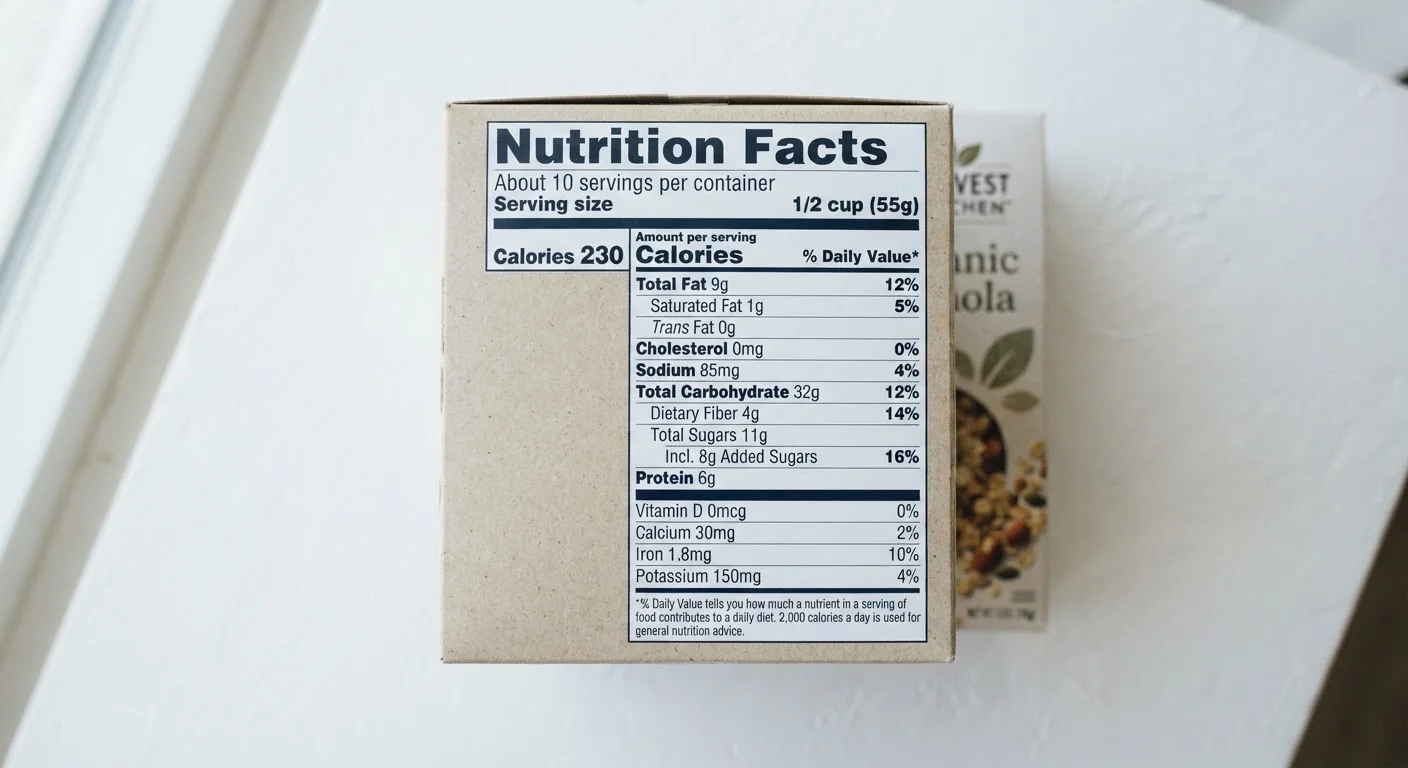
Start Here: Serving Size and Calories
The very top of a Nutrition Facts panel anchors everything else: serving size and the number of servings per container. This is the most important starting point because every single number below it - calories, fat, sodium, vitamins - applies to that specific serving amount, not the whole package.
Serving sizes are standardized by the FDA to reflect amounts people typically eat in one sitting, not what a manufacturer recommends. A bag of chips might list a serving as 1 oz (about 28g), but if you eat twice that, every number doubles. Always check servings per container first.
Calories follow immediately. They represent the total energy one serving provides. Calories themselves don't signal whether a food is "good" or "bad" - they're just a measure of energy. Context matters: a 200-calorie food rich in fiber and protein fuels you differently than a 200-calorie food made almost entirely of sugar.
Labels Are a Starting Point, Not a Prescription
The Nutrition Facts panel is a tool for comparison and general awareness - not a precise prescription for how you should eat. Individual calorie and nutrient needs vary based on age, activity level, health status, and other factors. For personalized guidance, a registered dietitian is the most qualified resource.
For a deeper look at how label language can be shaped by marketing, see our piece on common nutrition claims that sound scientific but aren't.
The Middle Section: Fats, Sodium, and Carbohydrates
Below calories, the panel breaks down three main nutrient categories you'll encounter in almost every food.
Fats
Total Fat is listed first, with Saturated Fat and Trans Fat broken out underneath. Total fat includes all fat types - saturated, unsaturated, and trans. Dietary guidelines generally suggest limiting saturated fat and avoiding artificial trans fats, which is why they're highlighted separately. Unsaturated fats (found in nuts, seeds, and oils) don't have their own dedicated line but are implied in the difference.
Sodium
Sodium is listed in milligrams. It's worth paying attention to, particularly because packaged foods can contribute significant amounts even when they don't taste especially salty. The %DV column gives useful context here - 20% DV or more in a single serving is considered high.
Carbohydrates
Total Carbohydrate includes dietary fiber, total sugars, and added sugars as sub-categories. Added Sugars became a required line item on updated labels because naturally occurring sugars (in fruit, for example) behave differently in the body than sugars added during processing. Seeing both figures helps you understand what a food's sweetness actually comes from.
The ingredient list alongside the nutrition panel can help confirm where those added sugars originate.
| Panel regulated by | FDA (U.S. Food and Drug Administration) |
| Reference calorie level for %DV | 2,000 calories per day (FDA Nutrition Labeling Guidelines) |
| "Low" nutrient threshold (%DV) | 5% DV or less (FDA label claim definitions) |
| "High" nutrient threshold (%DV) | 20% DV or more (FDA label claim definitions) |
| Current label format effective | January 2020 (most manufacturers) (FDA Nutrition Facts label update) |
| Nutrients required on every label | Calories, total fat, saturated fat, trans fat, cholesterol, sodium, total carbohydrates, dietary fiber, total sugars, added sugars, protein, Vitamin D, calcium, iron, potassium (FDA mandatory label nutrients) |
Protein, Vitamins, and the % Daily Value Column
Protein is listed in grams but notably does not carry a %DV on most labels - the FDA determined that protein deficiency is uncommon in the U.S. for most people, so the percentage isn't required unless a protein claim is made or the food is intended for children under four.
At the bottom of the panel, you'll find four required micronutrients: Vitamin D, Calcium, Iron, and Potassium. These were chosen because Americans commonly fall short of them. Older labels featured Vitamins A and C instead, but the formula was updated to reflect current public health data.
Reading the % Daily Value Column
The %DV column is one of the most practical parts of the label once you understand the shorthand. It tells you how much of a nutrient one serving contributes relative to a daily reference of 2,000 calories. 5% DV or less is low; 20% DV or more is high. You can use this to quickly compare two products or to gauge whether a food is a meaningful source of a nutrient you care about - or a heavy hitter for something you're keeping an eye on, like sodium.
For a broader look at nutrition vocabulary, our everyday nutrition glossary covers terms like bioavailability and glycemic index in plain language.
Serving Size
The standardized amount of food used as a reference for all nutrition information on the label. It reflects typical consumption amounts, not necessarily a recommended portion.
% Daily Value (%DV)
A percentage showing how much of a nutrient one serving contributes toward general daily reference amounts. Based on a 2,000-calorie reference diet - your actual needs may differ.
Added Sugars
Sugars and syrups added during food processing or preparation, distinct from naturally occurring sugars found in fruit or dairy. Listed separately under Total Sugars on the panel.
Saturated Fat
A type of fat found primarily in animal products and some plant oils. It is listed separately on labels because dietary guidelines distinguish it from unsaturated fats.
Dietary Fiber
The indigestible portion of plant foods. It is listed on the label because most people in the U.S. consume less than recommended amounts.
Trans Fat
A type of unsaturated fat that has been artificially hydrogenated. Artificial trans fats have been largely removed from the U.S. food supply but still appear on some labels.
This article is for general informational purposes only and is not a substitute for personalized nutrition advice. Consult a registered dietitian or qualified healthcare professional for guidance specific to your health needs.
The content on this site is for informational purposes only and is not a substitute for professional advice. Always consult a qualified professional for guidance specific to your situation.