

Start here
What an Ingredient List Actually Is
Core skill
How Order Works: The Weight Rule
Go deeper
Decoding Common Entries You'll See
Nuance
Ingredients Inside Ingredients
Round it out
What the List Doesn't Tell You
What an Ingredient List Actually Is
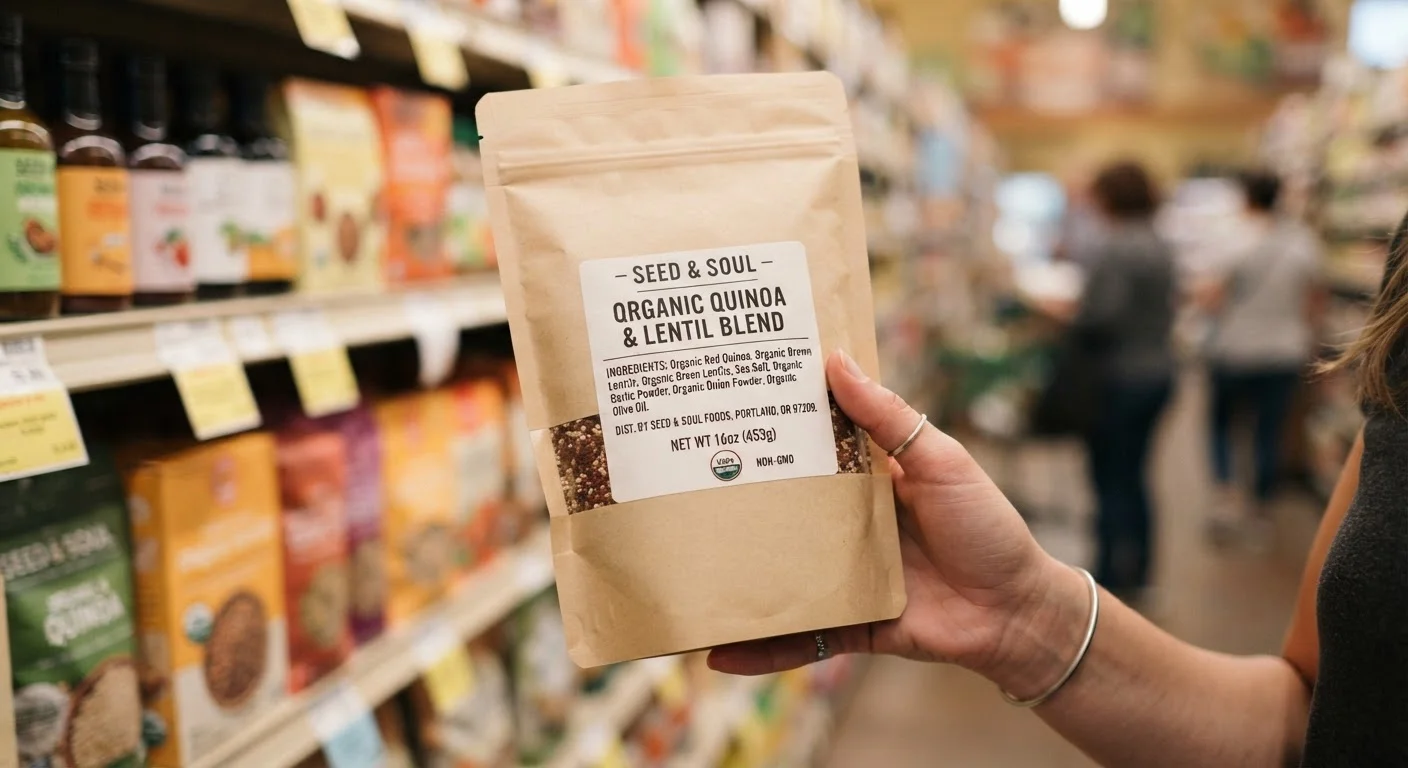
Every packaged food sold in the U.S. with more than one ingredient is required by the FDA to carry an ingredient list. It's a straightforward disclosure: everything that went into making that product, written out by name. No rankings, no nutrition amounts - just the contents, in a specific order.
The ingredient list lives separately from the nutrition facts panel, though the two complement each other well. If you've already explored how to read the numbers side of a food label, the nutrition label breakdown pairs naturally with what you'll learn here.
Think of the ingredient list as the recipe the manufacturer used - a shorthand version that tells you what's in the box before you decide whether to put it in your cart.
Ingredient list
A required disclosure on packaged food that names every ingredient used to make the product, written in descending order by weight.
Descending weight order
The rule that the ingredient present in the greatest amount by weight is listed first, with the rest following from heaviest to lightest.
Sub-ingredients
The individual components that make up a single ingredient in a product, shown in parentheses immediately after that ingredient's name.
Enriched flour
Refined wheat flour that has had certain B vitamins and iron added back in after they were removed during the milling process.
Natural flavors
An FDA-defined category for flavoring substances derived from plant or animal sources, covering a wide range of specific compounds.
Preservative
An ingredient added to food to slow spoilage, prevent discoloration, or inhibit the growth of harmful microorganisms.
How Order Works: The Weight Rule
This is the single most useful thing to know: ingredients are listed in descending order by weight. The first ingredient is the heaviest by raw weight before cooking or processing; the last is the lightest.
That means the first three to five ingredients typically define what the product mostly is. If a loaf of bread lists 'whole wheat flour' first and 'water' second, those two components make up the bulk of it. If a flavored yogurt lists 'sugar' second, right after 'skim milk,' that's meaningful context - the product contains quite a bit of it.
This rule applies across the whole list, right down to the minor entries near the end. Ingredients appearing toward the bottom are present in very small amounts - often fractions of a percent of the total product.
Decoding Common Entries You'll See
Some ingredient names are immediately recognizable - eggs, salt, oats. Others look intimidating but are quite ordinary once explained.
- Enriched flour: Refined wheat flour with B vitamins and iron added back after milling removes them.
- Ascorbic acid: Vitamin C, used both as a nutrient and as a preservative to prevent browning.
- Xanthan gum: A thickener derived from fermented corn sugar, common in gluten-free products and salad dressings.
- Tocopherols: A form of vitamin E, often listed as a natural preservative to prevent fats from going rancid.
- Natural flavors: A broad FDA-defined category covering flavoring compounds derived from plant or animal sources. The term doesn't specify the exact source.
Long or unfamiliar names aren't automatically a concern - many are established vitamins, minerals, or preservatives with well-documented uses in food manufacturing. If a name gives you pause, a quick search of the FDA's food ingredient database is a reliable starting point.
It's also worth knowing that front-of-package claims like 'low fat' or 'no added sugar' don't always tell the whole story. Packaging claims and what they leave out is a useful companion read for putting those phrases in context.
Ingredients Inside Ingredients
When you see parentheses on an ingredient list, that's the label's way of showing sub-ingredients - the components that make up one particular ingredient.
For example: Chocolate chips (sugar, chocolate liquor, cocoa butter, vanilla extract)
The chocolate chips are the parent ingredient; everything inside the parentheses is what makes up those chips. This nesting can go a level or two deep on complex products, which is why some ingredient lists look long even on relatively simple foods.
Sub-ingredients follow the same weight rule within their own parentheses - they're listed from heaviest to lightest within that ingredient grouping. This matters when you're looking for something specific, like where added sugars appear in a product's sub-ingredients.
What the List Doesn't Tell You
The ingredient list is genuinely useful, but it has real limits. It tells you what is in a product, not how much of each ingredient (beyond relative order). A product could list 'oats' third and still contain very little oats if the first two ingredients are heavy.
It also doesn't tell you about preparation method, sourcing, or farming practices beyond what's required to disclose - information that matters to some shoppers but lives outside the label's scope.
Reading ingredient lists is one part of a broader habit of engaging with food packaging critically. It works best alongside the nutrition facts panel, and occasionally alongside a clear-eyed look at front-of-package claims. The more familiar you get with the foods you buy regularly, the faster and easier this kind of label-reading becomes - it's genuinely a skill that compounds with practice.
This article is for general informational purposes only and is not intended as medical or dietary advice. For guidance tailored to your health needs, consult a qualified healthcare or nutrition professional.
Frequently Asked Questions
They're listed by weight, measured before cooking or processing. This is a U.S. FDA requirement for packaged foods sold in America. So if water is first on a soup label, it's the heaviest component by raw weight going into that product.
Parentheses signal sub-ingredients - the components that make up that one ingredient. For example, 'enriched flour (wheat flour, niacin, iron)' tells you what's inside the flour itself. This is standard formatting, not a red flag.
Not necessarily. Length alone isn't a reliable quality signal. A multigrain bread with many whole grains and added vitamins may have a long list, while a product with a short list could still be heavily processed. Focus on what the ingredients are, not just how many there are.
The nutrition facts panel shows quantities - grams of fat, milligrams of sodium, and so on. The ingredient list shows what's actually in the food by name, in order of weight. Both panels work together to give a fuller picture.
Under FDA regulations, 'natural flavors' are flavoring substances derived from plant or animal sources. The term covers a broad range of compounds and doesn't tell you the specific source, which is why some people with allergies or dietary restrictions look for more detail.
Most do. The FDA requires ingredient lists on most packaged foods with more than one ingredient. Single-ingredient foods like plain flour or fresh produce sold by weight are generally exempt. Check the label - if ingredients are present, they must be listed.
The content on this site is for informational purposes only and is not a substitute for professional advice. Always consult a qualified professional for guidance specific to your situation.