

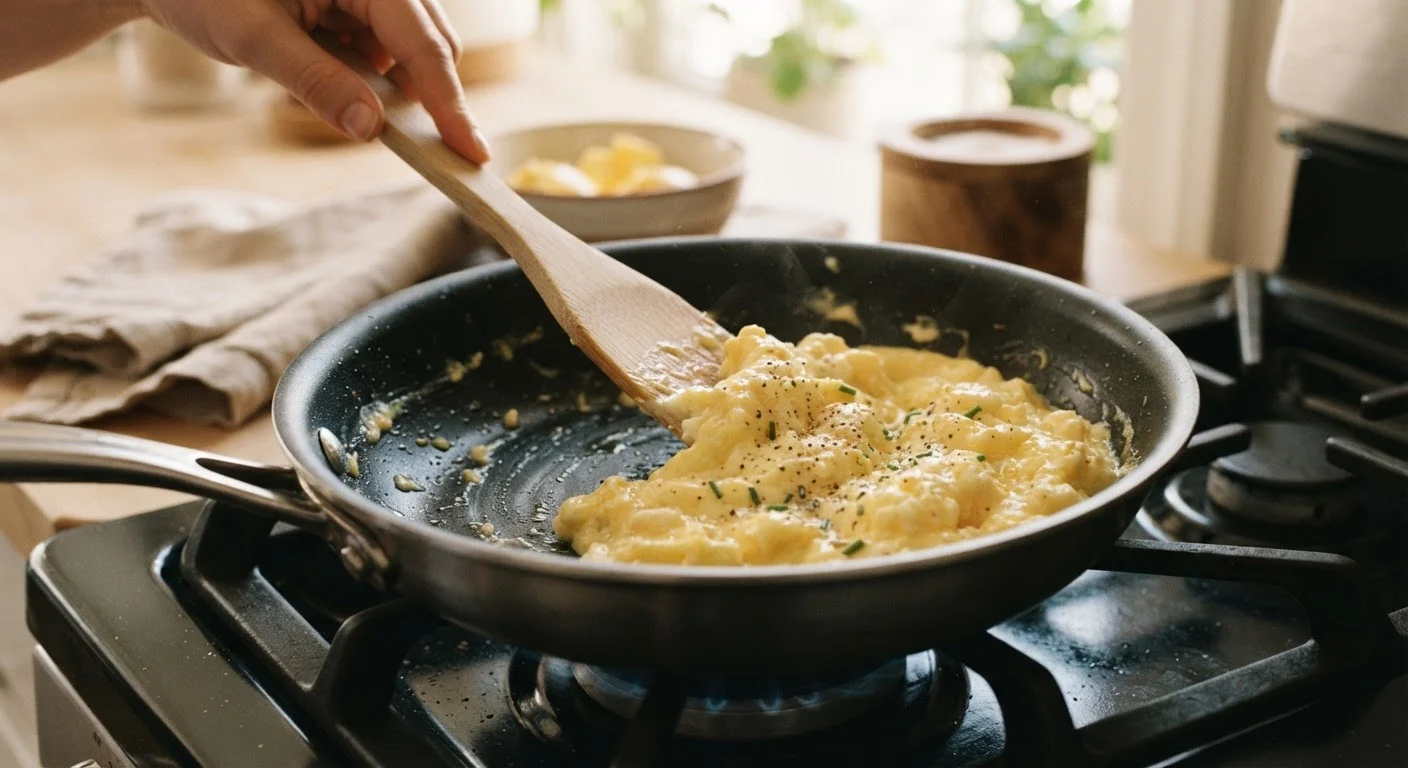
What Actually Happens Inside a Scrambled Egg
Scrambled eggs seem like the simplest thing in the kitchen - crack, whisk, cook. But the science underneath is worth understanding, because it explains every mistake that leads to a rubbery result.
Eggs are loaded with proteins that are loosely coiled in their raw state. When heat is applied, those proteins unwind and link together - a process called coagulation. Done gently, this produces soft, moist curds. Done aggressively, the proteins seize up, squeeze out moisture, and you get that familiar bouncy, watery texture on the plate.
Heat control is the central skill. Everything else flows from it. Just like common pasta myths that feel logical but work against the dish, scrambled egg instincts - crank the heat to cook faster, keep stirring constantly - often do more harm than good.
The Most Common Scrambled Egg Mistakes
Here's where things go wrong - and exactly why each mistake happens.
Cooking eggs over high heat to speed things up.
Why it happens: It feels efficient, and a hot pan seems like the path to a quick breakfast. Most people default to the same heat level they use for sautéing vegetables.
Leaving the eggs in the pan until they look fully done.
Why it happens: It's counterintuitive to pull food off heat before it looks finished. Many cooks wait until the eggs appear completely set, which is already too late.
Not whisking the eggs properly before cooking.
Why it happens: A quick fork stir seems sufficient, and it saves time. But incompletely mixed eggs cook unevenly, with rubbery whites setting faster than the yolks.
Adding salt to the raw egg mixture too far in advance.
Why it happens: Seasoning early is good practice for many dishes, so it feels natural to salt eggs while they're still in the bowl.
Using a pan that's too large for the portion size.
Why it happens: Grabbing whatever pan is handy is the default for most home cooks, and size rarely seems important for such a simple dish.
Quick Fixes That Actually Work
Getting consistently good scrambled eggs doesn't require a restaurant kitchen or special equipment. A few habit shifts cover most of the ground.
- Use low to medium-low heat and be patient. Eggs set faster than you think once the pan warms through.
- Pull the pan off the burner while the eggs still look slightly underdone. Residual heat finishes the job without overcooking.
- Whisk thoroughly until the yolks and whites are completely combined - no streaks.
- Salt after cooking, or at the very last moment, not while the raw eggs are sitting in the bowl.
- Use the right pan. A smaller pan concentrates the eggs into thicker curds; a pan that's too large spreads them thin and dries them out faster.
It also helps to understand that texture is personal. Some people like larger, fluffier curds; others prefer small, creamy ones. Lower heat and more frequent folding (rather than constant stirring) produce smaller, more custardy curds. Higher heat with less frequent movement gives you larger, fluffier pockets - just keep the heat moderate either way.
Food fundamentals like this are worth getting comfortable with. If you've ever been tripped up by nutrition claims that seem authoritative but contradict each other, our piece on where nutrition advice goes wrong is a useful companion read for building a more grounded approach to food information generally.
The content on this site is for informational purposes only and is not a substitute for professional advice. Always consult a qualified professional for guidance specific to your situation.