

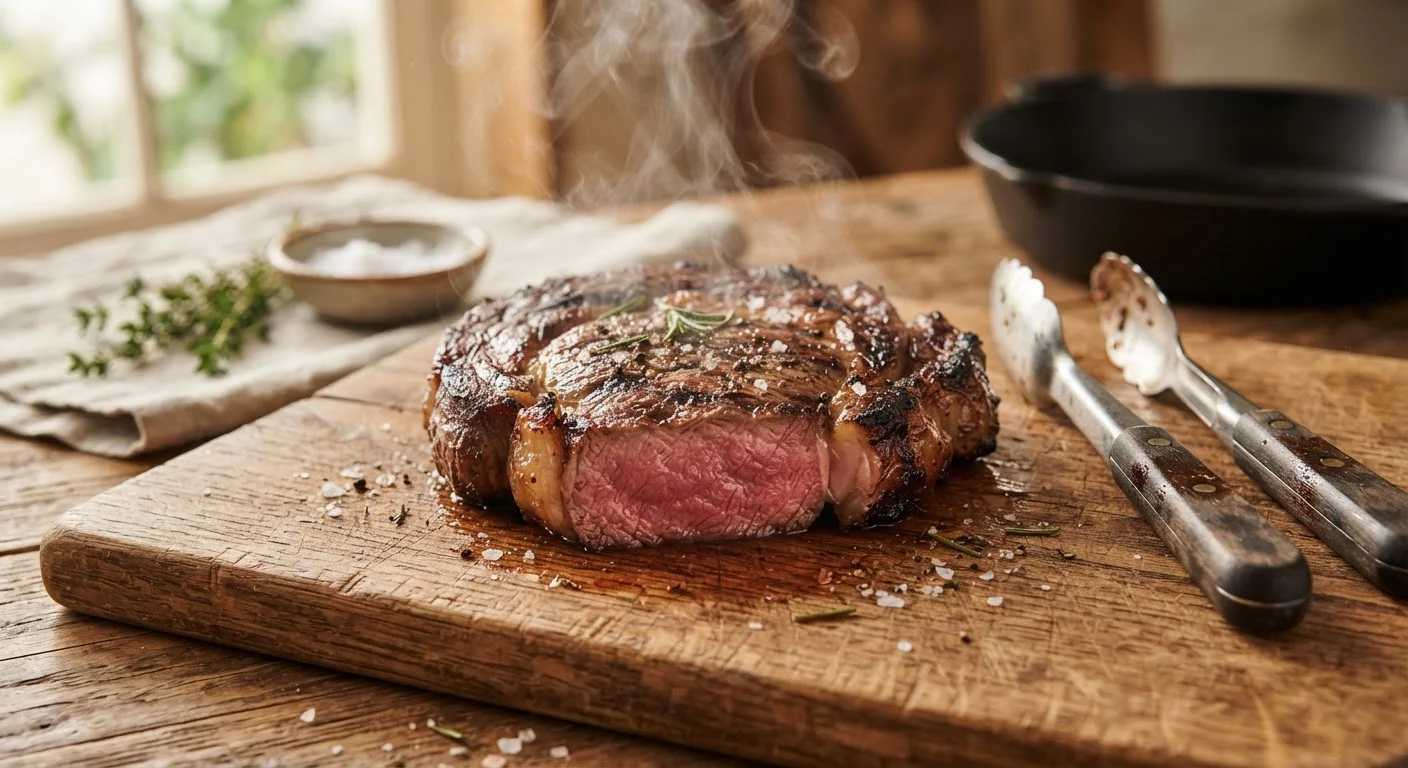
Why Juice Ends Up on Your Cutting Board
If you've ever sliced a steak fresh off the pan and watched a small puddle of liquid spread across the cutting board, that's the resting principle in action - or rather, the absence of it. Here's what's happening at a basic level.
When meat heats up, the muscle fibers contract and push moisture toward the center of the cut. The outer layers are essentially wringing themselves out. If you cut through the meat at that moment, those tightly contracted fibers release that accumulated moisture as soon as the pressure is relieved - straight onto your board instead of into your bite.
Resting gives those fibers time to relax. As the meat cools slightly and heat distributes more evenly, the muscle tissue becomes less tense and can reabsorb some of that moisture. The result: more juice stays inside the meat where it belongs.
A Simple Way to Remember It
Think of resting as the final stage of cooking, not the period after cooking. The heat doesn't stop working the moment the meat leaves the pan - it redistributes. Building rest time into your plan, rather than squeezing it in as an afterthought, makes the whole meal come together more smoothly.
Carryover Cooking: The Hidden Extra Step
Resting does something else that often surprises people: the meat keeps cooking even after it leaves the heat. This is called carryover cooking, and it's worth understanding if you've ever wondered why your steak can go from medium-rare to medium between the pan and the plate.
The outside of the meat is significantly hotter than the interior when it first comes off the heat. That stored heat continues moving inward for several minutes. Depending on the thickness of the cut and how hot your cooking surface was, a steak can rise another 5-10°F during resting. A large roast might climb even more.
This is why experienced cooks often pull meat from the heat a few degrees before the target temperature - they account for carryover. Knowing this can save you from overcooking a beautiful piece of meat in the time it takes to carry it to the table.
When Resting Matters Most (And When It Matters Less)
Resting is not equally important for every piece of protein. The benefit scales with the thickness and density of the cut.
- Large roasts (whole chickens, beef joints, pork shoulder) benefit the most - the temperature gradient between outside and center is significant, and resting time of 20-30 minutes makes a real, noticeable difference.
- Thick steaks and chops - a 5-10 minute rest is usually enough and worth the wait.
- Thin cutlets and fish fillets - these have minimal gradient and cool quickly; a brief 2-3 minute rest is fine, but extended resting isn't necessary and may just make them cold.
- Ground meat patties - the grinding process disrupts the muscle structure, so the juice-retention benefit is much smaller. A short rest doesn't hurt, but it's not critical.
The same basic understanding of heat and texture applies in other cooking contexts too - if you're curious about how temperature affects vegetables, the guide to roasting vegetables covers related principles in a practical way.
The Foil Question and Practical Tips
A common piece of advice is to tent resting meat with foil. This is a reasonable approach for large cuts where you want to retain heat over a longer rest period. That said, it's worth knowing the trade-off: if you worked to achieve a crispy skin on a roast chicken or a good sear on a steak, covering it traps steam and can soften that crust. For cuts where the surface texture matters, you might skip the foil or use it loosely.
A few practical points worth keeping in mind:
- Rest meat on a warm plate or board, not a cold surface that pulls heat away quickly.
- Don't cut into the meat just to check - every cut releases juice and disrupts the process.
- Plan resting time into your overall cooking schedule rather than treating it as an afterthought. It's part of the cooking, not separate from it.
Food advice is full of rules that get repeated without much explanation. Understanding the underlying reason - in this case, the physics of muscle fibers and heat - helps you make better decisions and adapt to whatever you're cooking. For a broader look at how to evaluate food and nutrition information critically, this piece on nutrition advice is a useful read.
Frequently Asked Questions
Yes, particularly for thicker cuts. When you slice immediately, contracted muscle fibers push moisture out as liquid pooling on the cutting board. Resting allows those fibers to relax and reabsorb some of that moisture, producing noticeably juicier results.
A general guide: steaks and chops rest for 5-10 minutes, while larger roasts such as a whole chicken or beef joint benefit from 20-30 minutes. As a rough rule, the bigger the cut, the longer the rest.
Some heat loss is unavoidable, but it's usually minimal for the short resting periods involved. Loosely tenting the meat with foil helps retain warmth. For large roasts, the carryover heat from inside the meat actually continues warming it during the rest.
All meats benefit from resting to some degree. Poultry and pork respond to the same physics - heat redistribution and fiber relaxation. Chicken breasts, pork tenderloin, and pork chops all produce better results when given a few minutes off the heat before cutting.
Resting times for typical cuts are short enough that food safety is not a concern for most cooked proteins, provided the meat reached the appropriate internal temperature during cooking. For large cuts left to rest longer, tenting with foil helps maintain adequate warmth.
The content on this site is for informational purposes only and is not a substitute for professional advice. Always consult a qualified professional for guidance specific to your situation.