

Start here
What Is a Password Manager?
Understand the risk
Why Reusing Passwords Is Risky
Go deeper
How Password Managers Actually Work
Take action
Setting Up Your First Password Manager
Build the habit
Making It a Daily Habit
What Is a Password Manager?
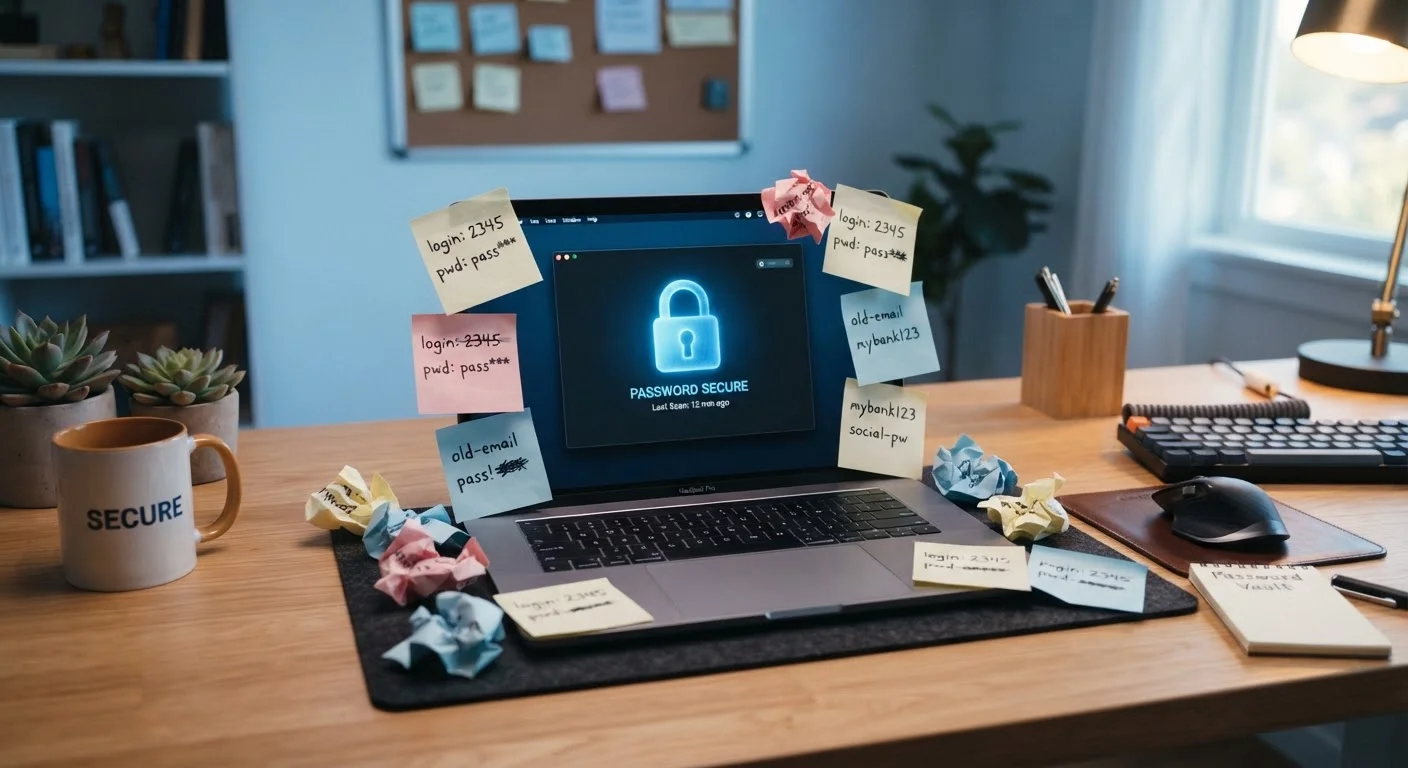
A password manager is an app that stores all your login credentials - usernames and passwords - in a single encrypted vault. Instead of memorizing dozens of passwords, you remember just one: your master password. The manager handles the rest, generating strong passwords, saving new ones automatically, and filling them in when you return to a site or app.
Think of it as a secure digital keychain. It sits in the background, quietly doing the work that most people skip - creating long, random, unique passwords for every account they own.
Master password
The single password you create to unlock your password manager vault. It should be long and memorable - and never reused anywhere else.
Vault
The encrypted container inside the password manager where all your stored credentials are kept. Only your master password can unlock it.
End-to-end encryption
A method of scrambling data so that only the sender and recipient can read it - no one in between, including the service provider, can access it.
Autofill
A feature that automatically enters your username and password into a login form so you don't have to type them manually.
Credential stuffing
An attack where stolen username-password pairs from one breach are automatically tested against many other websites to find matching accounts.
Recovery key
A backup code provided when you set up a password manager that lets you regain access to your vault if you forget your master password.
Why Reusing Passwords Is Risky
Using the same password across multiple sites is one of the most common - and most exploited - security habits. When a website suffers a data breach and passwords are exposed, attackers run those stolen credentials against other popular services automatically. This technique, called credential stuffing, means one compromised account can quickly become many.
According to cybersecurity researchers, billions of username-password combinations from past breaches circulate openly on criminal marketplaces. If your email-and-password combination is in one of those lists, any site where you used the same pair is at risk. A password manager eliminates this exposure by making each password unique - so a breach at one site doesn't ripple outward.
For a broader picture of simple protective habits, see the everyday security habits that matter most.
How Password Managers Actually Work
Your vault is protected using end-to-end encryption - typically AES-256, a standard used in banking and government systems. This means the contents are scrambled on your own device before they ever leave it. Even the company running the service cannot read your stored passwords.
When you visit a login page, the browser extension or mobile app recognizes the site and offers to fill your credentials automatically. When you create a new account, the manager can generate a random password - often 16 to 20 characters of mixed letters, numbers, and symbols - and save it immediately.
Sync happens through an encrypted connection, so your vault stays consistent across your phone, laptop, and tablet without you doing anything manually.
Enable Autofill on Your Phone
On most Android and iPhone devices, you can set your password manager as the default autofill provider in your phone's Settings. Once enabled, login fields in apps and mobile browsers will prompt you to fill credentials from your vault - no copying and pasting required.
Setting Up Your First Password Manager
Getting started is simpler than most people expect. Here's a practical sequence to follow:
- Choose a manager and create an account. Many well-regarded options offer free tiers. Look for one that supports your devices and browsers.
- Create a strong master password. Use a passphrase - three or four unrelated words strung together (for example, river-blanket-Tuesday-moon). This is the one password you must remember, so make it memorable but not guessable.
- Save your recovery key offline. Write it on paper and store it somewhere secure. If you lose access, this may be your only way back in.
- Install the browser extension. This enables autofill and lets the manager capture new passwords as you log into sites.
- Import or add passwords gradually. Many managers can import saved passwords from your browser. For anything not imported, the manager will capture and save credentials the next time you log in.
You do not need to update every password at once. Let the manager save credentials as you naturally use your accounts, and replace old, weak passwords over time.
Making It a Daily Habit
The real payoff of a password manager comes with consistent use. A few habits will help it become second nature:
- Let it generate passwords. Every time you create a new account or update an old password, use the manager's built-in generator. Resist the urge to type something memorable - random is safer.
- Check for weak or reused passwords. Most managers include a dashboard showing which stored passwords are duplicated or weak, so you can prioritize which ones to update first.
- Add two-factor authentication to the manager itself. Because your vault contains all your credentials, it deserves an extra layer of protection. Two-factor authentication means that even if someone learns your master password, they still cannot access your vault without a second verification step.
Password security is one piece of staying safe online. Explore the full Online Safety hub for guidance on topics from phishing to privacy settings.
Frequently Asked Questions
Yes - reputable password managers encrypt your vault using strong algorithms, meaning the stored data is unreadable without your master password. The encryption happens on your device before anything is synced to the cloud. No credible provider can see your actual passwords.
Most password managers offer account recovery options, such as a recovery key or a trusted emergency contact. You should save your recovery key somewhere offline as soon as you set up the app. Without it, recovery may not be possible - by design, to protect your privacy.
Most modern password managers sync across devices through an encrypted cloud account. Once installed on your phone, tablet, and computer, your vault stays up to date everywhere. Some tools also offer browser extensions that make auto-fill seamless on any device.
Most password managers work with both websites and mobile apps. On smartphones, they typically integrate with the operating system's autofill service, so they can fill in login fields inside apps just as they do in a browser.
Several well-regarded password managers offer solid free tiers that cover the core features - storing passwords and autofill. Paid plans typically add extras like encrypted file storage, emergency access, or multi-device sync. Evaluate what you actually need before upgrading.
The content on this site is for informational purposes only and is not a substitute for professional advice. Always consult a qualified professional for guidance specific to your situation.