

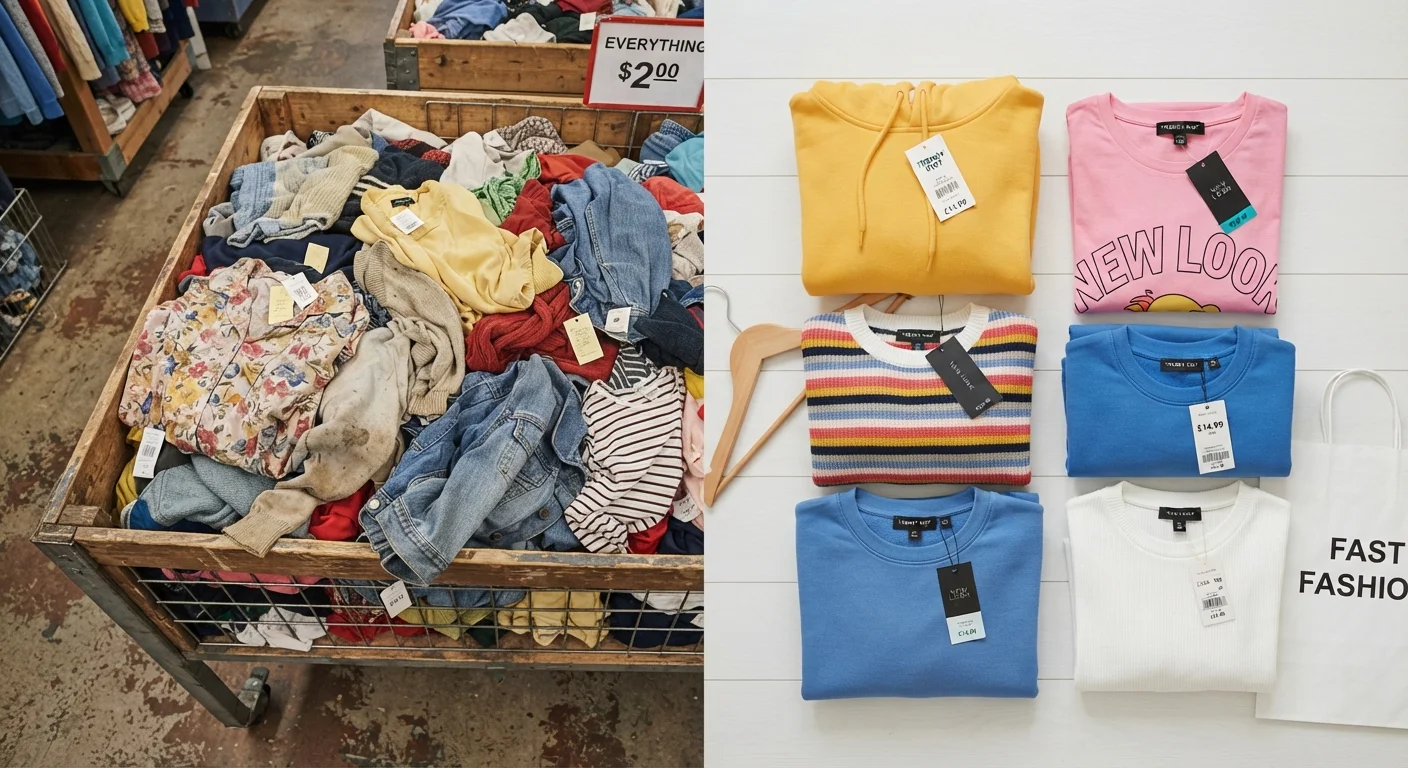
Option A
Thrift Shopping
The hunt-and-find approach to building a wardrobe on your own terms.
Best for: Shoppers who enjoy browsing, want lower prices on unique or durable pieces, and care about reducing textile waste.
Option B
Fast Fashion
The quick, convenient route to trend-forward clothing at low upfront prices.
Best for: Shoppers who need specific items quickly, prefer predictable sizing, and want easy online or in-store access.
The Real Cost Comparison
At face value, both options are marketed as affordable. But the true cost picture is more layered than a price tag.
Thrift stores often price individual items well below retail — jeans, sweaters, and jackets that would cost $40–$80 new might appear on a thrift rack for a few dollars. The catch: you can't guarantee you'll find what you're looking for. A successful thrift haul may take multiple visits or several hours of browsing. Your time has value, and that's a real trade-off.
Fast fashion's appeal is upfront affordability and near-instant access. A full outfit can be assembled quickly and inexpensively. However, many fast fashion garments are made with thinner fabrics and looser construction that may not hold up through dozens of washes. Replacing items frequently can quietly add up to more spending over time than a single higher-quality purchase would have required.
| Criterion | Thrift Shopping | Fast Fashion |
|---|---|---|
| Upfront cost per item | Generally very low | Low to moderate |
| Time required | High — browsing takes effort | Low — quick in-store or online |
| Size consistency | Unpredictable, varies by era | Standardized, reliable |
| Garment durability | Often higher (older construction) | Varies; often lower quality |
| Style variety | Unique, one-of-a-kind finds | Trend-driven, widely available |
| Environmental impact | Lower (extends garment life) | Higher (new production, waste) |
| Accessibility | Requires nearby store or time | Wide online and in-store access |
If you're thinking about scaling back how much you buy overall, see our look at owning fewer clothes and what makes it genuinely hard — it's a useful companion read to this one.
Convenience vs. the Thrill of the Find
Fast fashion is engineered for ease. You search online or walk into a store, find your size, pick your color, and you're done. Returns are usually straightforward. The experience is designed to be frictionless — and for many shoppers with limited time, that matters a lot.
Thrift shopping runs on a completely different rhythm. Inventory is unpredictable, sizes aren't reliably organized, and you might leave empty-handed. But for many people, that unpredictability is part of the appeal. Finding a well-made wool coat for $12, or a vintage denim jacket in exactly the right wash, creates a kind of satisfaction that a standard retail purchase rarely delivers.
If you've never tried thrift shopping and want a practical starting point, our first-timer's guide to thrift stores walks you through the process step by step so the experience feels less overwhelming.
~92M tons
Textile waste generated globally each year
The United Nations Environment Programme estimates the global fashion industry produces roughly 92 million tons of textile waste annually.
~$21B
U.S. secondhand apparel market value
According to ThredUp's industry reporting, the U.S. resale and secondhand apparel market has grown substantially over the past decade and continues to expand.
Environmental Trade-Offs: Neither Option Is Perfectly Clean
Thrifting is widely associated with sustainability, and the core logic holds: buying a garment that already exists keeps it in use and delays landfill disposal. The fashion industry is a significant contributor to global textile waste, and secondhand shopping does meaningfully extend a garment's useful life.
But thrift shopping isn't entirely without footprint. Donated clothing that doesn't sell is often exported to developing countries, where an oversupply of low-quality secondhand goods can disrupt local textile industries. And the growing popularity of thrifting has, in some markets, raised prices and created competition with lower-income shoppers who rely on these stores as a primary clothing source — not a trend.
Fast fashion's environmental toll is well-documented: high water usage, synthetic fibers that shed microplastics in the wash, and enormous volumes of unsold or quickly discarded clothing. That said, not every fast fashion item gets discarded immediately — many people wear these clothes for years and care for them well.
A Note on 'Sustainable' Fashion Claims
The word 'sustainable' is used loosely across the fashion industry — by thrift stores, resale apps, and fast fashion brands alike. No single shopping approach eliminates environmental impact entirely. When evaluating claims, it helps to look at the full lifecycle of a garment: how it was made, how long you'll actually wear it, and how it will eventually be disposed of. Skepticism toward marketing language, from any source, is reasonable.
Neither approach is a perfect solution. The most meaningful shift tends to come from buying less overall, regardless of where that clothing comes from.
The content on this site is for informational purposes only and is not a substitute for professional advice. Always consult a qualified professional for guidance specific to your situation.