

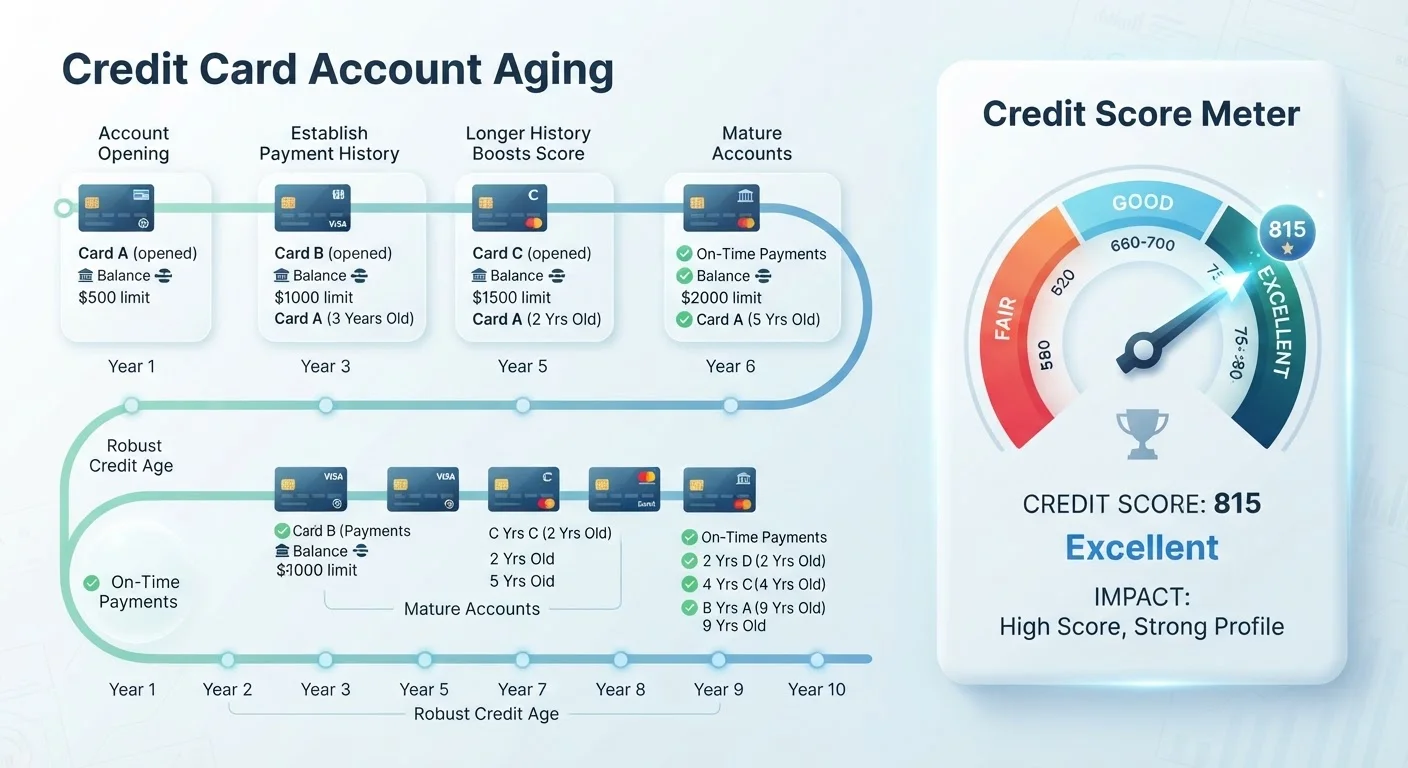
What Credit Age Actually Measures
When a lender pulls your credit report, they're not just looking at whether you pay on time. They also want to know how long you've been in the credit game. That's what credit history length captures.
Three figures go into this calculation:
- Age of your oldest account — the anchor of your history
- Age of your newest account — which can drag the average down
- Average age of all accounts — the most meaningful of the three
Credit age is part of a broader picture. See the five factors behind your credit score for a full breakdown of how each element is weighted.
Credit Age vs. Credit History: Same Thing?
These terms are often used interchangeably, and for practical purposes they refer to the same scoring factor. "Credit age" is the plain-language shorthand; "length of credit history" is the term you'll see in formal scoring breakdowns. Both point to the same underlying data: how long your accounts have been open.
Why Lenders Care About How Long You've Had Credit
A long credit history tells a lender something simple: you've been navigating credit for years without blowing it up. That track record is reassuring. A short history isn't a red flag on its own, but it gives lenders less data to work with, which translates to more uncertainty — and more uncertainty can mean a lower score or a higher interest rate offered to you.
This is why credit age is sometimes called a "passive" factor. You can't manufacture it quickly. Unlike credit utilization, which can shift within weeks, account age only grows one way: slowly, with time.
“The length of your credit history rewards patience. There's no product or trick that substitutes for simply having accounts that have been open and managed responsibly for a long time.”
— Consumer Financial Protection Bureau, U.S. federal agency overseeing consumer financial products and education
Common Mistakes That Quietly Damage Credit Age
Most people don't hurt their credit age on purpose — they just don't realize certain common moves have consequences.
Closing old accounts
When you close your oldest credit card, you don't immediately lose that account from your history — closed accounts in good standing typically stay on your report for up to 10 years. But eventually it disappears, and your average account age drops. If you're not using an old card, a better strategy is to keep it open and make a small purchase occasionally to prevent the issuer from closing it for inactivity.
Opening multiple new accounts quickly
Every new account you open lowers your average account age. Opening two or three cards within a short window can cause a noticeable dip. This is worth considering before you apply for several new products at once. For a look at how applications themselves affect your score, see what a hard inquiry is and when it actually matters.
Keep Old Accounts Alive With Small Charges
If you have an old credit card with no annual fee that you rarely use, consider putting a small recurring charge on it — like a streaming subscription — and paying it off automatically each month. This keeps the account active without risk of accumulating debt, and preserves that account's age on your report.
Building Credit Age When You're Starting From Scratch
If you're new to credit, you can't fast-forward the clock — but you can start it sooner rather than later. Opening one responsible account early, using it lightly, and paying the balance in full each month begins the aging process. The account you open today becomes your oldest account, which is a meaningful asset years from now.
People new to credit often find that secured credit cards are a practical starting point. They work like regular cards for building history, even though they require a deposit upfront.
15%
Share of FICO score tied to credit history length
According to FICO's publicly published score factor breakdown, length of credit history accounts for approximately 15% of a standard FICO score.
7+ years
Account age generally considered well-established
Credit scoring guidance from major bureaus and financial educators suggests accounts older than seven years contribute meaningfully to a strong credit profile.
10 years
How long closed accounts in good standing stay on your report
The Fair Credit Reporting Act allows positive closed accounts to remain on your credit report for up to 10 years, per standard bureau reporting practices.
This article is for general informational purposes only and does not constitute personalized financial or credit advice. Consult a qualified financial professional for guidance specific to your situation.
Frequently Asked Questions
Credit history length typically accounts for about 15% of a FICO score. It matters, but payment history (35%) and credit utilization (30%) carry more weight. That said, a thin or short credit history can still hold your score back meaningfully.
It can. Closing an old account removes it from your average account age calculation over time and may reduce your available credit, which affects utilization. If the card has no annual fee, keeping it open and occasionally using it is often the simpler choice.
Most scoring models consider a credit history of seven or more years to be well-established. You can still achieve a good score before that, but reaching an excellent score generally takes consistent, responsible use over many years.
It can. When someone adds you as an authorized user on an older account, that account's history may appear on your credit report, potentially increasing your average account age. Results vary by card issuer and scoring model.
Yes, modestly and temporarily. A new account lowers the average age of your accounts. The effect tends to be small if you already have several established accounts, and it usually recovers as the new account ages.
The content on this site is for informational purposes only and is not a substitute for professional advice. Always consult a qualified professional for guidance specific to your situation.