

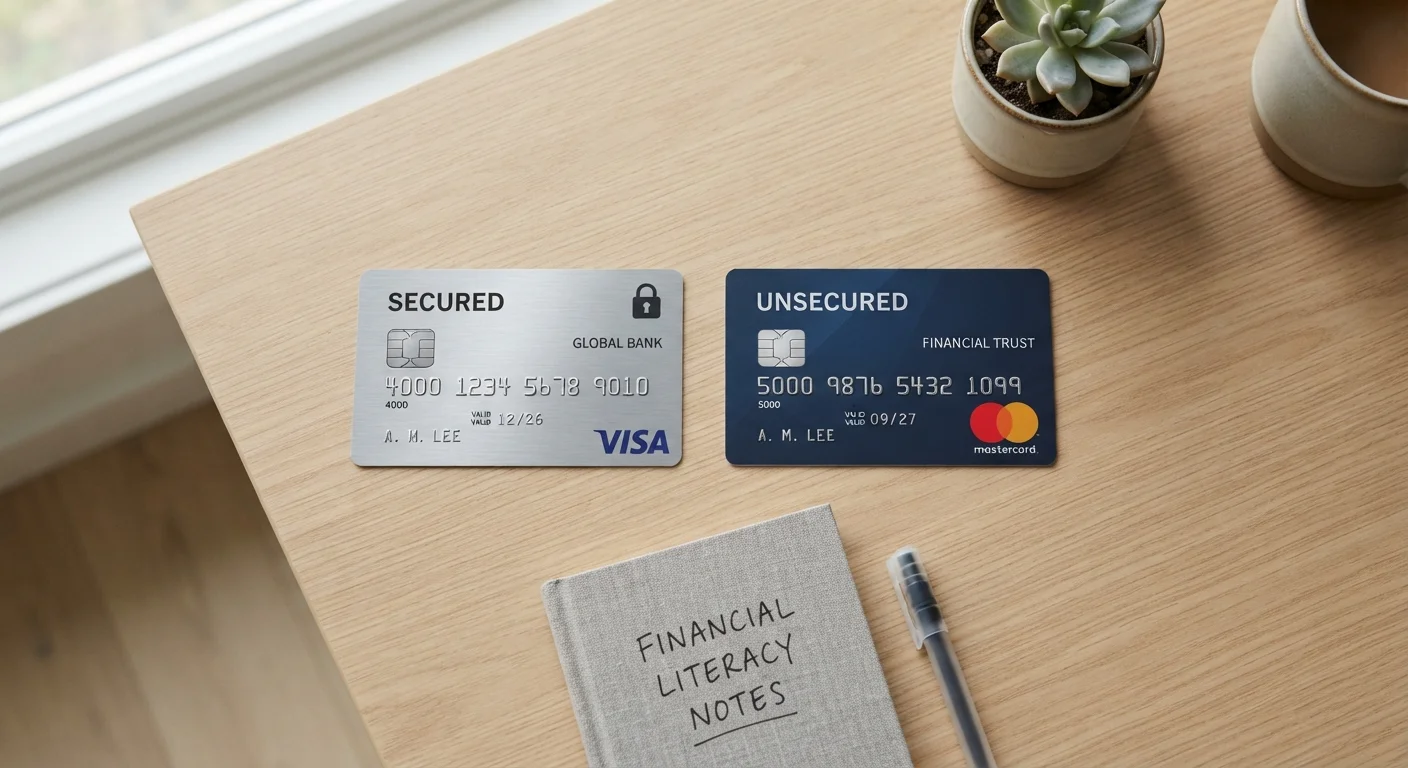
Our Verdict
For someone starting from scratch or rebuilding damaged credit, a secured card is usually the more accessible entry point. Once you have a track record of on-time payments and a score above roughly 580–620, an unsecured card becomes a realistic option that often comes with better terms and no deposit requirement.
| Best for | Recommended |
|---|---|
| No credit history or rebuilding after past problems | Secured credit card |
| Fair to good credit with some existing history | Unsecured credit card |
| Those who want to avoid tying up cash as a deposit | Unsecured credit card |
| Those who want the most straightforward path to approval | Secured credit card |
What Makes a Card Secured or Unsecured?
The core difference comes down to collateral. A secured credit card requires you to put down a cash deposit before you can use the card. That deposit — typically ranging from $200 to $500 — usually equals your credit limit. The lender holds it as protection in case you don't pay your bill. If you close the account in good standing, you get the deposit back.
An unsecured credit card requires no deposit. The lender extends credit based on your credit history, income, and other financial factors. This is the kind of card most people picture when they think of a standard credit card.
Both types function the same way in daily use: you make purchases, receive a monthly statement, and owe at least a minimum payment. And critically, both report your payment activity to the major credit bureaus — Equifax, Experian, and TransUnion — which means both can help you build a credit history.
For a broader look at how collateral shapes borrowing terms, see how secured and unsecured loans compare.
How Each Card Affects Your Credit Score
Credit scores are calculated from five main factors: payment history, credit utilization, length of credit history, credit mix, and new inquiries. Both secured and unsecured cards influence most of these categories in the same way.
Payment history is the biggest factor — roughly 35% of your score. Paying on time every month, whether you have a secured or unsecured card, is the single most impactful habit you can build. Missing payments damages your score regardless of card type.
Credit utilization — how much of your available credit you're using — accounts for about 30% of your score. This is where secured cards can put you at a slight disadvantage: a $300 deposit gives you a $300 limit, so even modest spending can push your utilization high. Keeping balances below 30% of your limit is a widely recommended guideline. It's also worth knowing that carrying a small balance does not help your score — paying in full each month is the better approach.
Over time, the age of your accounts also factors in. Opening either type of card starts the clock on your credit history. Credit history length plays a meaningful role in your overall score, so opening a card sooner rather than later generally works in your favor.
| Secured Card | Unsecured Card | |
|---|---|---|
| Deposit required | Yes — typically $200–$500 | No deposit needed |
| Approval difficulty | Generally easier; good for no/bad credit | Requires fair-to-good existing credit |
| Credit limit | Usually equals your deposit | Set by lender based on creditworthiness |
| Reports to credit bureaus | Yes, all three major bureaus | Yes, all three major bureaus |
| Typical interest rates | Often high; pay in full to avoid | Varies widely; can be high for thin credit |
| Path to upgrade | Many issuers upgrade after ~12–18 months | May qualify for better terms over time |
Who Should Consider Each Type?
If you have no credit history — or a history marked by late payments, collections, or a bankruptcy — a secured card is typically the more realistic starting point. Most secured cards have lenient approval requirements precisely because the deposit reduces the lender's risk.
Unsecured cards aimed at credit-builders do exist, often marketed to people with fair or thin credit files. However, they frequently come with higher interest rates or annual fees to offset the lender's risk. If you carry a balance, those costs add up quickly.
Use Your Card for Small, Recurring Purchases
One straightforward way to build credit with either card type is to charge a small, predictable expense — like a streaming subscription or a utility — and pay the balance in full each month. This keeps utilization low, avoids interest charges, and creates a consistent on-time payment record for the bureaus to see.
Once you've used a secured card responsibly for 12 to 18 months, many issuers will review your account for an upgrade to an unsecured product — and return your deposit. If your issuer doesn't offer this automatically, it's reasonable to ask.
Be mindful that certain everyday habits can quietly undermine the progress you're making. Some behaviors damage your score in ways that aren't always obvious, so it's worth reviewing them alongside your card strategy.
Costs, Limits, and Practical Considerations
Neither card type is free of potential costs. Secured cards may charge annual fees, and the deposit is money you can't use elsewhere while the account is open. Unsecured credit-builder cards often carry higher APRs (annual percentage rates — the yearly cost of carrying a balance) and sometimes monthly maintenance fees.
If you're deciding between using a credit card or a personal loan to cover an expense while building credit, the structures differ considerably. Understanding how personal loans and credit cards compare can help you match the right tool to your situation.
Before applying for either type, read the fee schedule carefully. Look for cards that report to all three major bureaus, keep fees manageable, and have a clear path toward either a higher limit or an upgrade over time. Consulting a nonprofit credit counselor can also help you choose an approach suited to your specific financial situation — this article provides general information, not personalized advice.
35%
Share of credit score from payment history
Payment history is the single largest factor in FICO score calculations, according to myFICO.
30%
Commonly recommended utilization ceiling
Keeping credit utilization below 30% is a widely cited guideline among credit scoring educators and consumer finance organizations.
The content on this site is for informational purposes only and is not a substitute for professional advice. Always consult a qualified professional for guidance specific to your situation.