

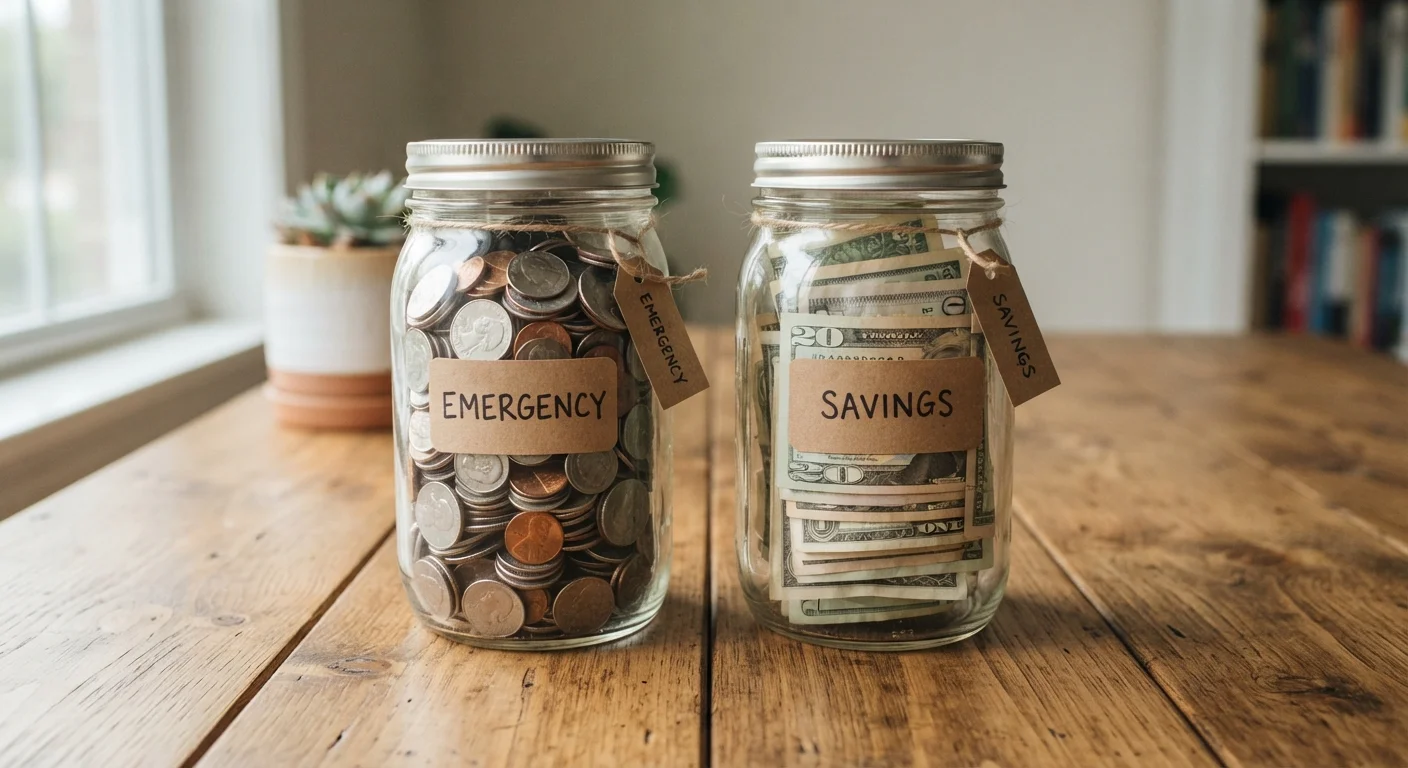
Option A
Emergency Fund
Your financial safety net for the unexpected.
Best for: Covering sudden, unplanned expenses like job loss, medical bills, or urgent car repairs.
Option B
Regular Savings Account
A flexible home for money with a planned purpose.
Best for: Saving toward specific goals like a vacation, a new appliance, or a down payment.
What Each One Actually Is
Many people use the terms interchangeably, but an emergency fund and a regular savings account are built for very different jobs. Mixing them up — or lumping them into the same pot — can leave you financially exposed when something goes wrong.
An emergency fund is money set aside exclusively for genuine, unforeseen crises: a sudden job loss, an unexpected medical bill, a car breakdown that prevents you from getting to work. It is not for holiday shopping, planned vacations, or anything you could predict. The defining feature is that you only touch it when something truly urgent and unplanned forces you to.
A regular savings account, by contrast, is where you park money you plan to spend on something specific at some point in the future. That could be a new laptop, a home repair you know is coming, a trip, or a down payment. The goal is known; only the exact timing may vary. For more on structuring those goals, see savings strategies worth knowing before you get started.
| Criterion | Emergency Fund | Regular Savings Account |
|---|---|---|
| Primary purpose | Cover unexpected crises | Save toward planned goals |
| When you access it | Only during genuine emergencies | When your planned goal is reached |
| Target amount | 3–6 months of living expenses | Whatever the goal costs |
| Flexibility | Should stay untouched unless crisis hits | Contributions and timing are flexible |
| Account type | Accessible, liquid savings account | Standard or high-yield savings account |
| Priority order | Build this first | Build alongside or after emergency fund |
Why Keeping Them Separate Matters
It might seem like extra work to maintain two separate buckets of money, but the separation is the whole point. When emergency and goal-based savings share the same account, it becomes easy to rationalize dipping into emergency reserves for something that feels urgent but isn't truly an emergency.
Financial educators commonly recommend keeping three to six months of essential living expenses in your emergency fund — enough to cover rent, utilities, food, and minimum debt payments if your income suddenly stops. That figure should feel stable and untouchable.
~57%
Americans who cannot cover a $1,000 emergency
A Bankrate survey found that a majority of U.S. adults would struggle to pay for an unexpected $1,000 expense from savings alone.
3–6 months
Recommended emergency fund size
Most financial guidance organizations, including the Consumer Financial Protection Bureau, recommend covering three to six months of essential expenses.
Your regular savings, on the other hand, should be fluid — growing toward a target and accessible when that planned moment arrives. If you're weighing where to keep these funds, a high-yield savings account may offer better returns for goal-based money. Our overview of high-yield savings accounts explains what sets them apart from standard options.
For those exploring where to open either account, it's also worth understanding how institutions differ. Credit unions and banks operate differently, and those differences can affect fees, interest rates, and accessibility.
Building Both When Money Is Tight
One of the most common questions is: what if I can't afford to save for both at the same time? The answer most financial educators give is to start with the emergency fund, even if the amounts are small. A fund with $500 in it is far better than no cushion at all — it can absorb a minor car repair without sending you to a credit card.
Once you have a baseline emergency cushion, even a small one, you can begin splitting contributions: some toward topping up the emergency fund, some toward your goal-based savings. Automating these transfers — so they happen right after each paycheck — removes the temptation to spend the money instead.
If building a starter emergency fund feels out of reach right now, building your first emergency fund on a tight budget walks through practical steps for doing exactly that on a modest income. And if you want a broader framework for how saving fits into your monthly money management, the budgeting basics hub is a useful starting point.
Keeping Funds in Separate Accounts
You don't need different banks to keep your emergency fund and savings separate. Many banks and credit unions allow you to open multiple savings accounts under one login. Naming each account — 'Emergency Fund' and 'Vacation Fund,' for example — is a simple but effective way to reinforce their different purposes and reduce the temptation to borrow from one for the other.
This article is for general informational purposes only and does not constitute personalized financial advice. For guidance specific to your situation, consider consulting a licensed financial professional.
The content on this site is for informational purposes only and is not a substitute for professional advice. Always consult a qualified professional for guidance specific to your situation.