

Option A
Debt Avalanche
The mathematically optimal approach to eliminating debt.
Best for: People who want to minimize total interest paid and are comfortable staying the course without quick wins.
Option B
Debt Snowball
The motivation-first method that builds momentum through early wins.
Best for: People who need visible progress to stay engaged and are willing to pay slightly more interest for that boost.
How Each Method Actually Works
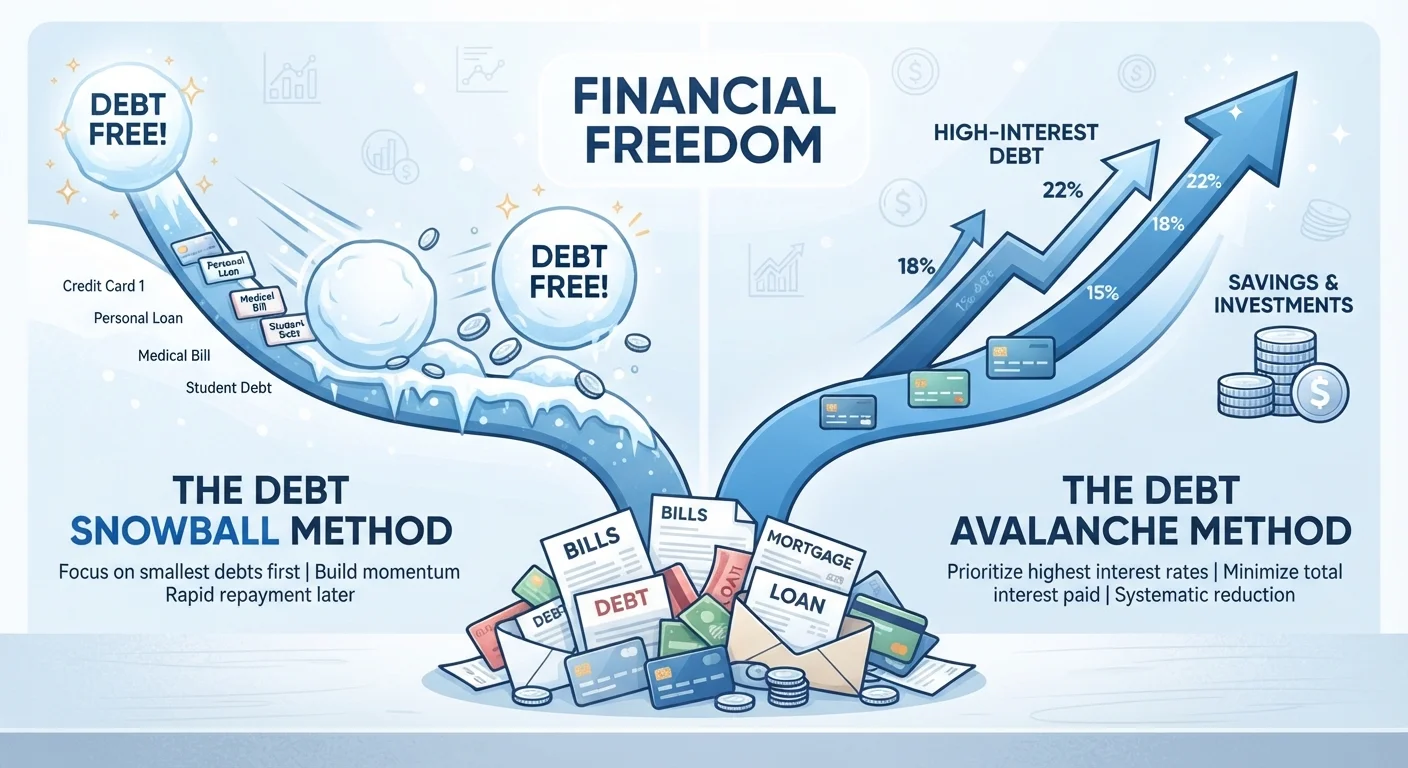
Both strategies follow the same basic structure: make minimum payments on every debt each month, then direct any extra money toward one specific target debt. The difference is how you choose that target.
With the Debt Avalanche, you rank your debts from highest interest rate to lowest. Your extra payments go toward the highest-rate balance first. Once that's cleared, you roll what you were paying on it into the next-highest-rate debt — and so on down the list.
With the Debt Snowball, you rank debts from smallest balance to largest, ignoring interest rates entirely. Extra money goes to the smallest balance first. Once eliminated, you roll that payment toward the next-smallest — building momentum like a snowball gaining size as it rolls.
If you're new to how debt and interest interact, the Debt 101 guide covers the core concepts in plain language before you choose a strategy.
| Criterion | Debt Avalanche | Debt Snowball |
|---|---|---|
| Payoff order | Highest interest rate first | Smallest balance first |
| Total interest paid | Lower (mathematically optimal) | Typically higher |
| Time to first debt eliminated | Longer if high-rate debt is large | Faster — smallest balance cleared first |
| Motivational structure | Rewards patience and discipline | Rewards early action and progress |
| Best suit | High interest rate spread between debts | Many small balances, needs momentum |
| Complexity | Requires tracking interest rates | Simple — just rank by balance size |
The Real Cost Difference
The avalanche method wins on pure math. Because high-interest debt compounds fastest, attacking it first slows the growth of your overall debt load. Over months or years, that translates into less total interest paid and — in most scenarios — a faster payoff timeline compared to the snowball.
The snowball costs more in interest by design. Leaving a high-rate balance untouched while you clear smaller debts means that balance keeps growing. The trade-off is behavioral: studies on consumer debt repayment — including research published in the Journal of Marketing Research — have found that focusing on eliminating individual accounts can increase the likelihood that people stay committed to repayment plans.
~$1,000s
Potential interest savings with avalanche vs. snowball
The exact difference varies widely by balance size and rate spread, but Consumer Financial Protection Bureau resources note that high-rate debt compounds quickly when left unaddressed.
3–5+
Average number of debt accounts held by indebted U.S. households
Federal Reserve survey data consistently shows many American households carry balances across multiple credit products simultaneously.
Neither method guarantees a specific outcome. Results depend on your balances, interest rates, and how consistently you apply extra payments. For a fuller picture of mistakes that can undermine either strategy, see common pitfalls that make debt harder to escape.
Choosing the Method That Fits You
There's no universally correct answer — the best debt repayment method is the one you'll stick with long enough to finish. A few honest questions can help point you in the right direction.
- How motivated are you by visible progress? If seeing an account balance hit zero keeps you going, the snowball's early wins matter.
- How large is your interest rate spread? If some debts carry dramatically higher rates (say, a 24% credit card alongside a 6% personal loan), the avalanche's savings become more significant.
- How many debts do you have? A large number of small accounts can feel paralyzing — the snowball clears that clutter faster.
Some people combine elements of both: starting with one small quick-win account for momentum, then switching to an interest-rate focus. That's a personal judgment call, not a standard strategy.
If your debt picture is more complex — multiple account types, variable rates, or a large total balance — debt consolidation is a separate option worth understanding before you commit to either method. And once you've chosen an approach, building a realistic repayment plan from scratch can help you put the structure in place.
Both Methods Assume Extra Cash Is Available
The avalanche and snowball only work when you have money beyond the minimums to direct somewhere. If your budget is stretched thin, the first priority is freeing up any additional cash — even a small amount. The budgeting basics hub has practical guidance on identifying room in a tight budget before you start a payoff plan.
This article is for general informational purposes only and does not constitute personalized financial advice. Consider consulting a licensed financial professional for guidance specific to your situation.
The content on this site is for informational purposes only and is not a substitute for professional advice. Always consult a qualified professional for guidance specific to your situation.