

Our Verdict
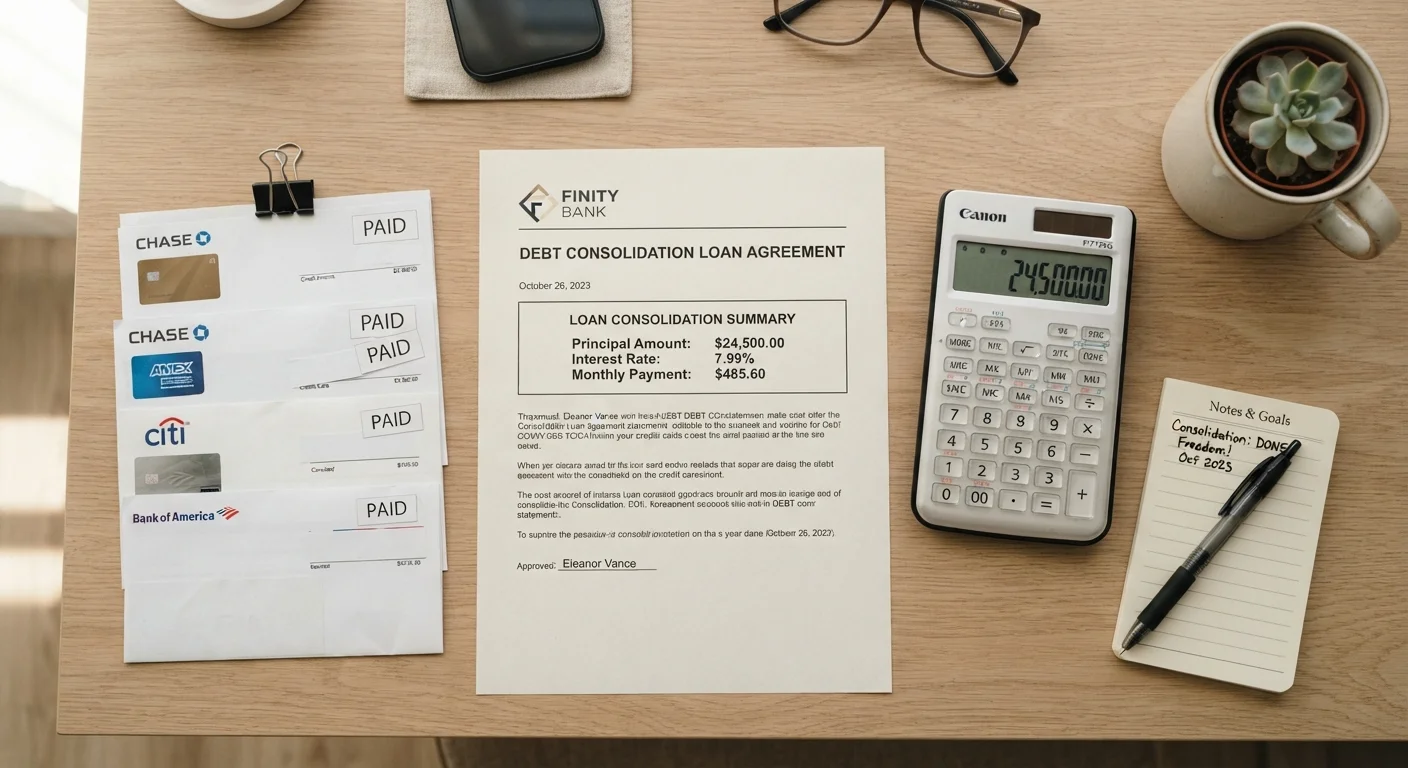
Debt consolidation is a genuinely useful tool when you qualify for a lower interest rate, have steady income, and are committed to changing the habits that created the debt. It is not a cure-all — without a budget and a clear repayment plan, many borrowers end up back where they started or worse. Run the full numbers, not just the monthly payment comparison, before deciding.
Best for people juggling several high-interest debts who have a solid enough credit profile to qualify for a meaningfully lower rate and a realistic plan to avoid accumulating new debt.
What Debt Consolidation Actually Means
Debt consolidation means taking multiple debts — often credit cards, medical bills, or personal loans — and combining them into a single new loan or repayment plan. Instead of making three, four, or five separate monthly payments at different interest rates, you make one payment, usually to one lender.
The most common methods include:
- Personal consolidation loans: A fixed-rate loan used to pay off existing debts. You then repay the new loan in set monthly installments.
- Balance transfer credit cards: Cards that offer a low or 0% introductory rate, letting you move high-interest balances onto one card.
- Home equity loans or lines of credit: Borrowing against your home's value to pay off unsecured debt — this carries real risk since your home is collateral.
- Debt management plans (DMPs): A nonprofit credit counseling agency negotiates reduced rates with creditors and you make a single monthly payment to the agency.
If you're new to borrowing concepts, our primer on debt basics walks through key terms before you dive in.
The Real Advantages of Consolidating
Consolidation isn't just about convenience. Under the right circumstances, it can deliver meaningful financial benefits.
Simplifies multiple payments into one
Managing a single monthly due date reduces the risk of missed payments and the mental load of tracking multiple accounts with different terms.
Potential to lower your interest rate
If you qualify for a rate below what your current debts carry — especially credit cards averaging above 20% APR — you can reduce the total interest paid over time.
Fixed repayment timeline
Unlike revolving credit card debt, a personal consolidation loan has a defined end date, which can make the goal of being debt-free feel concrete and achievable.
Can reduce monthly payment amount
Spreading debt over a new term may lower what you owe each month, freeing up cash flow — though this benefit should be weighed against total interest cost.
May stabilize or improve your credit over time
Paying on time consistently and reducing credit card utilization (by paying off card balances) can positively affect your credit score in the long run.
20%+
Average credit card APR in recent years
Federal Reserve data has tracked average credit card interest rates above 20% annually, making high-rate card debt especially costly to carry long-term.
3–5%
Typical balance transfer fee
Most balance transfer cards charge 3–5% of the moved balance as a one-time fee, which should be factored into any consolidation cost comparison.
That said, the savings only materialize if you secure a rate that is genuinely lower than what you're currently paying — and if you don't extend the loan term so far that you pay more interest in total, even at a lower rate.
The Drawbacks You Should Know Before You Apply
Consolidation is not automatically the right move. There are real trade-offs that catch many borrowers off guard.
Does not eliminate the underlying debt
Consolidation restructures what you owe — it doesn't reduce the principal. You still owe the same amount; only the terms change.
Fees can erode the savings
Origination fees on personal loans, balance transfer fees (often 3–5% of the transferred amount), or closing costs on home equity products can offset interest savings significantly.
Risk of extending total repayment time
A lower monthly payment often comes from a longer loan term. Stretched over more years, you may pay more interest in total even at a lower rate.
Requires good credit to get the best rates
Borrowers with lower credit scores may not qualify for rates low enough to make consolidation worthwhile, and a hard credit inquiry can temporarily dip your score.
Secured options put assets at risk
Using a home equity loan to consolidate unsecured credit card debt converts that debt into something backed by your home — defaulting could mean foreclosure.
Risk of accumulating new debt afterward
Once credit cards are paid off through consolidation, available balances become tempting again. Without changed spending behavior, borrowers can end up deeper in debt.
One of the most common traps: people consolidate credit card debt, then gradually run those cards back up. Now they have both the consolidation loan and fresh card balances. Our article on pitfalls that make debt harder to escape covers this pattern in more detail.
When Consolidation Makes Sense — and When It Doesn't
Consolidation tends to work well when:
- You have multiple high-interest debts (typically above 15–20% APR) and can qualify for a loan at a meaningfully lower rate.
- Your income is stable enough to handle fixed monthly payments reliably.
- You have a concrete plan — ideally a written budget — to avoid adding new debt.
It is usually the wrong tool when:
- Your credit score is too low to qualify for a competitive rate, meaning the new loan may not be cheaper.
- You're consolidating secured debt into unsecured debt, or the reverse, without understanding the implications.
- The root cause of your debt is a spending gap that consolidation won't fix.
Nonprofit Credit Counseling Is an Option
If you don't qualify for a favorable loan rate, a nonprofit credit counseling agency can sometimes negotiate reduced interest rates with your creditors through a debt management plan (DMP). These plans typically require a modest monthly fee and a commitment to stop using existing credit lines during the repayment period. Look for agencies accredited by the National Foundation for Credit Counseling (NFCC) to avoid predatory operators.
If you're weighing consolidation against other repayment strategies, it's worth comparing it directly with the debt avalanche and snowball methods, which can work without taking on a new loan at all.
How to Evaluate Whether It's Worth It
Before applying for any consolidation product, do this math:
- List every debt: Note the balance, interest rate, and remaining term for each one.
- Calculate your total interest cost as-is: What will you pay altogether if you stay the course?
- Compare to the consolidation offer: Factor in origination fees, balance transfer fees, or closing costs — not just the interest rate.
- Check the total repayment amount: A longer loan term with a lower rate can actually cost you more overall.
A realistic debt repayment plan can help you slot any consolidation loan into a broader payoff strategy, so you're not just shifting debt around but actively working toward becoming debt-free.
For ongoing spending habits that support repayment, budgeting basics is a practical complement to any debt strategy you choose.
This article is for general informational purposes only and does not constitute personalized financial, legal, or tax advice. Consult a licensed financial professional before making decisions about your specific situation.
The content on this site is for informational purposes only and is not a substitute for professional advice. Always consult a qualified professional for guidance specific to your situation.