

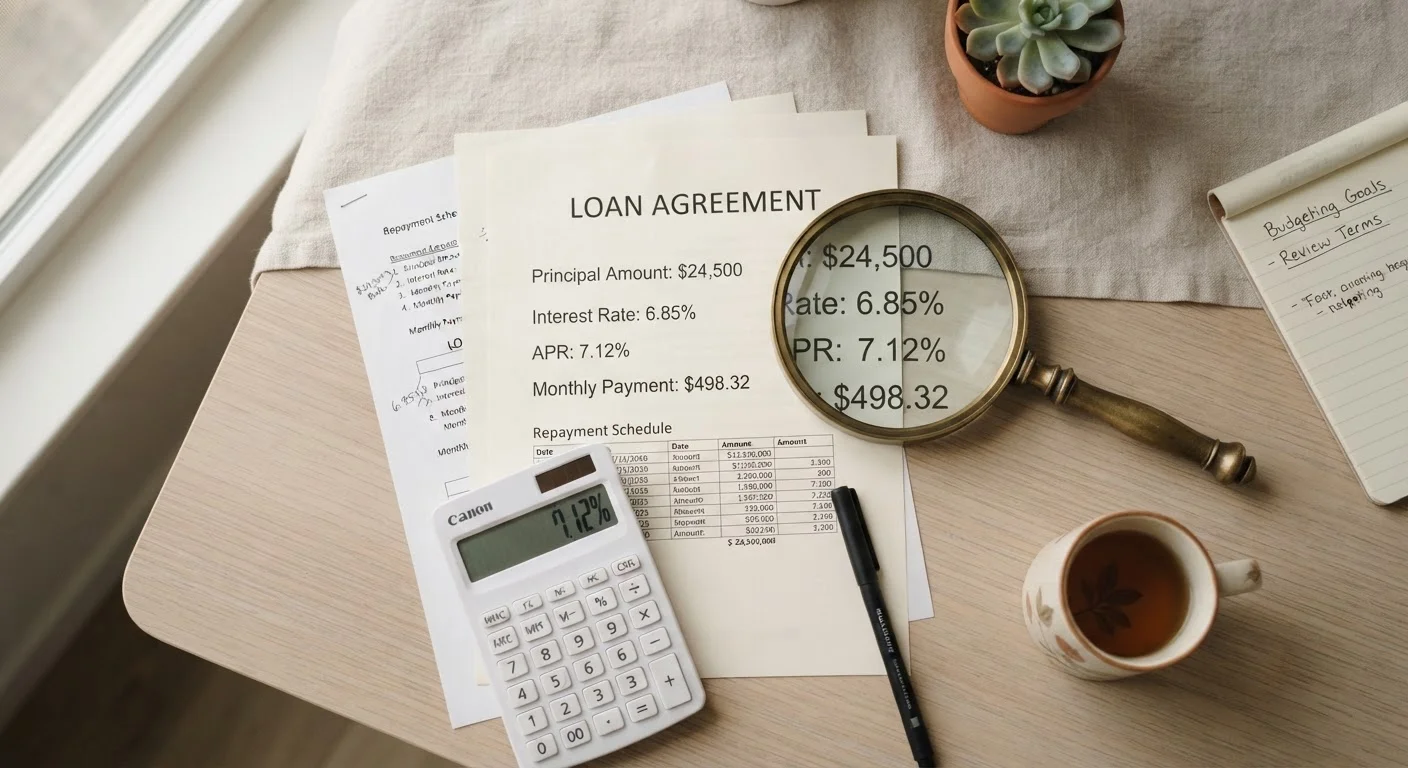
Three Numbers, Three Different Jobs
When you see a loan offer, you're usually shown at least two percentages: an interest rate and an APR. Many borrowers assume these are the same thing — or nearly the same. They're not, and mixing them up can lead to surprises when the bill arrives.
Think of it this way: the interest rate is the price tag on the money you borrow. The APR is closer to the total sticker price after you add on fees and other costs. And finance charges translate both of those percentages into an actual dollar figure — what you'll hand over beyond the amount you borrowed.
If you're new to borrowing, understanding the basics of debt and interest before signing anything will save you confusion later.
TILA
Federal law mandating APR disclosure
The Truth in Lending Act requires lenders to disclose APR before a borrower signs, giving consumers a standardized cost comparison tool.
Always ≥ Rate
APR vs. interest rate relationship
Because APR includes fees beyond the base interest rate, it equals or exceeds the stated interest rate on virtually every loan product.
20–30%
Fee-driven APR increase on some loans
On certain short-term or high-fee loans, the APR can dramatically exceed the stated interest rate when origination and processing costs are included.
Interest Rate: The Base Cost of Borrowing
The interest rate — sometimes called the nominal rate or note rate — is simply the percentage of the principal you pay each year for using borrowed money. If you take out a $10,000 personal loan at a 7% interest rate, roughly $700 represents the annual interest cost on that balance (before accounting for how payments reduce the principal over time).
The interest rate does not include fees, closing costs, or any other charges. It's a clean number that reflects only the price of the funds themselves. This is why the interest rate alone can be misleading when comparing loan offers — two lenders could both advertise 7%, but one charges significant origination fees that the other doesn't.
Use APR When Comparing Loan Offers
Always request the APR — not just the interest rate — from every lender before comparing. Because APR standardizes costs into one number, it lets you line up two very different loan structures side by side and identify which is genuinely less expensive. This single habit can save you hundreds or thousands over a loan's life.
APR: The More Complete Picture
The Annual Percentage Rate (APR) takes the interest rate and folds in most of the fees associated with getting the loan. These can include origination fees, broker fees, discount points on a mortgage, and certain prepaid costs. The result is a single annualized percentage that more accurately reflects what the loan costs per year.
Because APR incorporates fees, it is almost always higher than the stated interest rate on the same loan. A mortgage advertised at 6.75% interest might carry a 7.05% APR once origination and processing fees are included. Federal law — specifically the Truth in Lending Act — requires lenders to disclose the APR in loan documents so you have a standardized figure to work with.
When you're reading through a loan agreement, the APR box is one of the first places worth checking. For a plain-language guide to other terms you'll encounter, see our loan terms reference.
Finance Charges: Putting a Dollar Amount on the Cost
While interest rates and APR are percentages, finance charges are dollar figures. The finance charge on a loan tells you the total amount you'll pay in interest and fees over the life of the loan — not what percentage, but what actual sum of money leaves your pocket beyond the principal.
For example, if you borrow $15,000 and repay $18,400 in total over three years, the finance charge is $3,400. That number tells you exactly what borrowing cost you in concrete terms. It's a useful gut-check: does that cost feel proportionate to what you're using the money for?
Finance charges also appear on credit card statements, where they reflect the interest charged on any unpaid balance during that billing cycle. Your credit score can affect the APR you're offered, which directly influences how large those finance charges become over time.
This article is for general informational purposes only and does not constitute personalized financial or legal advice. For guidance specific to your situation, consult a licensed financial professional.
Frequently Asked Questions
APR includes the interest rate plus additional costs like origination fees, closing costs, or mortgage points. Because these fees are folded into the calculation, the APR is almost always higher than the stated interest rate on the same loan.
Use the APR for apples-to-apples comparisons. Two loans can have the same interest rate but very different APRs if one comes with higher fees. The APR captures those differences in a single figure.
Finance charges typically include interest, origination fees, mortgage broker fees, and certain prepaid costs. Not every fee qualifies — some third-party costs like title insurance may be excluded depending on the loan type.
Yes. Credit card APRs work slightly differently because balances can vary month to month, but the APR still determines how much interest accrues on any unpaid balance. Carrying a balance on a high-APR card can become costly quickly.
Yes, but only when a loan carries no fees at all. In practice this is rare, though some no-fee loan products do advertise matching rates. Always read the loan disclosure to confirm.
The content on this site is for informational purposes only and is not a substitute for professional advice. Always consult a qualified professional for guidance specific to your situation.