

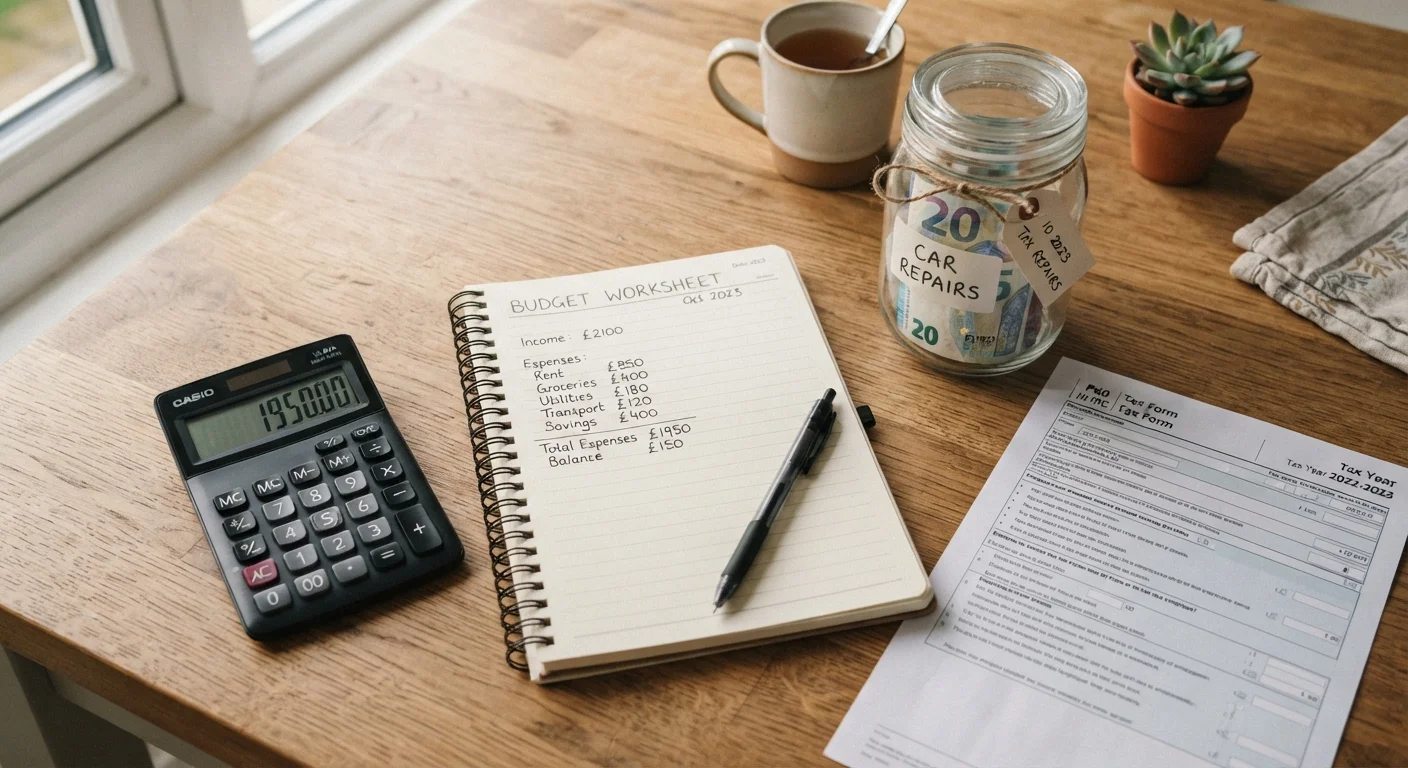
Why Irregular Expenses Break Most Budgets
Most people design their budgets around predictable monthly bills — rent, utilities, groceries. That works until a $700 car repair lands in October, or a tax bill arrives in April. Because neither showed up last month, there's no line item for them, and the budget collapses.
The frustrating part is that these expenses aren't truly surprising. You know your car will need repairs eventually. You know taxes are due every spring. The problem isn't unpredictability — it's that most budgets treat irregular costs as emergencies rather than as planned expenses that happen to arrive on an uneven schedule.
Sinking funds and expense averaging solve this by spreading the cost across 12 months instead of absorbing it all at once. The math is straightforward, and the relief it provides is real.
What you will need
How to Build Your Irregular-Expense Budget
Follow the steps below to identify your irregular costs, convert them into monthly savings targets, and build a system that keeps the money ready when bills arrive.
Bank or credit card statements
Used to look up past irregular expenses so you can calculate realistic averages.
Spreadsheet or budgeting app
Used to organize your sinking fund categories and track monthly contributions.
Separate savings account
Used to physically hold sinking fund money apart from everyday spending funds.
List every irregular expense you can think of
Open your statements and scan for charges that don't appear every month. Common categories include:
- Federal and state income taxes (or quarterly estimated payments)
- Car registration, inspection fees, and insurance renewals
- Car repairs and tires
- Home or renters insurance premiums
- Medical and dental bills not covered by insurance
- Annual subscriptions (streaming bundles, software, memberships)
- Holiday and birthday gifts
- Back-to-school costs
- Vet visits and pet medications
Write every one down, even if it feels minor. Small irregular charges add up faster than most people expect. For a broader checklist, see budget categories every household should account for.
Estimate the annual cost of each item
For expenses you can look up — like last year's tax bill, car registration notice, or insurance renewal — use the actual figure. For unpredictable costs like car repairs or medical bills, calculate an average from your past two or three years of statements.
If you don't have that history yet, use a conservative estimate. For car repairs, a commonly cited rule of thumb is to save at least 1% of the car's current value per year for maintenance, though actual costs vary widely by vehicle age and condition.
Write the estimated annual total next to each item on your list.
Convert each annual figure into a monthly contribution
Divide each annual estimate by 12. That result is the amount you need to set aside each month to be fully funded when the bill arrives.
Example:
| Expense | Annual Estimate | Monthly Contribution |
|---|---|---|
| Car repairs | $600 | $50 |
| Car registration | $120 | $10 |
| Holiday gifts | $360 | $30 |
| Annual insurance | $900 | $75 |
Add all monthly contributions together. This is the total you need to route to irregular-expense savings each month.
Open a sinking fund and label it
A sinking fund is simply a savings pool you build gradually for a specific, known future expense. It's not an emergency fund — it's for costs you can predict, even if you can't predict the exact date.
Move your total monthly contribution into a dedicated account each payday. If your bank allows sub-accounts or savings buckets, use them to separate categories. If not, a single sinking fund account with a running spreadsheet works just as well.
[tip_callout]Automate the transfer so it happens without effort
Set up an automatic transfer from your checking account to your sinking fund on payday — before you have a chance to spend the money elsewhere. Even a small fixed amount moved automatically is more reliable than manually transferring whatever's left at the end of the month.
If your income varies month to month, set the automatic transfer to a conservative base amount and add extra manually during higher-income months. For more on managing variable income, see budgeting on an irregular income.
Review and adjust your estimates regularly
Your irregular expenses will change over time. A new car, a different insurance policy, or a growing family all shift the numbers. Plan to revisit your sinking fund list at least once a year — or any time a major expense comes in significantly higher or lower than expected.
A simple end-of-month budget review makes this easy to maintain. See setting up a monthly budget review routine for a step-by-step approach.
[warning_callout]This Is General Information, Not Financial Advice
The strategies described here are for educational purposes only and do not constitute personalized financial, tax, or legal advice. Everyone's financial situation is different. For guidance specific to your circumstances, consult a licensed financial adviser or tax professional.
Common Pitfalls to Avoid
A few mistakes tend to derail sinking fund plans early on:
- Underfunding tax savings: If you're self-employed or have side income, taxes can be your largest irregular expense. Don't estimate based on last year's bill if your income has changed significantly.
- Raiding the fund for non-intended expenses: Once money is labeled for car repairs, spending it on a vacation defeats the purpose. Keep sinking funds visually and mentally separate from discretionary savings.
- Forgetting to start mid-year: If car registration is due in three months and you haven't saved anything yet, divide the total by three — not twelve. You'll catch up, just on a compressed timeline.
If you notice your budget is consistently coming up short despite having sinking funds, that may be a sign the budget structure itself needs adjusting. Signs your current budget isn't working can help you diagnose what's off.
This article is for general informational purposes only and does not constitute personalized financial, tax, or legal advice. Consult a qualified professional for guidance specific to your situation.
The content on this site is for informational purposes only and is not a substitute for professional advice. Always consult a qualified professional for guidance specific to your situation.