

Our Verdict
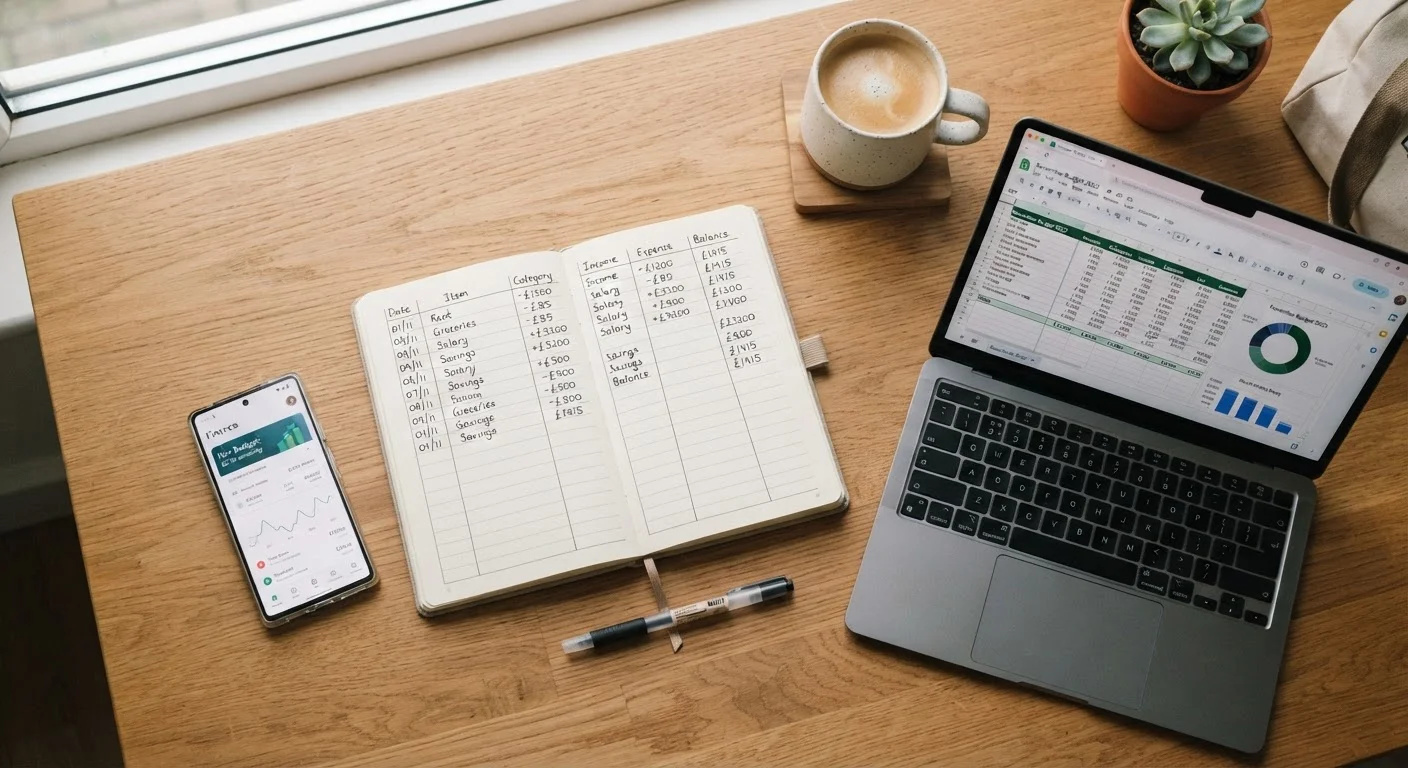
Spreadsheets, apps, and paper tracking each get the job done - the differences lie in how much manual effort you're willing to put in and how much you want to automate. Apps suit people who want low-friction daily tracking; spreadsheets suit those who want full customisation; paper suits those who benefit from writing things down by hand. Whichever you choose, pairing it with a regular review habit is what produces real results.
| Best for | Recommended |
|---|---|
| Those who want automation and minimal daily effort | Budgeting Apps |
| Those who want full control and custom categories | Spreadsheets |
| Those who prefer a low-tech, tactile approach | Pen and Paper |
| Those just starting out and building awareness | Pen and Paper |
Why the Method Matters (and Why It Doesn't)
Tracking your spending is one of the most concrete things you can do to get a handle on your finances. But the tool itself is almost secondary - what matters is whether you'll actually use it. A beautifully designed app you open twice and forget is less useful than a worn notebook you check every evening.
That said, the right format can reduce friction enough to make consistency far easier. This comparison breaks down three common approaches - spreadsheets, budgeting apps, and pen-and-paper methods - across the dimensions that most affect everyday use. For a broader look at how spending tracking fits into a full budgeting framework, see the complete budgeting guide.
| Spreadsheets | Budgeting Apps | Pen and Paper | |
|---|---|---|---|
| Setup effort | Moderate - build or adapt a template | Low - account linking, then automated | Minimal - notebook and pen |
| Daily time required | 5-15 min manual entry | 1-5 min review and correction | 5-10 min handwritten logging |
| Cost | Free or low-cost tools available | Free tiers exist; full features often paid | Near zero |
| Customisation | Very high - fully flexible | Moderate - preset categories | Unlimited - whatever you write |
| Data privacy | High - stays on your account | Lower - linked to financial accounts | Highest - fully offline |
| Best for | Detail-oriented, analytical users | Busy people wanting automation | Visual or tactile learners |
Spreadsheets: Maximum Control, Some Assembly Required
A spreadsheet - whether in Google Sheets, Excel, or a similar tool - lets you build exactly the structure you want. You define the categories, set the formulas, and decide how granular to get. That flexibility is the main appeal.
The trade-off is manual data entry. Every transaction needs to be typed in, which takes discipline. For many people, this daily or weekly ritual actually reinforces awareness of where money is going - but for others, it quickly becomes a chore that gets skipped.
Spreadsheets work especially well if your budget follows a specific framework. For example, if you're using the 50/30/20 rule or zero-based budgeting, you can build columns that map directly to those allocations. See how these frameworks compare to decide which one your spreadsheet should reflect.
Free templates are widely available, so you don't need to start from scratch. Privacy is also straightforward - your data stays on your own device or private cloud account.
Budgeting Apps: Automation With Trade-Offs
App-based trackers can link directly to your bank accounts and credit cards, pulling in transactions automatically and categorising them. This dramatically lowers the daily effort required, which is why apps tend to have strong initial adoption rates.
The downsides are worth knowing upfront. Many capable apps charge a monthly or annual subscription fee. Connecting financial accounts to a third party involves some degree of data-sharing, which is a privacy consideration each person should weigh for themselves. Automatic categorisation also isn't perfect - subscriptions sometimes land in the wrong bucket, and you'll need to review and correct periodically.
Apps shine for people with variable or high-frequency spending - multiple income streams, frequent small purchases, or the need to track spending across a trip. If you're managing a daily travel budget, an app that works offline and syncs later can be particularly useful.
Before adding a new app to your routine, it's worth asking whether you can get more from tools you already use - see organising your digital life without downloading yet another app for a practical take on that question.
Pen and Paper: Slow, Deliberate, and Surprisingly Effective
Writing transactions by hand is the oldest budgeting method, and research in cognitive science consistently suggests that handwriting strengthens memory and retention compared to typing. In practical budgeting terms, that means you're more likely to remember - and think twice about - what you spend when you physically record it.
Paper tracking has almost no setup cost, requires no subscription, involves zero data-sharing, and works without a battery. It's also highly portable and doesn't require any technical knowledge.
The limitation is that paper doesn't do math for you. Totaling categories, spotting trends, or comparing month-over-month requires manual calculation. It also doesn't scale well if you have many accounts or complex finances.
Paper methods pair naturally with envelope-style budgeting, where physical cash is divided into spending categories. Once a category's cash is gone, spending stops - a simple, tactile form of real-time feedback that apps can only simulate.
Try a Method for 30 Days Before Switching
Most people abandon a tracking method within the first two weeks, often before it becomes a habit. Give any method a full month before deciding it isn't working. If you find yourself skipping days, the problem is usually the review routine - not the tool. A consistent five-minute check-in each evening matters more than the format you're using.
Whatever method you start with, pair it with a structured monthly review. The monthly budget audit checklist walks through exactly what to look for at the end of each cycle.
This article is for general informational and educational purposes only and does not constitute personalised financial advice. Consider consulting a qualified financial professional for guidance specific to your situation.
The content on this site is for informational purposes only and is not a substitute for professional advice. Always consult a qualified professional for guidance specific to your situation.